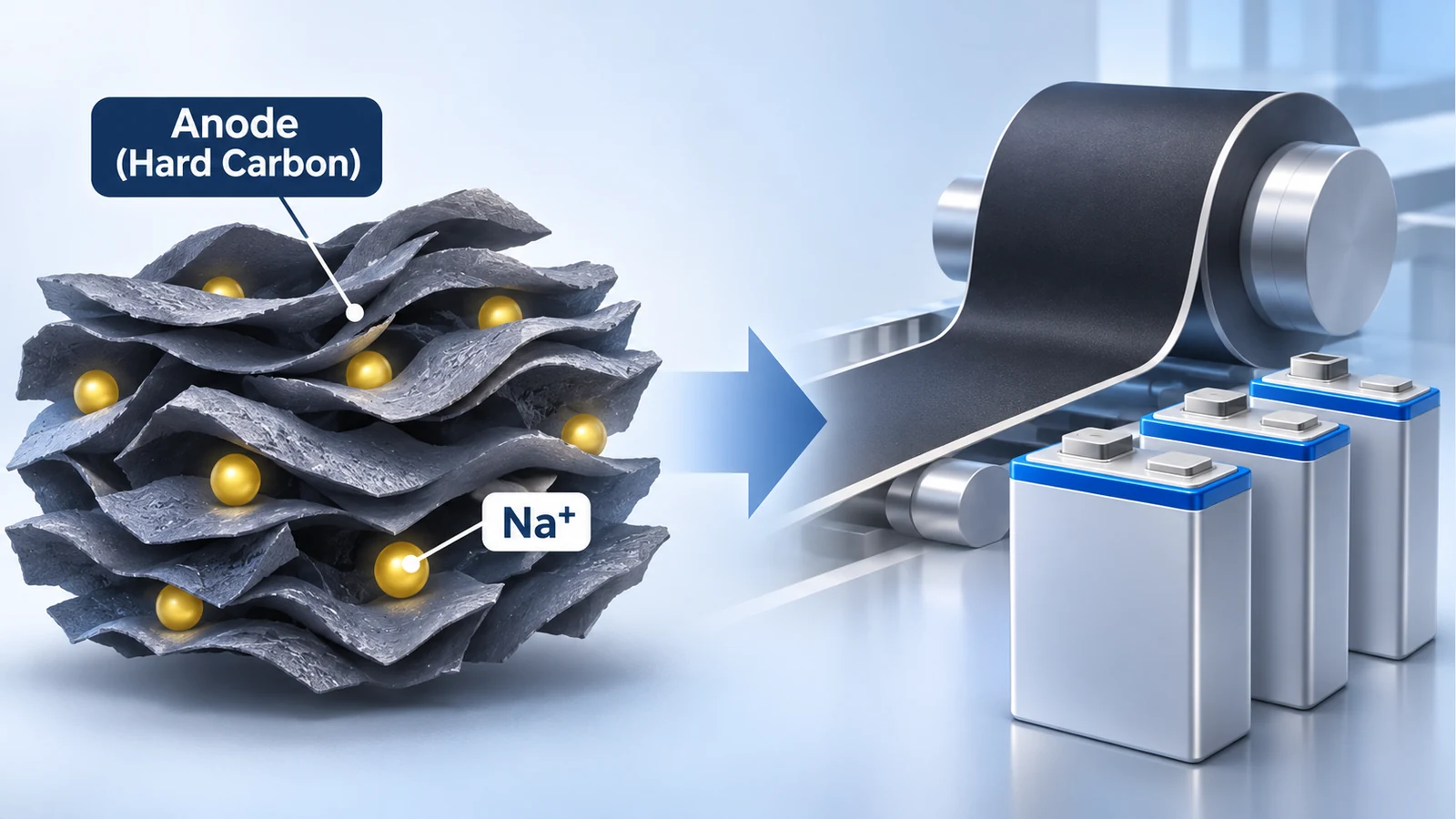
In September 2026, the shortlist of bidders for a battery energy storage project in Hebei Province, China, was made public. The project was procuring two kinds of battery systems: one using lithium iron phosphate (LFP), already widely deployed, and another using sodium instead of lithium.
The price gap was striking. The first-ranked bids were 0.518 yuan per watt-hour (Wh) of storage capacity for the LFP system and 1.035 yuan/Wh for the sodium-ion system. The sodium-ion bid was almost twice as high.1
That seemed strange. Sodium is more abundant than lithium, and its raw materials are cheaper. It is so common that it is found in the salt dissolved in seawater. The possibility of making batteries from cheaper raw materials was one of the main reasons sodium-ion technology had attracted attention.
The procurement volumes were different: 360 megawatt-hours (MWh) for LFP and 40 MWh for sodium-ion, a ninefold difference. The bid prices therefore cannot be treated as a direct comparison of battery manufacturing costs. But the sodium-ion system had clearly been offered at a higher unit price in an actual procurement process.
A month later, a claim pointed in the opposite direction.
According to the energy storage publication Energy-Storage.news, Chinese battery manufacturer CATL introduced its sodium-ion storage system, TENER Sodium, in Australia in October. CATL claimed that it could cut total engineering, procurement and construction costs by more than 10% compared with a conventional containerized LFP system.2
CATL was also the first-ranked bidder for the sodium-ion system in Hebei. In two separate projects involving the same company, one sodium-ion system attracted a bid price almost twice as high per unit of capacity, while CATL projected construction costs more than 10% lower for another system.
So how cheap are sodium-ion batteries, really?
To answer that question, we first need to look at how sodium is stored inside a battery. A material central to the success of lithium-ion batteries could not simply be used in the same way with sodium.
Why Graphite Could Not Simply Be Reused for Sodium
When a lithium-ion battery is charged, lithium ions are stored in its negative electrode. The most common negative-electrode material is graphite. Its carbon atoms form thin sheets stacked in layers, and lithium ions can move into and out of the spaces between them.
Graphite was inexpensive and well suited to repeated charging and discharging. It was one important reason lithium-ion batteries could be mass-produced successfully.
Sodium sits directly below lithium on the periodic table, and the two elements have similar electrochemical properties. So why not store sodium in graphite instead of lithium?
It was not that simple.
In conventional carbonate-based electrolytes, sodium ions have difficulty being stored stably between graphite layers in the way lithium ions are. The ions differ in size, and the compounds sodium forms with graphite differ in stability. A negative-electrode material central to the success of lithium-ion batteries could not readily be carried over unchanged.3
A different carbon material offered a way forward.
In 2000, David A. Stevens and Jeff R. Dahn of Dalhousie University in Canada published research showing that sodium could be repeatedly stored in and released from hard carbon.4
Hard carbon is also made of carbon. Unlike graphite, however, its carbon layers do not stack neatly. They are bent and misaligned, leaving tiny spaces within the structure. Those features provide sites where sodium can be stored.
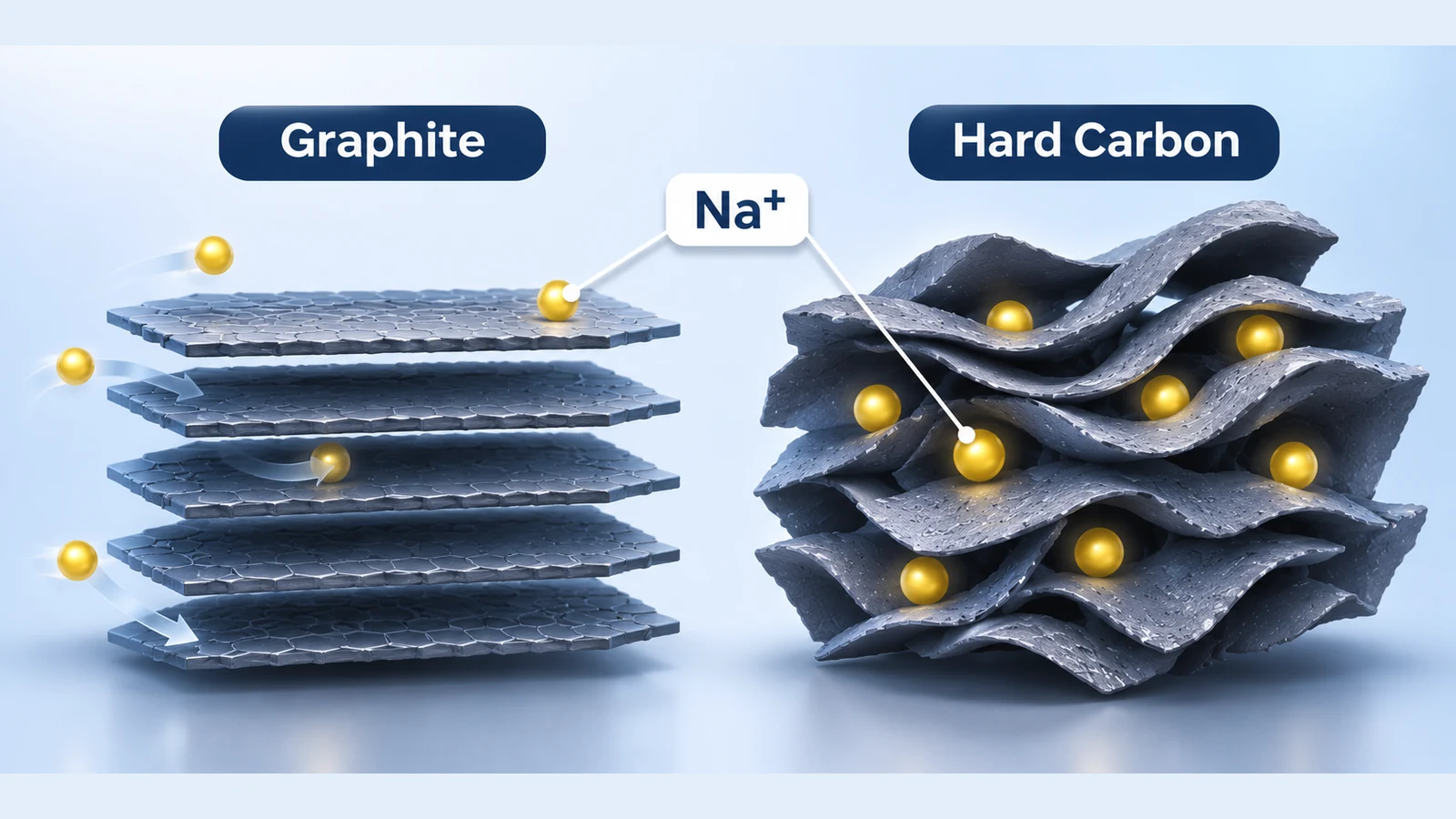
For lithium-ion batteries, graphite's orderly structure was an advantage. For sodium-ion batteries, hard carbon—with its less orderly structure—emerged as a promising alternative.
Hard carbon can be made from a range of feedstocks, including plant by-products and synthetic resins. That raised the prospect of sourcing not only sodium but also negative-electrode feedstocks at low cost.
But demonstrating sodium storage in a laboratory and manufacturing battery-grade negative-electrode material in a factory were two different challenges.
An irregular internal structure offered a solution. Factories now faced a paradox: reproducing that irregularity at scale, with consistent quality.
The Cost of Turning Cheap Feedstocks into Battery-Grade Carbon
Hard carbon is made by heating feedstocks to high temperatures. The temperature, duration and impurities remaining in the starting material affect the arrangement of carbon layers and the structure of tiny pores. Those differences influence how much sodium the material can store and how reliably it can withstand repeated charge-discharge cycles.
A laboratory can make small samples with the desired characteristics and test their performance. A factory must produce material for large numbers of batteries, day after day, at consistent quality. Even when feedstocks vary, the performance of the finished negative-electrode material must stay within an acceptable range.
CATL also had to address such problems in mass production.
In 2026, the company disclosed processes it had improved to produce sodium-ion batteries at scale. Unwanted bubble formation during hard-carbon processing and moisture management were among the challenges it identified. CATL said it had improved manufacturing consistency by controlling carbon micropores and surface properties and by refining the initial charging process.5
Moisture must be controlled because it can trigger unwanted reactions inside a battery, some of which generate gas or impair performance. If some sodium is consumed by side reactions during the first charge, the usable storage capacity also falls.
After demonstrating a material's performance, manufacturers have to reproduce it consistently at scale.
That costs money.
In its 2025 analysis of battery supply chains, the International Energy Agency (IEA) noted that even if hard-carbon feedstocks are cheap, processing them into battery-grade negative-electrode material can be costly.6
The gap in production scale is also substantial. Lithium-ion batteries have benefited from decades of mass production, with mature materials supply chains and manufacturing processes. By contrast, the IEA reported that global sodium-ion battery output in 2025 was less than 1% of lithium-ion battery output.6
Investment in factory equipment is spread across the units that can be sold. When output is low or many units fail quality checks, each saleable battery has to bear a larger share of that cost. A battery made from inexpensive raw materials can therefore still have a high manufacturing cost.
That is the production problem. For a new battery technology to survive as a business, the manufacturer must also deliver its products to customers and turn them into revenue.
A Factory Can Close Even with Orders in Hand
In April 2024, American battery manufacturer Natron Energy began commercial production of sodium-ion batteries in Michigan.
Natron drew on the crystal structure of Prussian blue, a pigment used since the eighteenth century. It made both electrodes from Prussian blue analogues containing iron and manganese, materials whose crystal frameworks can accommodate sodium ions. The technology was aimed at data centers and industrial power applications requiring rapid charging and discharging and high power output.7
Natron had production facilities and was pursuing a new factory, yet it shut down the following year.
Financing was decisive. Although the company had secured commitments for additional investment in spring 2025, reporting later indicated that scheduled funding payments had stopped. Even with customer orders in hand, Natron still needed time to complete safety certification and deliver its products.8
Expected funding was not arriving, while the bills for running the factory kept coming.
Ultimately, Natron could not raise the funds to bridge that gap. In a closure notice filed with Michigan labor authorities in August 2025, the company said it had been unable to obtain the working capital and operating funds needed to fulfill orders.9
Developing the technology and securing orders were not enough to make the business work. Natron could not overcome the financing gap between making a product and turning it into actual revenue.
CATL Is Not Just Building a New Battery
In April 2026, CATL signed a three-year agreement with Chinese energy-storage specialist HyperStrong to supply 60 gigawatt-hours (GWh) of sodium-ion batteries.5
Turning an agreement of that scale into actual deliveries requires more than stable battery production. The company must supply storage systems that customers can install and operate.
CATL already has large production facilities, established material supply chains, quality-control systems and customer relationships from its lithium-ion business. It is starting from a different position than a company that has to build all of those capabilities from scratch.
In June 2026, CATL said its sodium-ion storage-system production line was operating and set a year-end target for cumulative shipments.10
The next step is to convert manufacturing capacity and supply agreements into actual customer deliveries. For now, CATL has reported production-line operations and a shipment target.
Its existing business infrastructure can also help beyond the factory floor.
CATL says it designed its sodium-ion storage system to fit a platform with the same external form factor as its existing LFP systems. The aim is to reduce the equipment modifications and installation work customers need when changing battery types.5
For customers, the price of the battery is only part of the bill. The equipment and construction work needed to install it also matter.
That brings us back to the original price paradox.
Twice the Bid Price, Yet 10% Lower Construction Costs?
The bid prices in Hebei and the cost savings CATL projected in Australia refer to different measures.
In Hebei, the comparison was between bid prices for two storage systems procured in different volumes. The sodium-ion system's bid price per unit of storage capacity was higher, but that difference cannot be converted into a difference in battery-cell manufacturing costs.
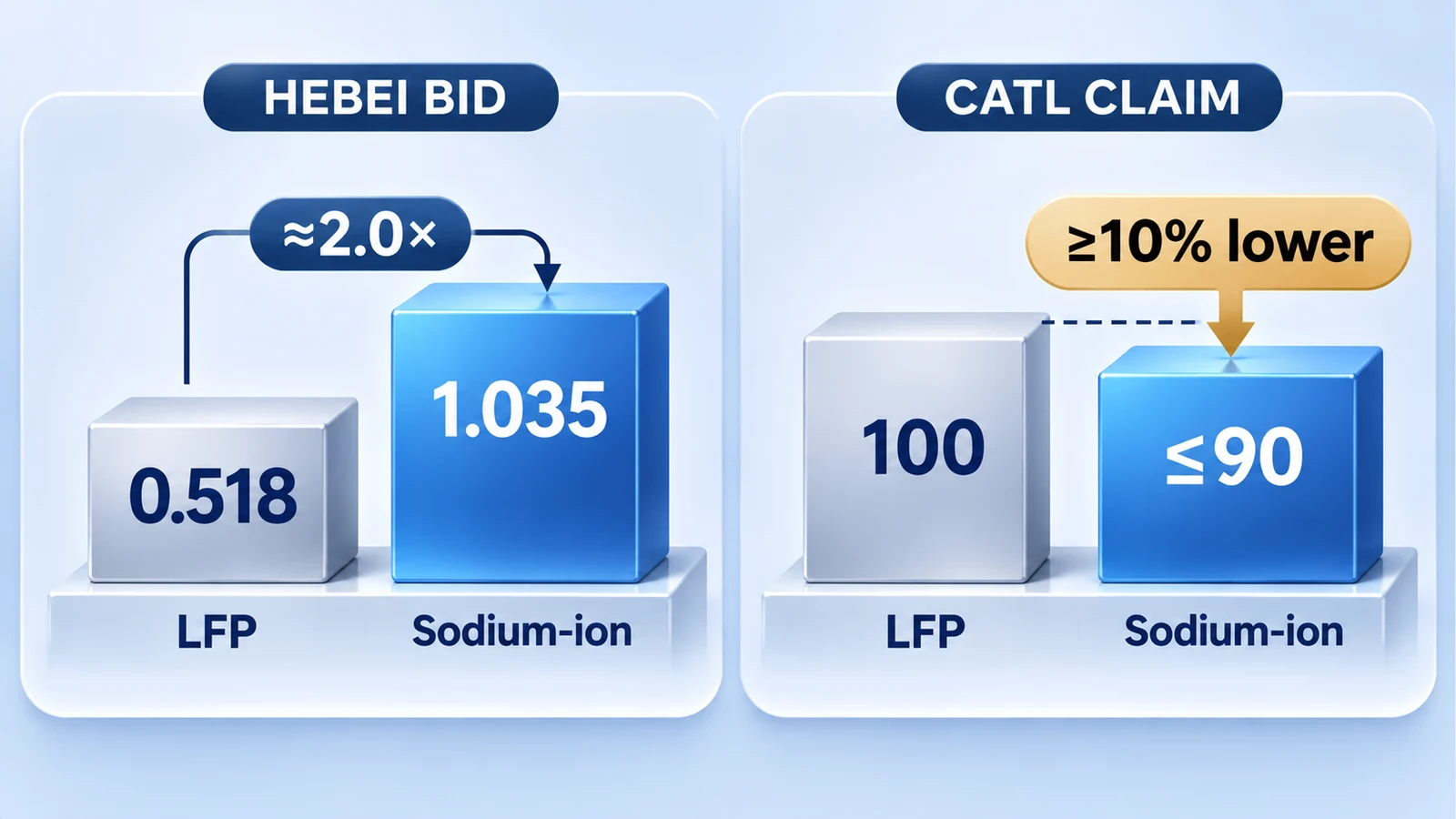
CATL's claimed savings of more than 10%, by contrast, concerned the engineering, procurement and construction costs of an entire storage facility.
An energy storage facility needs more than batteries: it also needs power-conversion equipment, cooling systems, controls and installation work. Those costs can change with the battery technology and system design.
One figure was a bid price for a storage system; the other was the manufacturer's projection for the total cost of building a storage facility.2
Operating costs matter after installation, too. Charge-discharge efficiency, service life and maintenance costs all affect long-term economics. Sodium-ion batteries' low-temperature performance can also be an advantage in some applications. The IEA identifies cold climates as one setting in which sodium-ion batteries may be competitive.6
Sodium-ion batteries do not have to be cheaper than LFP in every application to be competitive. They can be the more attractive option under certain installation and operating conditions.
Abundant raw materials open up the possibility of cheaper batteries. Realizing it, however, requires making materials that store sodium, mass-producing them at consistent quality, and delivering systems that work with customers' equipment.
Whether inexpensive sodium can become a low-cost battery depends on manufacturing. Whether that battery is economical depends on the conditions in which customers use it.
Keep reading CAUSIFOLD
Follow new CAUSIFOLD articles and updates on Substack.
Subscribe on Substack ↗Notes
1. China Energy Storage Alliance (CNESA), 2026-09-10: Analysis of the September 9 shortlist announcement for the 100 MW/400 MWh hybrid energy-storage pilot project in Renqiu, Hebei. Envision Energy, the first-ranked bidder for the 360 MWh LFP portion, offered 186.48 million yuan (0.518 yuan/Wh); CATL, the first-ranked bidder for the 40 MWh sodium-ion portion, offered 41,416,220 yuan (approximately 1.035 yuan/Wh). The procurement volumes and equipment specifications differ, so these figures do not compare cell manufacturing costs. Some later reports of the final award contain inconsistencies between the LFP total and its stated unit price; the article therefore uses the September 9 shortlist figures.
2. Energy-Storage.news, 2026-10-28: CATL's claim, presented at the Australian launch of TENER Sodium, that EPC costs could fall by more than 10%. EPC means engineering, procurement and construction. The particular project assumptions and calculation method have not been disclosed, so this is not an independently verified saving.
3. Birte Jache and Philipp Adelhelm, “Use of Graphite as a Highly Reversible Electrode with Superior Cycle Life for Sodium-Ion Batteries by Making Use of Co-Intercalation Phenomena,” Angewandte Chemie International Edition (2014). DOI: 10.1002/anie.201403734. In some ether-based electrolytes, sodium can enter graphite layers together with solvent molecules through co-intercalation. The article discusses the limitations of conventional carbonate-based electrolytes.
4. David A. Stevens and Jeff R. Dahn, “High Capacity Anode Materials for Rechargeable Sodium-Ion Batteries,” Journal of The Electrochemical Society (2000). DOI: 10.1149/1.1393348. An early study demonstrating reversible sodium storage in hard carbon. The details of the storage mechanism and the contributions of specific microstructures remain subjects of research.
5. CATL, 2026-05-06: Announcement covering the three-year, 60 GWh strategic supply agreement signed with HyperStrong on April 27, and process improvements addressing bubble formation and moisture management on the hard-carbon production line. Improvements are described by the company; actual production yield figures have not been published. The product's detailed composition and physical compatibility with every system have not been independently verified.
6. International Energy Agency (IEA), analysis of emerging battery supply chains in Global Critical Minerals Outlook 2025 and “Sodium-ion battery momentum grows, but challenges remain,” 2026-02-17: Sources for hard-carbon feedstocks and processing costs, sodium-ion output amounting to less than 1% of lithium-ion production in 2025, low-temperature performance and the conditions governing competition with LFP. The production share is not a comparison of nameplate manufacturing capacity.
7. Cameron Murray, Energy-Storage.news, 2024-04-30: Reporting on the start of production at Natron's Michigan factory and its electrodes based on Prussian blue analogues. Natron's technical presentation describes Prussian blue analogues of differing composition in the positive and negative electrodes. The historic pigment and the electrode compounds belong to a related structural family; they are not the same chemical formulation.
8. Steve LeVine, The Information, 2025-06-30, “The Battery Industry Crisis Catches Up to Natron”: Original reporting on approximately $55 million in investment commitments and staggered funding, the cessation of subsequent payments, approximately $25 million in orders cited by executives, and certification pending before delivery. Underlying contracts, amounts and dates of funds actually transferred, enforceability of orders and the exact certification scope have not been independently confirmed. The article does not use those figures or detailed certification conditions as established causal evidence.
9. Natron Energy, closure notice filed with the Michigan Department of Labor and Economic Opportunity, 2025-08-28: Primary-source notice of planned September 3 facility closures, layoffs and insufficient working capital and operating funds to fulfill orders. The article does not claim that technical failure or low manufacturing yield directly caused the shutdown.
10. CATL, “CATL Debuts World's First Field-Validated Sodium-Ion BESS,” 2026-06-22: CATL's announcement of its mass-production system and a target of 1 GWh in cumulative shipments by the end of 2026. This is a target, not completed deliveries. Available public material does not independently establish cumulative customer deliveries as of November 6, 2026. CATL gave June 2027 as its target for the start of global deliveries.