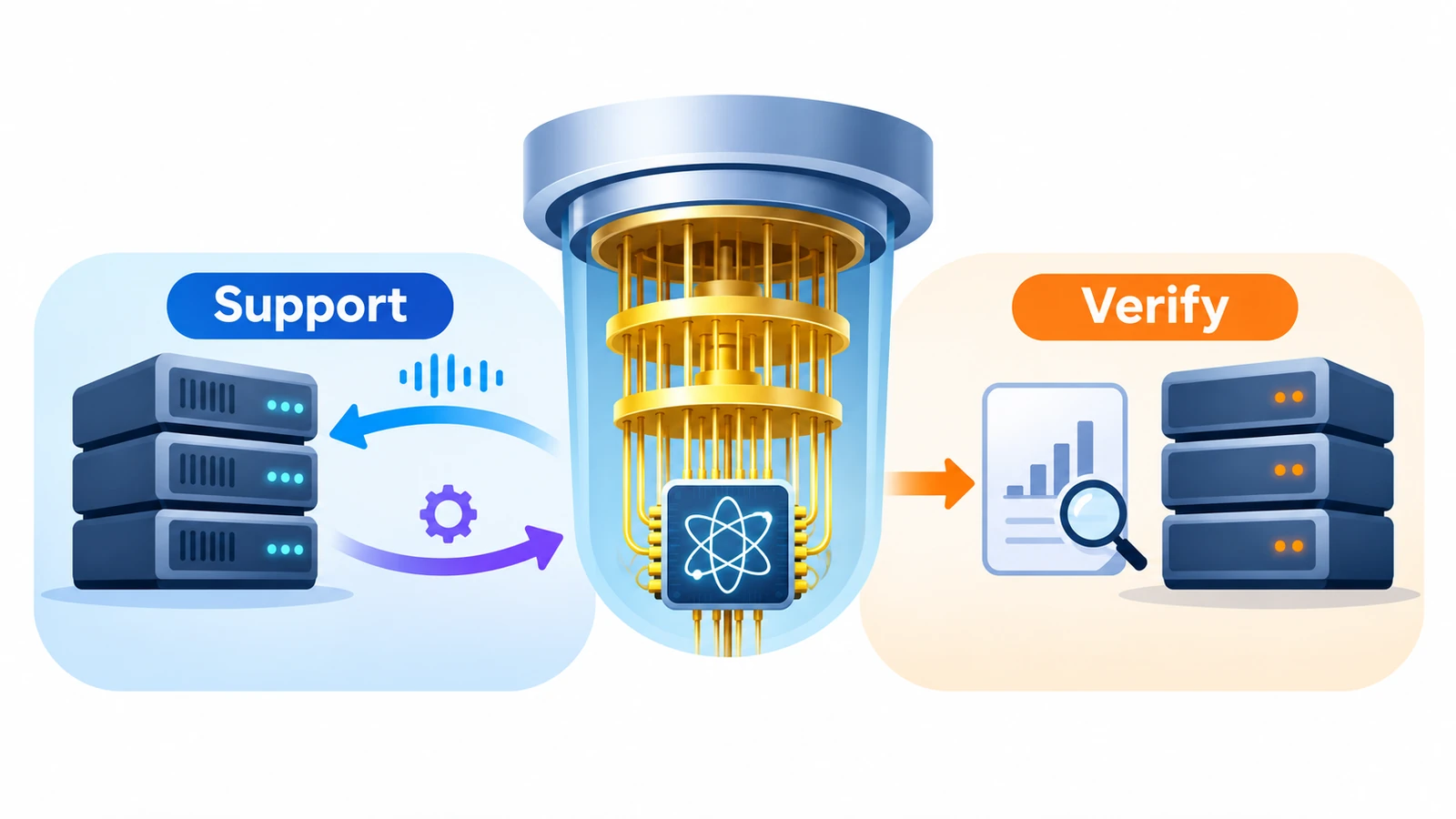
Quantum computers also need help from other computers to manage errors. On November 5, IBM, which develops quantum computers, unveiled a research platform in Poughkeepsie, New York, in collaboration with Oak Ridge National Laboratory and chipmaker AMD. The platform places a quantum computer and a high-performance computer in the same facility. Its purpose is to reduce the delay in exchanging data between the two systems and to study how error decoding can be integrated with control of the quantum processor.1
Researchers call the digital machines we use every day classical computers. Even the most advanced supercomputers fall into that category. Classical computers are both potential rivals to quantum machines and partners in making them work.
Who Decodes a Quantum Computer’s Errors?
Conventional digital computers process information as bits, represented by zeros and ones. Quantum computers use qubits, which can exist in superpositions of states corresponding to zero and one. A physical qubit is a qubit implemented on a quantum chip. Even small disturbances can introduce errors.
To protect quantum information, researchers encode it across the states of several physical qubits. One unit of information protected in this way is a logical qubit. Researchers can find signs of errors by measuring relationships among the physical qubits without directly measuring the protected quantum information.
A decoder is a program or device that interprets error information and determines how to respond. Using such information to limit the effects of errors and protect encoded information is known as quantum error correction. When a decoding result is needed to guide the next control step, the decoder must deliver it in time.
IBM's November research platform brings together its superconducting Nighthawk R2 quantum processor and Oak Ridge's Umbra high-performance computer. Umbra uses AMD CPUs and GPUs, with the GPUs handling many calculations in parallel. The three organizations plan to investigate how classical processing of error information can inform control of the quantum processor.
IBM’s November 5 announcement described the facility and its design for low-latency integration. Researchers have yet to report the combined system’s end-to-end decoding and control time or its effect on logical error rates.
Error Decoding Has a Deadline
An error decoder must be assessed on both how much error data it can process and how long it takes to return a decision.
In June, researchers at Riverlane, a quantum error-correction company, and Rigetti, which builds superconducting quantum computers, measured this response time. They integrated a decoder built around an FPGA into Rigetti's control system. An FPGA is a chip whose internal circuitry can be configured for particular tasks.
In a test using eight physical qubits, the researchers completed nine rounds of error-related measurements. The interval between the final measurement and conditional control of a physical qubit based on the decoded result was 9.6 microseconds. One microsecond is one-millionth of a second. Decoding accounted for 6.5 microseconds, and communication and control for another 3.1 microseconds.2
This measurement came from Riverlane and Rigetti's eight-qubit experiment. The right decoder for a given system depends on the volume of error data and the response-time limit.
Classical Computing Strikes Back
Classical computers have another role: challenging claims of quantum advantage with better classical algorithms.
In July, an IBM–University of Chicago quantum research team reported running a particular circuit on 70 logical qubits and collecting 2,051 outputs that passed error checks in 16.1 minutes. IBM argued that the task was difficult for the leading classical methods then known and claimed quantum advantage. The term refers to an advantage for quantum computers on a particular computational task.3
In August, Hidetaka Manabe, Hanfeng Gu and Feng Pan proposed a new classical approach to analyzing that circuit. They changed the order in which the calculation’s components were combined, reducing the memory needed to store intermediate results. Using an optimized tensor-network calculation, they computed the probability of each output IBM had published.
The team reported taking 37.3 minutes to calculate those probabilities using 256 GPUs. IBM's 16.1 minutes measured the time needed to generate new outputs; the classical team's 37.3 minutes measured the time needed to calculate probabilities for outputs already disclosed.4
Fewer Qubits, a New Test for Classical Algorithms
In September, a revised IBM–University of Chicago experimental paper presented a new circuit. The pattern of interactions between logical qubits changed from the open chain used in July to a ring.5
The number of logical qubits fell from 70 to 64. Yet the ring-shaped circuit was harder for the classical method that Manabe, Gu and Pan had developed for the open chain. Computational difficulty depends not only on the number of qubits but also on how operations are connected.
The September revision also added Manabe, Gu and Pan, authors of the August classical analysis, as coauthors. On September 22, Kim Renaud of Calcul Québec in Canada filed a report with the public Quantum Advantage Tracker describing CPU-based probability calculations for published outputs from the ring circuit.6
Verification Also Has a Cost
If classical computers cannot readily calculate the probabilities of every possible output, how can researchers assess the accuracy of a quantum experiment?
In their July experiment, the IBM–University of Chicago researchers used postselection: they discarded runs flagged by error checks and analyzed only the outputs that passed.
The team estimated a fidelity lower bound from error-check data and measurements of reference circuits that were easier to verify. Under specified assumptions about errors and noise, and at a stated confidence level, the bound estimates how closely the resulting quantum state matches the target state at a minimum.
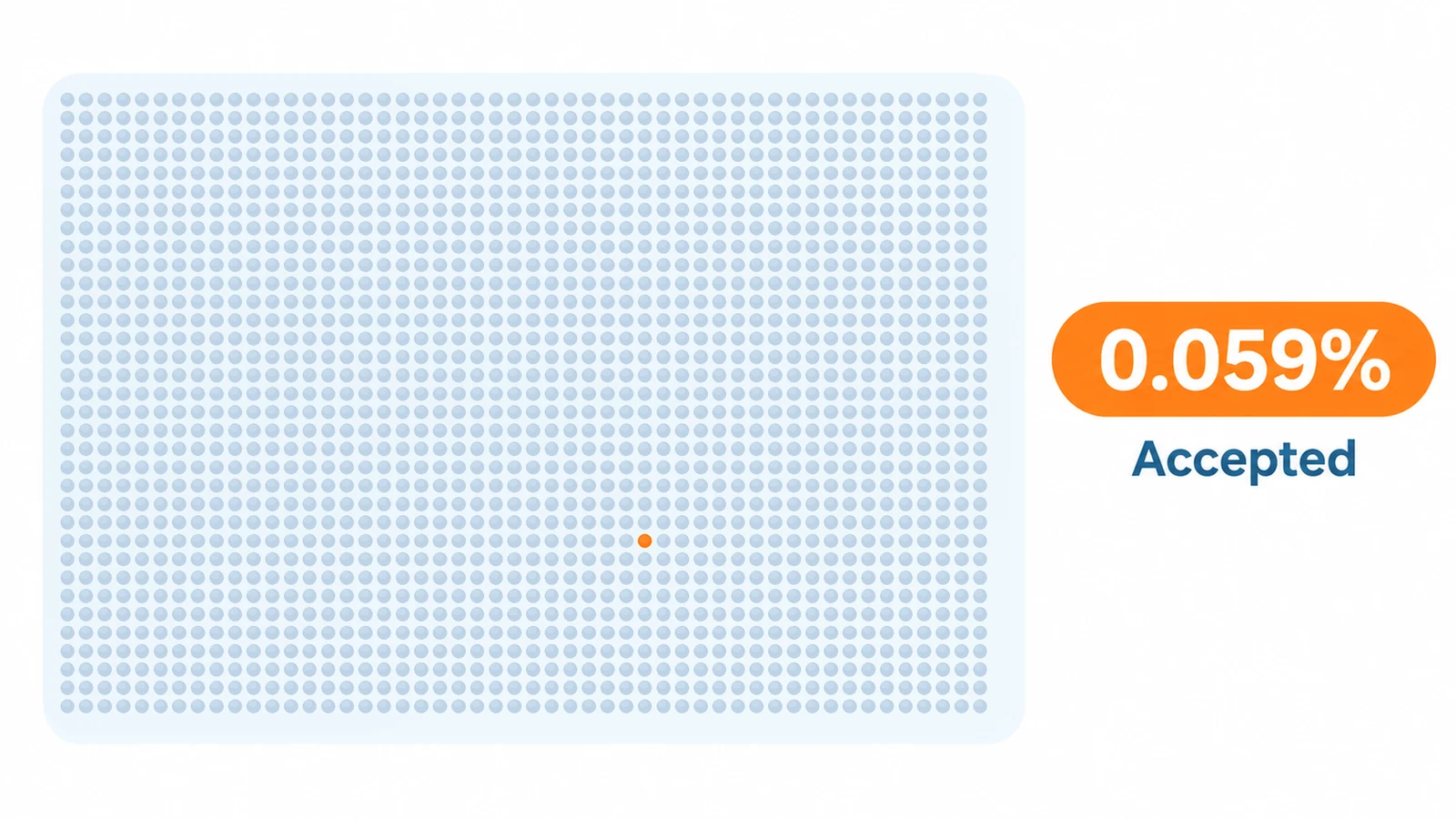
Only about 0.059% of runs in the July experiment passed the error checks. Obtaining usable outputs therefore required discarding many runs. A performance comparison must account for the time and hardware resources consumed in that process.7
The Whole System Must Be Measured
Classical computers used for error decoding must deliver decisions before the next quantum-control step needs them. Improvements in classical algorithms also mean that claims of quantum advantage must be tested against newer methods. Classical computers help quantum processors operate, while more capable classical algorithms also test claims of quantum advantage.
Assessing a quantum computer therefore requires more than timing the quantum chip. Resources spent on error decoding, runs discarded during checking, and the cost of verifying results all matter. Comparisons with classical methods must use the same computational task and accuracy requirements.
The IBM–Oak Ridge–AMD platform launched in November should be evaluated by measuring the time needed to process error information and apply the resulting control, along with resource use and any reduction in logical error rates.
Quantum computing’s competitiveness should be judged by comparing the efficiency of the complete quantum–classical system with that of a classical alternative solving the same problem to the same accuracy.
Keep reading CAUSIFOLD
Follow new CAUSIFOLD articles and updates on Substack.
Subscribe on Substack ↗Notes
1. Rafi Letzter, “ORNL, IBM, and AMD launch co-design platform for quantum error correction,” IBM Quantum, November 5, 2026. See also the joint IBM–Oak Ridge–AMD announcement. The announcement describes the co-location of IBM's quantum processor and Oak Ridge's Umbra supercomputer in Poughkeepsie, and the low-latency research environment.
2. Laura Caune, Luka Skoric, Nick S. Blunt et al., “Demonstrating real-time and low-latency quantum error correction with superconducting qubits,” Nature Communications 17, 7383 (2026). In the eight-physical-qubit Riverlane–Rigetti experiment, the team measured 6.5 microseconds for decoding and 3.1 microseconds for communication and control, after nine measurement rounds.
3. IBM and the University of Chicago, “IBM and The University of Chicago Demonstrate Quantum Advantage,” July 30, 2026. The underlying paper is Simon Martiel et al., “Sampling hard circuits with verifiably high fidelity,” arXiv:2607.25941v1 (July 28, 2026). The researchers collected 2,051 postselected outputs in 16.1 minutes. “Quantum advantage” is IBM's claim at the time.
4. Hidetaka Manabe, Hanfeng Gu and Feng Pan, “Classical Simulation and Design Frontiers for IBM’s Doped Clifford Sampling Experiment,” arXiv:2608.13110 (first version August 13, 2026; revised October 29). The reported 37.3-minute runtime was for batched amplitude and probability calculations on IBM’s 2,051 published outputs using 256 GPUs.
5. Simon Martiel et al., “Sampling hard circuits with verifiably high fidelity,” arXiv:2607.25941v3 (September 2, 2026). The revision reports a circuit with 64 logical qubits, 76 physical qubits, depth 73 and 314 T gates; Hidetaka Manabe, Hanfeng Gu and Feng Pan were added as coauthors. The circuit submission to the quantum-advantage tracking forum also documents its logical ring topology. Verification limit: The reported fidelity lower bound of 0.349 at 95% confidence depends on the authors' noise model and statistical estimation. The published abstract and bibliographic record were cross-checked for the qubit counts, revised circuit and author list, but the complete Methods and supplementary material for v3 could not be accessed directly. The detailed calibration steps, model assumptions and statistical limits have therefore not been independently verified in full.
6. Kim Renaud, “injected_graph_scan_nq64_depth73,” Quantum Advantage Tracker, public submission #249 (September 22, 2026). This submission reports classical CPU calculations of probabilities for 1,389 published outputs from the revised circuit. It is a public submission, not a peer-reviewed paper.
7. Simon Martiel et al., “Sampling hard circuits with verifiably high fidelity,” arXiv:2607.25941v1 (2026). The error-check acceptance rate in the relevant experiment was 5.90(5) × 10⁻⁴ (about 0.059%). Analysis used only the outputs surviving postselection.