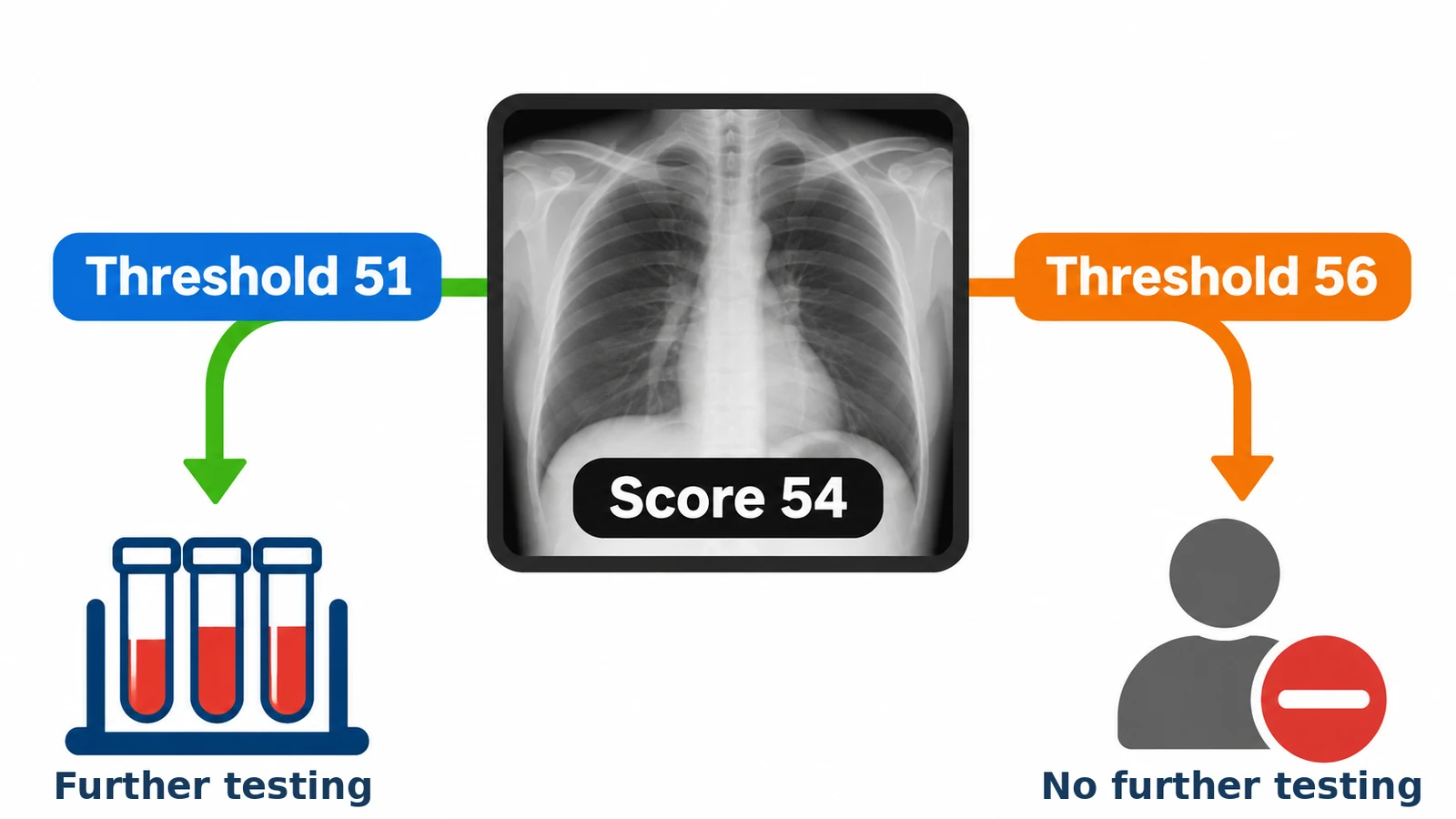
When researchers in Ghana modeled raising the cutoff for a tuberculosis-screening AI from 51 to 56, they projected fewer follow-up tests and lower costs. The trade-off was a greater risk of failing to flag people who had TB.
But when they compared the same AI system with the existing method of selecting patients for further tests, the model projected both lower testing costs and less harm from missed or delayed TB diagnoses.
Why did the same system look worse in one comparison and better in the other?
It Depends on What You Compare
In Ghana, Yaw Adusi-Poku and colleagues examined records collected between 2022 and 2023 from 701 people suspected of having TB. They used those records to model the costs and potential effects of AI-assisted screening. The software, CAD4TB, examines chest X-rays, identifies features that may indicate TB, and assigns a score. At the time, a score of 51 or above triggered a recommendation for further testing to detect the bacteria that cause TB.1
In the model, raising the cutoff to 56 sent fewer people for additional testing and reduced costs. But it also lowered the proportion of people with TB whom the software would flag for further testing, from 91.5% to 90.4%. That saving came with a higher risk of delaying some diagnoses.
The researchers then changed the point of comparison. Instead of comparing two AI cutoffs, they compared the 56-point AI approach with the existing practice of having medical staff select patients for further testing based on symptoms and chest X-rays. The model estimated that total testing costs would be about 29% lower. The model also predicted less harm from TB going undetected or being diagnosed late.1
The first analysis compared two cutoff scores for the same AI. The second compared AI-assisted screening with the existing process. The apparent contradiction comes from that change in reference point.
A separate study in Ghana found that an AI system and a radiologist sometimes disagreed over the same chest X-rays. In the Bono East region, Kenneth Nii Amartey and colleagues had AI software and a radiologist independently assess chest X-rays from 250 people suspected of having TB who had difficulty providing sputum samples. The AI scored four of the images below 51, but the radiologist saw signs that raised suspicion of TB.2
On the AI score alone, those four people would not have been flagged for further testing. The radiologist's assessment differed from the AI's. The paper does not say whether those four people subsequently underwent further testing, received a TB diagnosis or started treatment.
A New Price Deal Arrived Before the Study
In July 2026, about a month before the Ghanaian cost study appeared, Unitaid and the Clinton Health Access Initiative (CHAI) announced a new pricing agreement for TB-screening AI software. Both organizations work to improve access to medical technologies in lower-income countries. One of the participating companies, Delft Imaging, supplies the CAD4TB software used in the Ghanaian research.3
Under the agreement, eligible public-sector and nonprofit buyers can obtain annual software licences at prices up to 65% lower, charged per connected X-ray machine. The number of X-rays the software can read is unlimited.
Screening and diagnosing TB also require X-rays, tests for the bacteria, and medical staff. The agreement applies to the software's annual licence fee—not to the full cost of screening or diagnosis. A lower licence price could change how many people a health service can screen within a fixed budget.
Costs also depend on what an AI is instructed to do. In the United States, Dvir Aran and colleagues tested generative AI systems that read patient records and recommend diagnostic tests. They applied the same US Medicare payment rates to tests listed by clinicians and to those recommended by AI. The tests listed in clinicians' records would have cost an average of about $71 per patient. The tests recommended by the AI systems would have cost an estimated $97 to $289, depending on the model.4
When the researchers told the AI systems to consider costs or recommend fewer tests, the estimated cost of those recommendations fell sharply. The instructions given to an AI can change the tests it recommends—and their estimated cost. The next challenge is to reduce costs without overlooking tests that patients need.
Did People Diagnosed with TB Start Treatment?
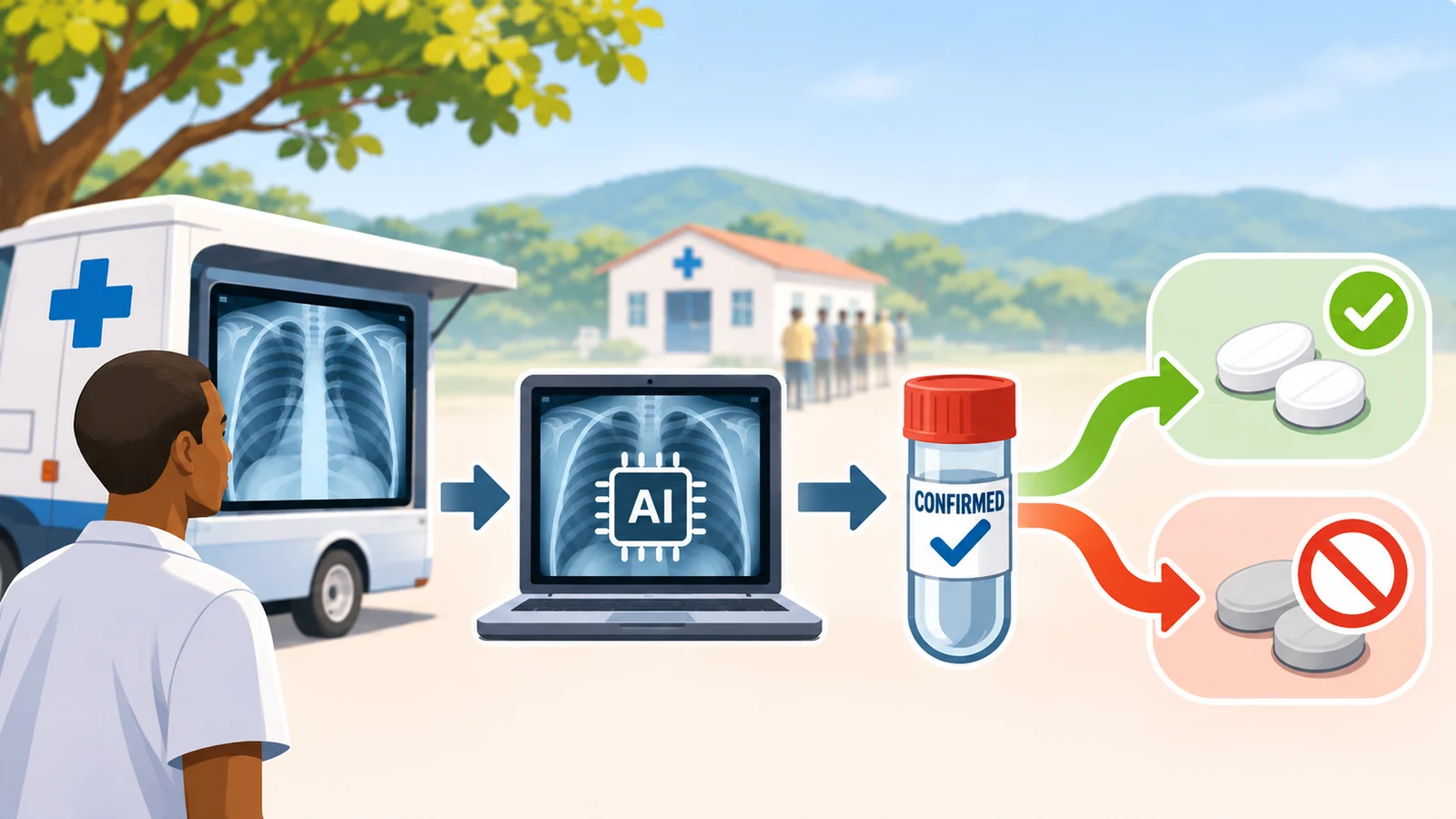
In Tondo, a densely populated part of Manila, Médecins Sans Frontières (Doctors Without Borders) combined mobile X-ray equipment, AI image reading, tests for TB bacteria, and local health workers. The organization reported that since 2022 its program had screened more than 51,000 people and identified 2,493 new cases of TB.5
Of those diagnosed, 62% started treatment. Shortages of medicines and testing supplies made it harder for people to start treatment. AI and mobile X-ray equipment may help find more cases, but diagnosis alone does not guarantee that care will follow.
In Kenya, Ambrose Agweyu and colleagues tested a different kind of AI, designed to help clinicians document consultations and plan treatment. They randomly assigned clinicians to AI-assisted or usual care and examined results among 9,691 enrolled patients.6
The researchers counted events within 14 days, including patients returning because their symptoms had not improved or unexpectedly needing care at a higher-level facility or emergency department. Such events occurred in 2.2% of patients in the AI-assisted group and 2.0% in the comparison group. The adjusted analysis found no statistically significant difference. Some aspects of clinical documentation and treatment planning, however, received higher quality scores in the AI-assisted group.
Who Gets to Choose a Better AI?
The World Health Organization (WHO) recommends setting TB-screening AI cutoffs to fit the patients and medical resources available locally. The Africa Centres for Disease Control and Prevention, the African Union's public-health agency, is also developing common principles for countries to govern and securely share their health data.7
When better AI systems become available, local clinicians and health authorities need to be able to test them and adjust screening rules. They also need the ability to negotiate licence fees and switch suppliers when a better option emerges. Such capabilities are essential if local health systems are to benefit from future advances rather than depend on decisions made elsewhere.
In 2026, South Korea announced a vision for a Global AI Hub to address public-interest challenges alongside international organizations. It also signed a separate letter of intent on AI cooperation with the African Development Bank, which finances development projects across Africa. South Korea's health ministry and WHO issued the Seoul Declaration on AI in Healthcare.8
How many people gained access to testing? How many people with TB were identified and connected to treatment? Can local health systems choose and operate better technology themselves?
The real measure of medical AI is not merely the price of a single test, but how many more people can be diagnosed and connected to treatment with limited budgets and staff—and whether local health systems can keep building that capacity.
Source Notes
1. Comparing TB screening costs in Ghana
Yaw Adusi-Poku, Jacob Solomon Idan and colleagues, “Cost-effectiveness analysis of computer aided detection for tuberculosis in Ghana: A decision-analytic modeling study,” PLOS ONE 21(8), e0356244 (2026). Original study.
The researchers analyzed 701 people suspected of having TB at 23 Ghanaian health facilities, using data collected from July 2022 through June 2023. Tests for TB bacteria were positive in 342 people and negative in 359; this study sample does not represent the prevalence of TB in Ghana's general population. With a 56-point CAD4TB cutoff, the model estimated costs of $23,449.01, compared with $33,239.09 for the existing screening process. It also predicted 10.08 fewer quality-adjusted life-years (QALYs) lost because of missed or delayed TB diagnosis. When the researchers instead compared the 56-point cutoff directly with 51 points, the model estimated $1,185.30 in lower testing costs, a fall in the proportion of true TB cases flagged from 91.5% to 90.4%, and a loss of 1.08 QALYs. A QALY combines years lived with health during those years. Both sets of calculations combine observed test data with assumptions about likely costs and effects.
2. A separate Ghanaian field study
Kenneth Nii Amartey, Paulina Clara Appiah and colleagues, “The use of computer-aided detection for tuberculosis (TB) diagnosis in the Bono East, Ghana,” Journal of Global Health Science 8(S1), e3 (2026). Original study.
Among 250 patients, the AI and radiologist both judged 17 chest X-rays suspicious for TB and another 223 not suspicious for TB. Four people rated below the AI cutoff were marked suspicious by the radiologist; their average AI score was 42.5. In six other cases, AI flagged a possible problem but the radiologist did not. The participants had previously sought care but had difficulty supplying sputum samples needed for molecular tests. The paper gives no follow-up TB test results, diagnoses or treatment histories for the four disputed readings. Its figure shows that the radiologist flagged 21 people, 17 of whom were also flagged by AI, while the prose describes 21 people jointly identified by both methods as starting treatment. The authors' clarification is needed to reconcile those numbers. This study used different patients from the 701-person study in note [1].
3. New prices for TB-screening software
Unitaid and Clinton Health Access Initiative, “Unitaid and CHAI cut cost of AI screening software” (17 July 2026). The offer covers eligible public and nonprofit buyers in 138 countries and software supplied by Delft Imaging and DeepTek. Prices were quoted at $2,500 to $2,850 per connected X-ray machine per year, including unlimited readings, installation, training, updates and maintenance. The announced discount of up to 65% applies only to annual software licences. It does not represent a reduction in the Ghanaian study's estimated total diagnostic costs.
4. Estimated costs of AI-recommended tests in the United States
Dvir Aran and colleagues, “Comparative Cost of Care Recommended by Clinicians vs. Large Language Models,” NEJM AI (2026). DOI; researchers' calculations; separate analysis of instructions given to 19 AI models.
The researchers used 200 de-identified medical records and tested 24 AI systems. Applying 2026 US Medicare rates to the tests listed in each plan produced an average of $71.35 from clinicians' records and $97 to $289 across AI systems. In a separate analysis involving 19 models, the average cost of AI-recommended tests relative to clinicians' records was 3.23 times as high under ordinary instructions, 2.48 times as high when costs were considered and 1.37 times as high when fewer tests were encouraged. These figures are estimated prices for tests listed in clinical records and AI recommendations, not actual spending on tests performed.
5. Finding and treating TB in Tondo, Philippines
Médecins Sans Frontières, “Philippines: From tuberculosis response to broader community health action in Tondo” (31 July 2026). The organization reported screening more than 51,000 people since 2022, identifying 2,493 new TB cases and starting treatment for 62% of those diagnosed. The program combined mobile X-rays, AI interpretation, confirmatory testing for TB bacteria, and local health workers. Its reported figures describe the combined program.
6. Testing AI support in everyday care in Kenya
Ambrose Agweyu, Paul Mwaniki and colleagues, “Generative AI-enabled clinical decision support system in primary care: a pragmatic, cluster-randomized trial,” Nature Medicine 32, 3032–3039 (2026). Original study.
The researchers randomly assigned 103 clinicians working across 16 facilities to AI-assisted care or usual care. They enrolled 9,691 patients; the primary analysis included 4,693 in the AI group and 4,654 in the comparison group. Within 14 days, a combined set of problems—including unresolved symptoms prompting a return visit, unplanned higher-level or emergency care, missed or delayed referrals, and diagnostic or prescribing problems—occurred in 102 patients (2.2%) in the AI group and 94 (2.0%) in usual care. After adjustment for differences between patients and clinicians, the estimated difference was not statistically significant (adjusted odds ratio 0.77, 95% confidence interval 0.55 to 1.08; P = 0.13).
7. Local screening rules and health data governance
WHO, “Use of computer-aided detection software for tuberculosis screening” (2025). The recommendation concerns screening people aged 15 and above and calls for choosing score cutoffs suitable for local TB patterns and available resources. Africa CDC, “AU Member States Validate African Continental Health Data Governance Framework” (22 October 2026). AU member states validated the proposed framework; final adoption and implementation in each country are subsequent steps.
8. South Korea's international AI cooperation announcements
South Korean Ministry of Foreign Affairs, “Global AI Hub vision” (21 May 2026); African Development Bank, “Korea–Africa AI Hub letter of intent” (September 2026); Ministry of Health and Welfare and WHO, “Seoul Declaration on AI in Healthcare” (21 October 2026). These documents describe an initiative, intent to cooperate, and shared policy principles. Evidence that individual projects were implemented or improved patient outcomes would require separate evaluation.
Keep reading CAUSIFOLD
Follow new CAUSIFOLD articles and updates on Substack.
Subscribe on Substack ↗