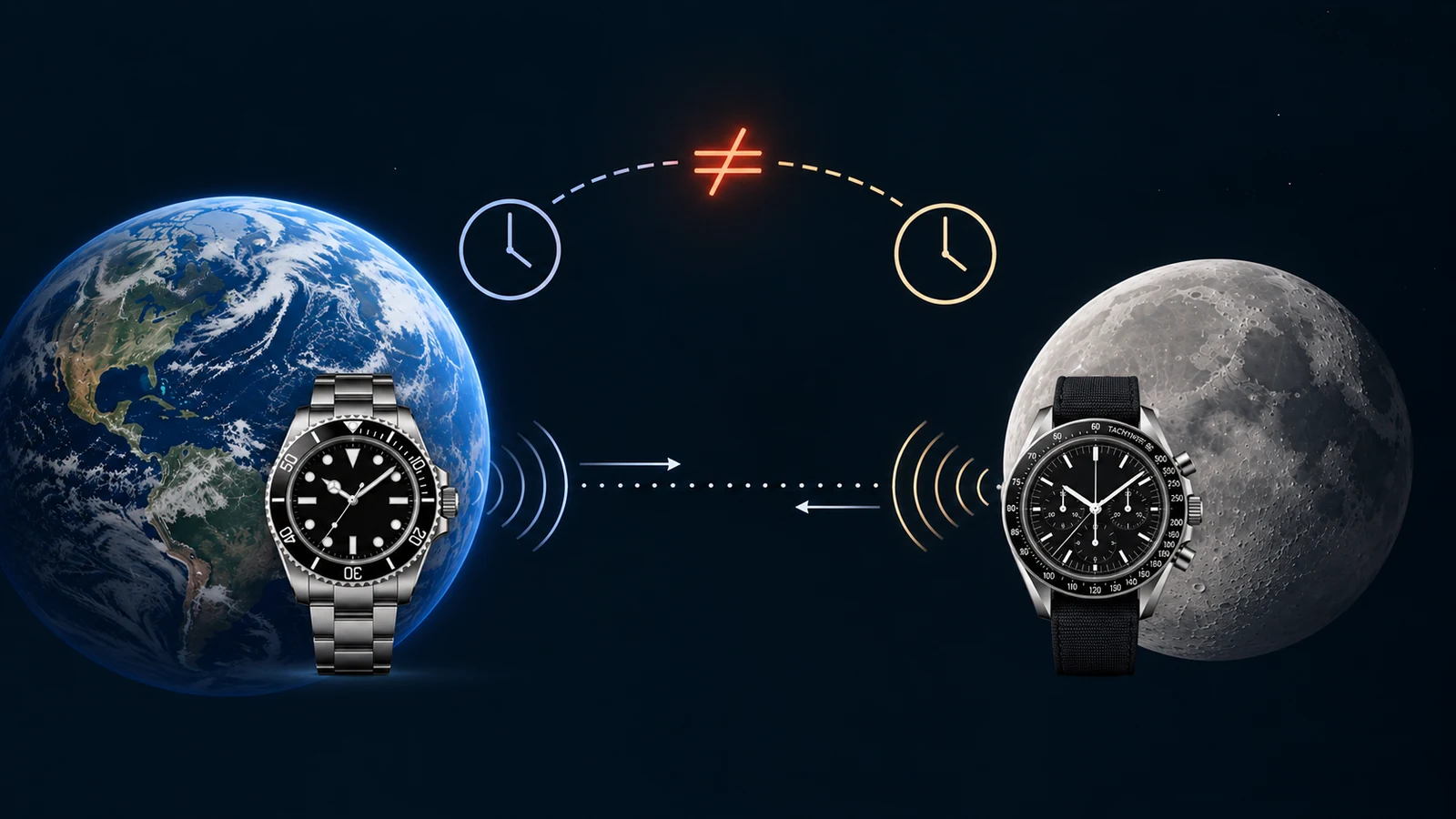
In early 1969, while touring Europe, American astronaut Frank Borman joked that he and his crewmates deserved overtime pay. Two months earlier, Apollo 8, under his command, had carried the first humans to orbit the Moon and return to Earth. The joke rested on a calculation: during the mission, the crew experienced about 300 microseconds more elapsed time than people who remained on Earth.
A microsecond is one millionth of a second. Borman's argument was that those extra fractions of a second ought to count as overtime.
The joke, reported by the American newsmagazine TIME, had a basis in physics. At NASA's request, University of Maryland physicist Carroll Alley had applied relativity to the mission. High-speed motion tends to slow the passage of time, while moving farther from Earth's stronger gravitational field has the opposite effect. For Apollo 8, the combined calculation indicated about 300 additional microseconds of elapsed time for the astronauts.1
In November that same year, Apollo 12 commander Pete Conrad landed on the Moon with an Omega Speedmaster wristwatch issued by NASA. It was a hand-wound mechanical watch. The Smithsonian National Air and Space Museum still preserves that watch.2

In 1972, NASA's John Lavery performed a similar calculation using Apollo 12's actual flight trajectory. An ideal clock traveling with the spacecraft would have accumulated about 570 microseconds more elapsed time than a reference clock on Earth.3
Both numbers are relativistic calculations covering the missions from departure to return, not measurements read directly from the astronauts' wristwatches.
On October 15, 2026, the General Conference on Weights and Measures (CGPM), the international body responsible for measurement standards, adopted a resolution addressing a common lunar time scale and its relationship to Coordinated Universal Time on Earth.4
The challenge now extends beyond calculating the time experienced by an astronaut on a journey to the Moon. When landers and rovers operated by different countries work at widely separated locations on the Moon, how can we compare their clock readings and verify them against a common time reference?
Even Earth's standard time does not come from a single clock
Coordinated Universal Time (UTC) is not the reading of one atomic clock kept somewhere on Earth.
The International Bureau of Weights and Measures (BIPM) combines atomic-clock measurements and clock-comparison data from institutions around the world to compute International Atomic Time (TAI). TAI is a continuous time scale based on atomic clocks. UTC is derived from it by applying leap seconds to keep civil time aligned with Earth's rotation.5
Collecting and processing those data takes time, so the official UTC calculation is published after the fact. We can nevertheless learn the current time immediately because national timing laboratories operate atomic clocks that provide real-time readings aligned with UTC.
Each institution's realization is called UTC(k), where the letter k identifies the institution.
These clocks have small differences. Every month, the BIPM's Circular T reports the offsets between UTC and each UTC(k). Laboratories use those results to check how far their local readings diverged from the international reference and to inform clock operation.
A common time standard works because the differences between separate clocks can be measured and checked.
The same checks will be needed on the Moon, where a clock's location also affects how fast it runs.
Why would a clock on the Moon run faster?
In 2024, Neil Ashby and Bijunath Patla calculated how gravity and motion affect the running rates of clocks on Earth and the Moon.6
They compared ideal clocks on gravitationally defined reference surfaces for each body. On average, the lunar clock accumulated about 56 microseconds more elapsed time per day because the two clocks ran at slightly different rates.
Fifty-six microseconds is imperceptible in daily life. For navigation systems, however, the travel time of radio signals is essential to measuring distance. Light travels roughly 300 meters in one microsecond. Precise positioning therefore requires accounting for very small errors in clock readings.
Relativity explains why the clock rates differ. Time generally passes more slowly in stronger gravity. Motion also affects how fast a clock runs. Both effects must be included when comparing clocks on Earth and the Moon.
Even across the lunar surface, clock rates depend on location. Mountains, craters, and local variations in gravity all matter. A clock on the surface also experiences different gravitational and motional conditions from one aboard a satellite orbiting the Moon.
Reliable clock comparisons also require knowing where each clock is and how it moves.

Elapsed time and a shared time scale
A physical clock measures the elapsed time along its own path through spacetime. Physicists call this proper time. The calculations about the Apollo crews asked how much proper time had accumulated along their different trajectories.
To compare events at different locations on the Moon, we need a common rule for assigning a time coordinate to each event. This is the role of coordinate time.
In 2024, the International Astronomical Union (IAU) adopted resolutions defining a lunar-centered reference system and lunar coordinate time (TCL), allowing positions and event times on and around the Moon to be described consistently.7
TCL supplies those time coordinates for events on and around the Moon.
Defining one meter does not automatically produce a perfectly calibrated ruler. A physical ruler must be made and its markings checked. The relationship between a lunar time scale and an atomic clock is similar.
To relate the proper time accumulated by a lunar clock to its corresponding TCL time coordinates, we must account for the clock's position and motion.
That raises another possible approach: if lunar clocks need corrections anyway, why not choose a time scale whose rate matches clocks on the lunar surface?
Rescaling time also affects coordinate calculations
In 2026, Adrien Bourgoin and colleagues compared three possible lunar reference time scales.8
The first retains TCL without rescaling it. The second adjusts the time scale so that its average rate matches a reference clock on the lunar surface. The third makes its average rate match Terrestrial Time (TT), the time scale used in certain astronomical calculations on Earth.
Matching the time scale to a lunar surface clock could make local operations more convenient. Matching Earth's reference rate could simplify other calculations.
But changing the unit scale of coordinate time also requires consistent treatment of spatial coordinates.
In relativistic reference systems, time and space are defined together. A constant rescaling of the time coordinate must be accompanied by consistent adjustments to the coordinates used to describe position and distance, and to certain parameters used in gravitational calculations. Otherwise the calculations no longer follow a common convention.
The researchers judged unscaled TCL to be the simpler and more consistent choice because it avoids those additional rescaling adjustments. A subsequent study supported the same direction.
The next challenge is to realize that time scale using actual clocks on the Moon.
How can we compare the readings of two clocks?
Imagine installing a precise atomic clock on the Moon. Its location is known and corrections for gravity and motion have been calculated.
To find out how closely its reading follows an international reference, we have to compare it with another clock by exchanging signals.
Bourgoin and colleagues proposed a way to compare a lunar clock with a terrestrial UTC(k) realization.8
Suppose a clock on Earth records when it transmits a signal and a clock on the Moon records when the signal arrives. The difference between their recorded readings also includes the time taken for the radio signal to travel. We must account for that travel time to infer the offset between the clocks.
That requires an accurate calculation of the signal path, the positions of Earth and Moon, and delays introduced by the transmitting and receiving equipment.
One indispensable input is an ephemeris: a set of calculated positions for celestial bodies such as Earth and the Moon at specified times. Uncertainty in those positions and in the signal propagation time affects the clock comparison.
The terrestrial reference must be checked as well. The BIPM's later report of the UTC–UTC(k) offset allows the lunar reading to be connected to the international reference.
Establishing this documented chain of comparisons, with an assessment of its uncertainty, is called metrological traceability.
With such a system, independent institutions could operate clocks on the Moon while checking how far their readings differ from a common time reference.
Putting the proposed procedure into operation will still require tests of clock performance, positioning data and delays in signal-transfer hardware under real mission conditions.

How close are we to a common lunar time reference?
Technologies that could support accurate time and position information on the Moon are already being developed.
In March 2025, the Lunar GNSS Receiver Experiment (LuGRE), developed jointly by NASA and the Italian Space Agency (ASI), received GPS and European Galileo navigation signals on the lunar surface and calculated a position solution.9
The experiment demonstrated that terrestrial satellite-navigation signals could also be used on the Moon.
In October 2026, the European Space Agency (ESA) announced NovaMoon, a plan for a lunar surface facility equipped with atomic clocks and a position reference station.10 Preparations are under way to provide more accurate time and position information on the Moon.
Lunar operations must also account for interruptions in communication with Earth.
An atomic clock continues measuring elapsed time without a signal from Earth. But if it cannot be compared with another clock for a long period, small instabilities and environmental effects increase the uncertainty about its reading relative to the common reference.
Different lunar missions also require different levels of timing accuracy and independence. Early missions can use time information supplied from Earth with appropriate corrections. As more countries' rovers and landers share observations and use common navigation services, the value of a verifiable shared time reference grows.
Frank Borman joked about the extra microseconds he had experienced on Apollo 8. The challenge now is to go beyond calculating those tiny differences and verify the readings of clocks at different locations on the Moon against a common reference.
To verify “now” on the Moon, we need a way to compare and validate the readings of different clocks against the same reference.
Keep reading CAUSIFOLD
Follow new CAUSIFOLD articles and updates on Substack.
Subscribe on Substack ↗Notes and sources
1. TIME, “Relativity: A Matter of Overtime”, March 7, 1969; NASA, Astronautics and Aeronautics, 1969, entry for March 6. The accounts describe Carroll Alley's relativistic calculation and Frank Borman's overtime joke. The NASA chronology cites TIME.
The joke's twist: Before Apollo 8, Borman and Jim Lovell had flown in Earth orbit on Gemini missions. As TIME reported Alley's calculations, including those earlier flights left Borman about 100 microseconds and Lovell about 200 microseconds younger than if they had stayed on Earth. Only William Anders, for whom Apollo 8 was the first spaceflight, could claim the extra elapsed time. These, too, were calculations rather than wristwatch measurements.
2. Smithsonian National Air and Space Museum, “Chronograph, Conrad, Apollo 12”. The museum's record of the Omega Speedmaster issued by NASA to Apollo 12 commander Pete Conrad in 1969.
3. John E. Lavery (1972), Relativistic Time Corrections for Apollo 12 and Apollo 13, NASA Technical Note D-6681: report PDF; NASA catalog record. The report PDF abstract gives 570.3±0.3 microseconds in a calculation described as considering Earth, Moon and Sun gravity; the NASA catalog abstract gives 560±1.5 microseconds, describing Earth and Moon Newtonian gravitational potentials. The descriptions of the calculations differ, and no separate NASA explanation resolving the numerical discrepancy has been confirmed in the public material reviewed. A separate simplified trajectory calculation excluding solar gravity also yielded about +560 microseconds of accumulated elapsed-time difference; it is not a reproduction of NASA's full analysis. The article uses the report PDF's number.
4. International Bureau of Weights and Measures (BIPM), Resolution 6 of the 28th CGPM, On the definition of an international lunar reference time scale and its traceability to UTC, adopted October 15, 2026: official adopted resolutions and Resolution 6. It addresses an international lunar reference time scale and its traceability to UTC. Adoption does not mean a common lunar time service is already operating. The complete operative provisions were not independently checked clause by clause for this update, so no specific implementation is presented as settled.
5. BIPM, “Coordinated Universal Time (UTC)” and “Circular T”. BIPM computes International Atomic Time (TAI) from atomic-clock data and comparisons; in 2026, UTC still follows the leap-second system. TAI and UTC differ by an integer number of seconds and advance at the same rate between leap-second adjustments. Timing laboratories maintain UTC(k) in real time. Resolution 5 of the 28th CGPM (2026) makes continuous UTC effective on May 20, 2027, and sets a maximum permitted |UT1−UTC| of 3,600 seconds (one hour). This is a ceiling, not a prediction that the actual difference will reach one hour on that date.
6. Neil Ashby and Bijunath R. Patla (2024), “A Relativistic Framework to Estimate Clock Rates on the Moon”, The Astronomical Journal, 168, 112. For ideal clocks at the terrestrial geoid and lunar selenoid, the model finds an average 56.02 microseconds more accumulated elapsed time per day on the Moon. This is a clock-rate comparison, not a fixed offset between clock readings or a field measurement. The distance light travels in one microsecond is not identical to an actual navigation position error.
7. IAU, 2024 Resolutions II and III, defining the lunar-centered reference system (LCRS), lunar coordinate time (TCL) and the need for an internationally coordinated lunar time system: resolutions index.
8. Adrien Bourgoin, Pascale Defraigne and Frédéric Meynadier (2026), “Lunar reference timescale”, Metrologia, 63, 015003. Their analysis covers consistent handling of spatial coordinates and gravitational parameters under time-scale choices, as well as comparing clocks against UTC. The difference of about 58.7 microseconds/day between TCL and TT is defined differently from the approximately 56.02 microseconds/day comparison between clocks at lunar and terrestrial reference surfaces in [6]. See also Lunar Time.
9. NASA, “NASA Successfully Acquires GPS Signals on Moon”, March 4, 2025. LuGRE demonstrated reception of terrestrial GNSS signals and calculation of a position solution on the Moon.
10. ESA, “Introducing NovaMoon”, October 12, 2026. The announcement describes plans for lunar surface atomic clocks and a time and position reference facility.