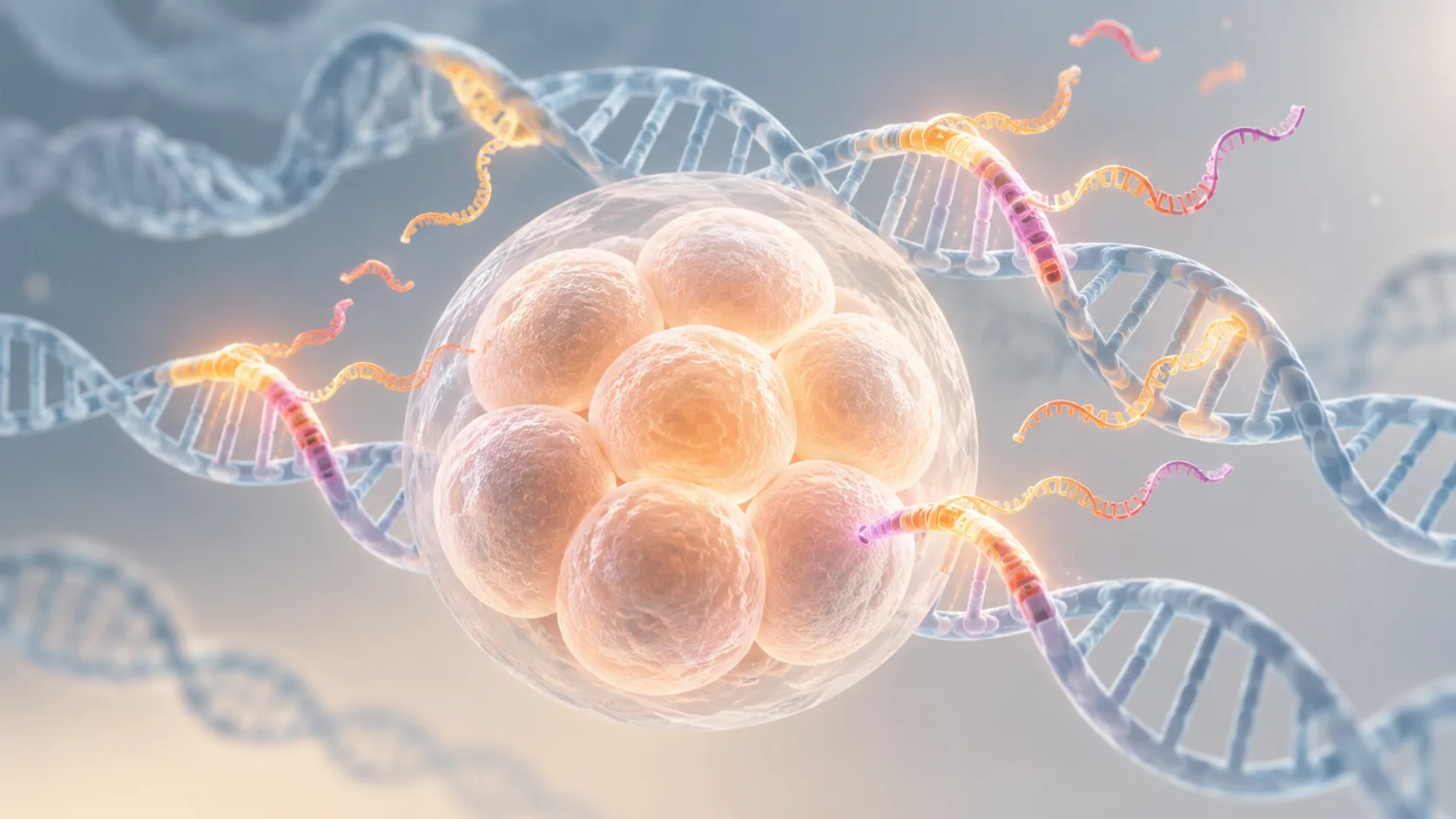
Around the time a human embryo reaches eight cells, some embryos stop developing. Finding out why is difficult. Research involving human embryos requires donor consent and rigorous ethical review, and the embryos available for study are limited. Scientists therefore examine donated embryos while also using stem-cell models that reproduce some of the gene activity seen in early development.
In a 2026 paper in Science, Yangquan Xiang and colleagues found an unexpected clue while studying human embryos whose development had stopped. Compared with embryos that continued developing, embryos arrested at the eight-cell stage showed lower activity in DNA sequences left behind by viruses that infected our distant ancestors.
The human genome contains many traces of ancient retroviral infections. Most can no longer produce an intact virus, and many of these sequences were long regarded as genetic leftovers with little function. But one group of viral-derived repetitive sequences, known as MLT2A1, turned out to be more than a passive remnant.
When the researchers reduced the RNA produced from MLT2A1 sequences, embryonic development was disrupted and the activation of numerous genes weakened. RNA molecules are made using DNA as a template; some also regulate the activity of other genes. Closer investigation revealed that MLT2A1 sequences scattered across the genome produce different RNAs that work together to reinforce gene activity in the early embryo.1
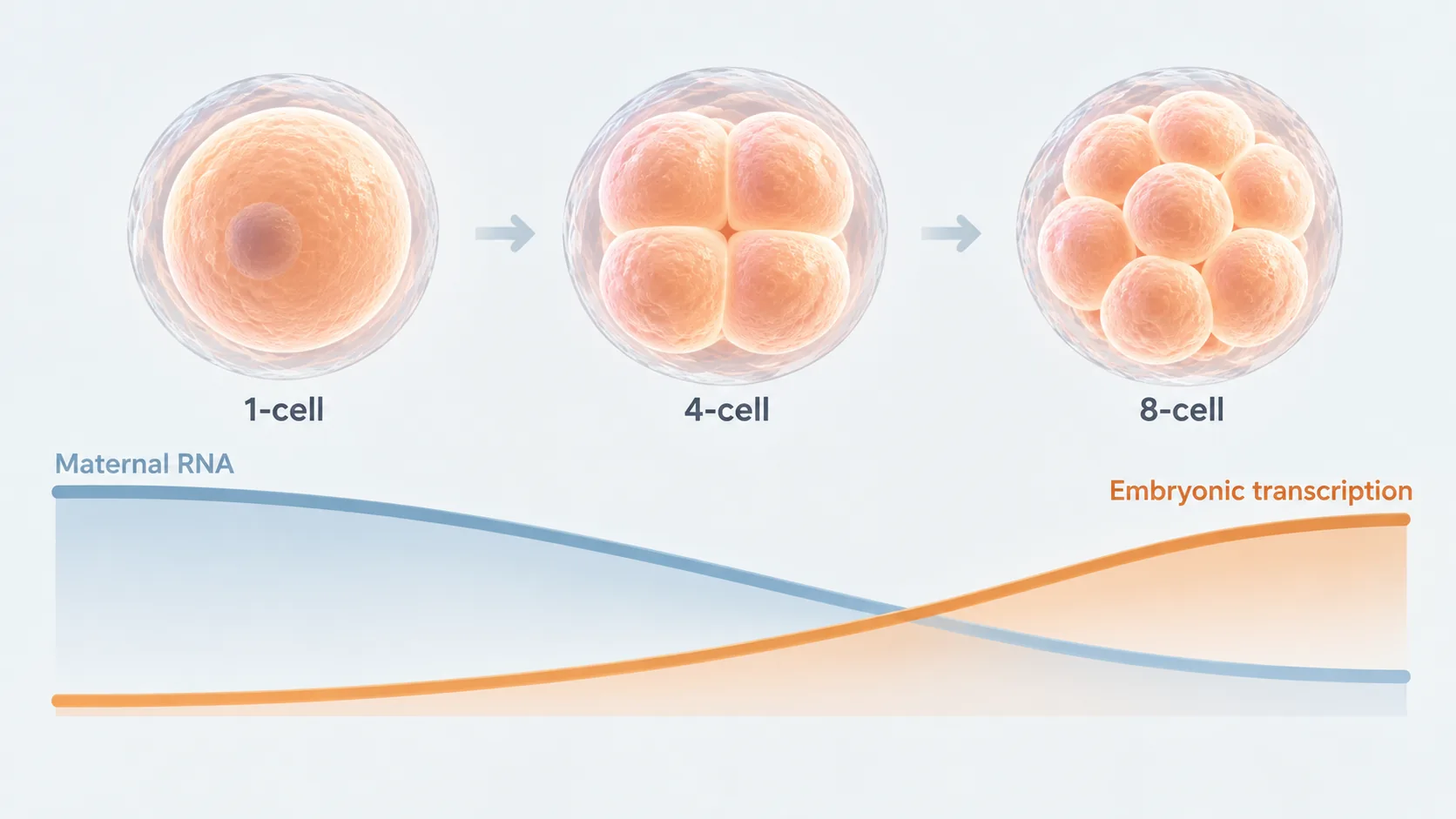
This matters because of a transition that takes place soon after fertilization. At first, an embryo relies heavily on RNA and proteins supplied by the egg. It gradually increases transcription from its own DNA, with a major wave of gene activation around the eight-cell stage. This process is called zygotic genome activation (ZGA).2
DNA inherited from ancient viruses was helping human embryos activate their own genomes.
Viral traces in the human genome
Retroviruses insert their genetic material into the DNA of infected cells. If an insertion occurred in a germ cell of a distant ancestor and was passed to subsequent generations, the viral-derived DNA could become part of the inherited genome.
Over time, mutations accumulate in these sequences. Even after they lose the ability to produce an intact virus, their DNA can persist. Inherited sequences of this kind are known as endogenous retroviruses (ERVs).
The fact that humans can make use of viral-derived genetic material is not new. A well-known example is syncytin, a protein derived from a retroviral envelope protein that helps placental cells fuse.3
Nor is the expression of viral-derived sequences in early human embryos a new discovery. But observing that a sequence becomes more or less active at a particular developmental stage cannot, on its own, establish whether it contributes to development.
That is why the experiments reducing MLT2A1-derived RNA mattered. The team tested MLT2A1 function in research embryos and in cultured cells that reproduce some features of the human eight-cell transcriptional state. Reducing this RNA weakened the activation of multiple genes and impaired embryonic development under the conditions tested.14
MLT2A1 was therefore more than a marker whose activity happened to be lower in embryos that had stopped developing. The experiments supported a functional role in early genome activation.
But that role could not be explained simply by the activity of a single gene.
Scattered sequences form a regulatory network
Members of the MLT2A1 sequence family occur at many locations in the genome. Each copy sits beside a different stretch of DNA.
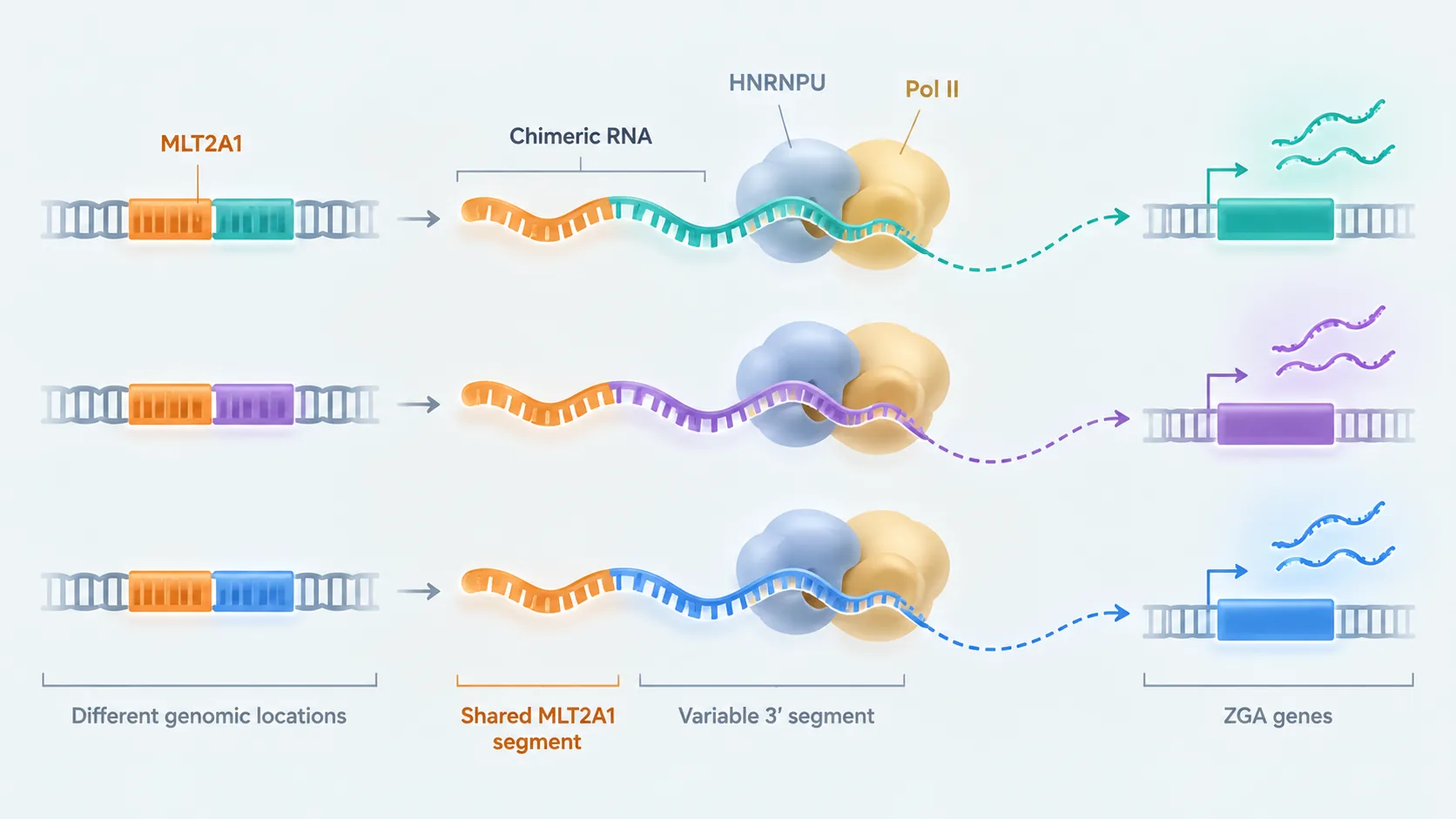
When the researchers examined the RNAs produced at these sites, they found that many transcripts did not end at the MLT2A1 sequence. They continued into the adjoining DNA.
The result was a set of RNAs with similar beginnings but different endings. An RNA assembled from segments derived from different sequences is called a chimeric RNA.
The researchers also linked this structure to function. The variable ends of the RNAs broadened the range of genomic regions in which they could act. Their shared MLT2A1-derived segments, meanwhile, interacted with an RNA-binding protein called HNRNPU. This protein helped recruit RNA polymerase II, the enzyme responsible for transcribing DNA into RNA.1
The variable segments extended the network’s reach; the shared segments helped bring in the machinery for gene transcription.
These RNAs strengthened the expression of multiple embryonic genes as well as other MLT2A1-family sequences. Together, RNAs originating at different sites helped support a broader program of gene activation.
That is the distinctive finding. The study went beyond showing that an ancient viral sequence had acquired a useful function: it described how sequences scattered through the genome, and the RNAs they produce, can act as a connected regulatory network.
What switches this activity on—and when?
How does MLT2A1 activity begin?
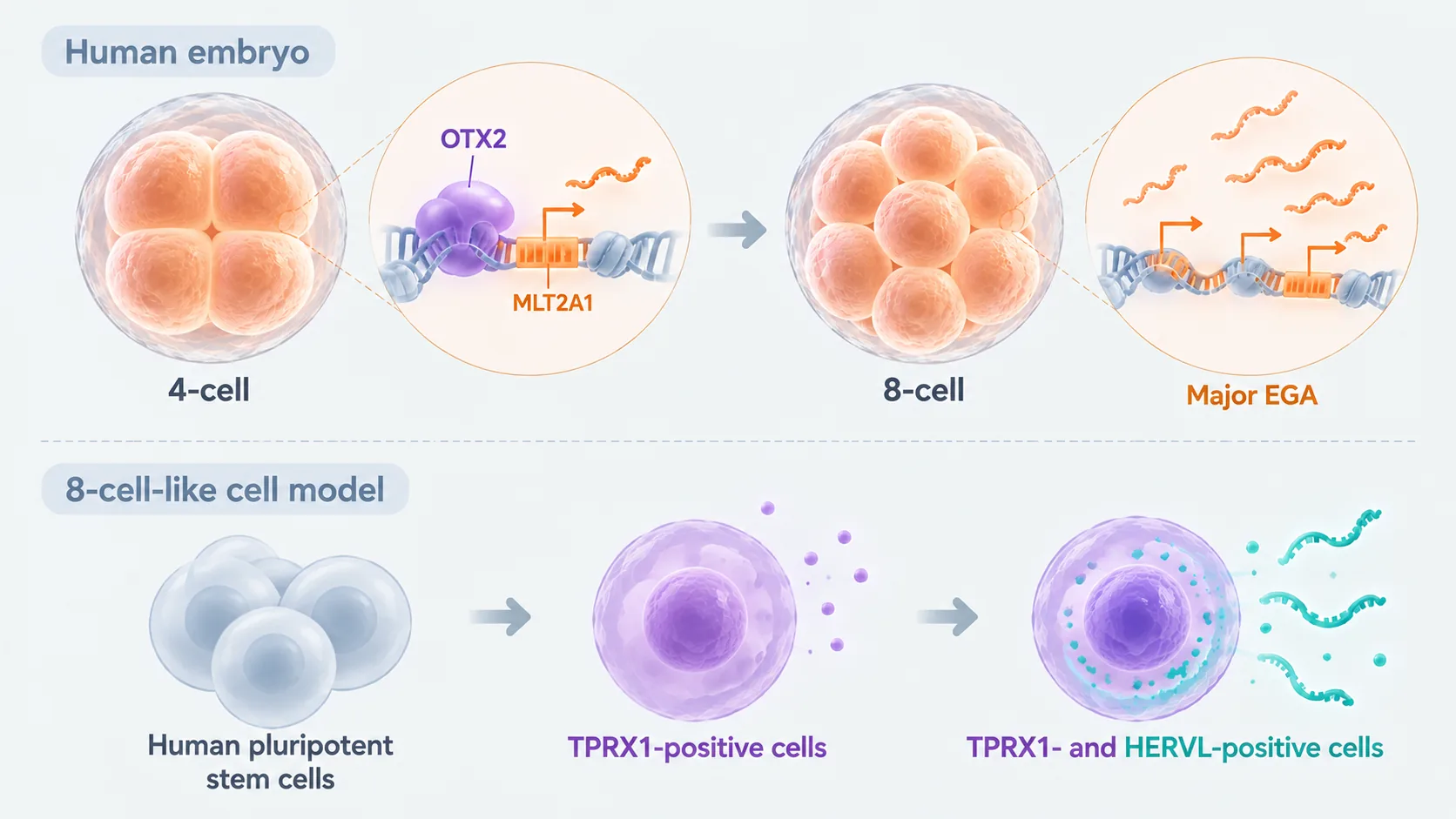
In a 2025 paper in Nature Genetics, Qiuyan Wang and colleagues showed that OTX2, a transcription factor passed from the egg to the embryo, helps regulate early human genome activation. Transcription factors are proteins that bind particular regions of DNA and influence gene activity.
From the four-cell stage, OTX2 promoted the activation of MLT2A1 alongside several other genes and repeat sequences. Early embryonic transcription therefore does not begin through MLT2A1 acting alone; it depends on regulatory factors inherited from the egg and other components of the embryo’s control machinery.5
This raises another question. To understand development, it may matter not only which components participate in genome activation but which become active first, and which follow.
A study published in Cell Reports in October 2026 examined a related sequence of events. An Huang and colleagues did not use actual human embryos. Instead, they studied eight-cell-like cells (8CLCs): cultured human stem cells that display some of the gene-expression features of early embryos.
As these cells acquired an eight-cell-like state, expression of the regulatory factor TPRX1 appeared first. Cells expressing HERVL, a family of viral-derived repeat sequences, appeared later. Suppressing HERVL activity also affected the transition toward this embryo-like state.6
The work did not replicate the MLT2A1 mechanism in human embryos. It did, however, show that viral-derived sequences become active in a particular order in this cell model, and that their activity can contribute to changes in cell state.
Researchers have also developed more efficient ways to produce such models. Cultured cells offer additional opportunities to investigate the sequence of regulatory events without repeatedly manipulating actual human embryos.7
What went wrong in embryos that stopped developing?
None of these findings provides an immediate treatment for infertility or a clinical solution for in vitro fertilization.
An observation that MLT2A1 activity was lower in arrested embryos is different from an experiment showing that reducing its RNA can disrupt development. The arrested-embryo datasets include samples with different pronuclear classifications. Some manipulation experiments used three-pronuclear (3PN) research embryos, which differ from normally fertilized embryos. Results from eight-cell-like cells likewise do not directly establish whether an actual embryo can continue developing.4
Embryos that arrest at the same stage need not have undergone the same molecular changes. In some, regulators that initiate gene activity might be impaired. In others, the interactions among multiple RNAs might be disrupted.
Whether either kind of disturbance actually causes developmental arrest remains unresolved. The study identified a role for MLT2A1-derived RNAs; it did not provide a way to classify arrested embryos by cause.
The study provides a molecular clue for testing whether the same outcome—developmental arrest—can arise from different causes.
Keep reading CAUSIFOLD
Follow new CAUSIFOLD articles and updates on Substack.
Subscribe on Substack ↗Notes
1. Principal 2026 study. Xiang, Y. et al., “Endogenous retroviruses synthesize heterologous chimeric RNAs to reinforce human early embryo development,” Science 391, eadv5257 (2026). DOI: 10.1126/science.adv5257. Yangquan Xiang is one of the co-first authors. The researchers observed lower MLT2A1 expression in human embryos arrested at the eight-cell stage. Functional perturbations and molecular analyses supported a transcriptional network involving chimeric RNAs, HNRNPU, and RNA polymerase II. The observational and perturbation evidence must be distinguished. MLT2A1 belongs to an ERVL-associated family of long terminal repeat (LTR) sequences. Research data are deposited under NCBI BioProject PRJNA1116059 and GEO GSE268270.
2. Zygotic genome activation. Shortly after fertilization, a human embryo relies substantially on RNA and proteins inherited from the egg. Transcription from the embryo’s own genome then increases, with a major wave around the eight-cell stage. Not all genes switch on at once. Xiang et al., Science (2026)
3. Earlier research on viral-derived sequences. Mi, S. et al., “Syncytin is a captive retroviral envelope protein involved in human placental morphogenesis,” Nature 403, 785–789 (2000). DOI: 10.1038/35001608. Göke, J. et al., “Dynamic transcription of distinct classes of endogenous retroviral elements marks specific populations of early human embryonic cells,” Cell Stem Cell 16, 135–141 (2015). DOI: 10.1016/j.stem.2015.01.005. Both the functional use of viral-derived genetic material and stage-specific repeat expression in early human embryos were studied before 2026. Expression alone, however, does not establish a necessary developmental function.
4. Research ethics and experimental systems. The International Society for Stem Cell Research (ISSCR) provides international guidance on donor consent and oversight in its Guidelines for Stem Cell Research and Clinical Translation. The 2025 update also addressed oversight of stem-cell-based embryo models. Models such as 8CLCs, which reproduce selected gene-expression features, should not be treated as complete human embryos.
Xiang and colleagues studied actual human embryos and eight-cell-like cells. The arrested-embryo transcriptome dataset, GEO GSE268186, includes samples classified as 2PN, 3PN and 0PN. These designations refer to two, three or no pronuclei observed at the relevant assessment, respectively; 0PN does not by itself establish that fertilization did not occur. The comparison with normal 2PN embryos also used reprocessed previously published transcriptomic data (SRP163205). Gene-expression data following MLT2A1 depletion are deposited under GSE268184. In the HNRNPU-depletion experiment GSE301882, siRNA was injected into 3PN research embryos. Results from these different fertilization, culture and manipulation conditions cannot all be interpreted as if they came from normally fertilized embryos. For the experimental nature of 8CLCs, see Taubenschmid-Stowers, J. et al., “8C-like cells capture the human zygotic genome activation program in vitro,” Cell Stem Cell 29, 449–459.e6 (2022), DOI: 10.1016/j.stem.2022.01.014.
5. The host-derived regulator OTX2. Wang, Q. et al., “Maternal factor OTX2 regulates human embryonic genome activation and early development,” Nature Genetics 57, 2772–2784 (2025). DOI: 10.1038/s41588-025-02350-8. Qiuyan Wang is a co-first author. At the four-cell stage, OTX2 promoted the activation of TPRX1, TPRX2, HERVL-int and MLT2A1. Combined suppression of OTX2 and TPRXL further impaired eight-cell-stage gene activation and chromatin accessibility. These results support a regulatory role for OTX2, but they do not demonstrate that TPRX1 directly activates MLT2A1 in actual human embryos.
6. Activation order in eight-cell-like cells. Huang, A. et al., “Sequential TPRX1 and HERVL activation delineates a progression toward the totipotent-like state,” Cell Reports 45, 118163 (2026). DOI: 10.1016/j.celrep.2026.118163. An Huang and colleagues used distinct fluorescent signals to distinguish TPRX1 and HERVL activity and followed changes in cell state over time. CRISPR interference and RNA-targeting manipulations support a functional contribution from HERVL sequences and their RNAs during this transition. The experiments used cultured cell models; the mechanisms of individual HERVL loci remain unresolved.
7. An improved route to the cell model. Kong, X. et al., “Chemical reprogramming of human pluripotent stem cells into 8-cell-like states,” Cell Research (2026). DOI: 10.1038/s41422-026-01314-9. Xi Kong and colleagues used seven chemicals and LIF (the 7CL condition) to generate eight-cell-like cells in approximately six days. The reported proportion of TPRX1-positive cells was approximately 51.5%; it was not a rate of human embryo production or successful normal development. This is an advance in generating and characterizing a cell model.