
Depending on how it is cooled, concentrated sugar syrup can set into clear, hard candy—or form sugar crystals. The outcome depends on the water content, cooling rate, and conditions for crystal formation. In both cases, sugar solidifies. Yet the internal structures are quite different. In glassy candy, molecules are arranged irregularly and have little freedom to move. In a sugar crystal, they form an ordered structure.1
The two processes can compete. If sugar becomes glassy before crystals can grow, crystallisation is hindered. But once crystals begin to form, they draw more sugar molecules from their surroundings.
Researchers have now identified a similar competition involving proteins. What they saw under the microscope was more surprising still.
Fine protein fibres were lengthening while nearby spherical droplets slowly shrank. Both were made of the same protein. One structure lengthened as another shrank—as if the growing fibres were drawing on material held in the droplets.
In a study published in Nature Physics on 20 October 2026, the researchers describe this as competition between two routes to protein solidification. Liru Feng and Louise Jawerth at Leiden University planned and led the experimental work. Ryota Takaki and Frank Jülicher at the Max Planck Institute for the Physics of Complex Systems were among those who developed the theoretical model.2
As fibres grow, droplets shrink
The protein in question was FUS. It helps cells process RNA and is implicated in some cases of amyotrophic lateral sclerosis (ALS).
Under certain conditions, FUS proteins gather into tiny, liquid-like droplets. Protein molecules are much more concentrated inside the droplets than outside, but they remain mobile: they move within the droplets and exchange with the surrounding solution. The droplets themselves can also merge. Such concentrated assemblies are called condensates.
When proteins cluster together, they are more likely to come into contact. Condensates therefore seemed likely places for the formation of long protein fibres. A 2015 study observed FUS liquid droplets developing more solid-like aggregated states over time; some ALS-associated mutations accelerated this process.3
Yet the place with the highest protein concentration was not necessarily where fibres grew most readily.
The researchers first prepared FUS droplets, then added small pieces of fibres that had already formed. These fragments served as seeds, allowing more protein molecules to attach and extend the fibres.
Fibres were also seen at droplet surfaces, but most elongation occurred in the dilute solution around the droplets. Fibres could also grow in conditions without droplets.
“Dilute” does not mean protein-free. FUS molecules are still moving in the solution outside the condensates. As they join a fibre, it grows longer.
As growing fibres draw protein molecules from the surrounding solution, the balance of concentrations between the solution and the droplets changes. A droplet is not a sealed capsule. Some of its protein can return to the solution as the system rebalances, reducing the droplet's volume.
The researchers constructed a physical model that includes exchange between droplets and solution. In the model, how readily molecules cross the droplet boundary affects the rate and pattern of shrinkage. The model provides a mechanism for the observed combination of fibre elongation and droplet shrinkage.4
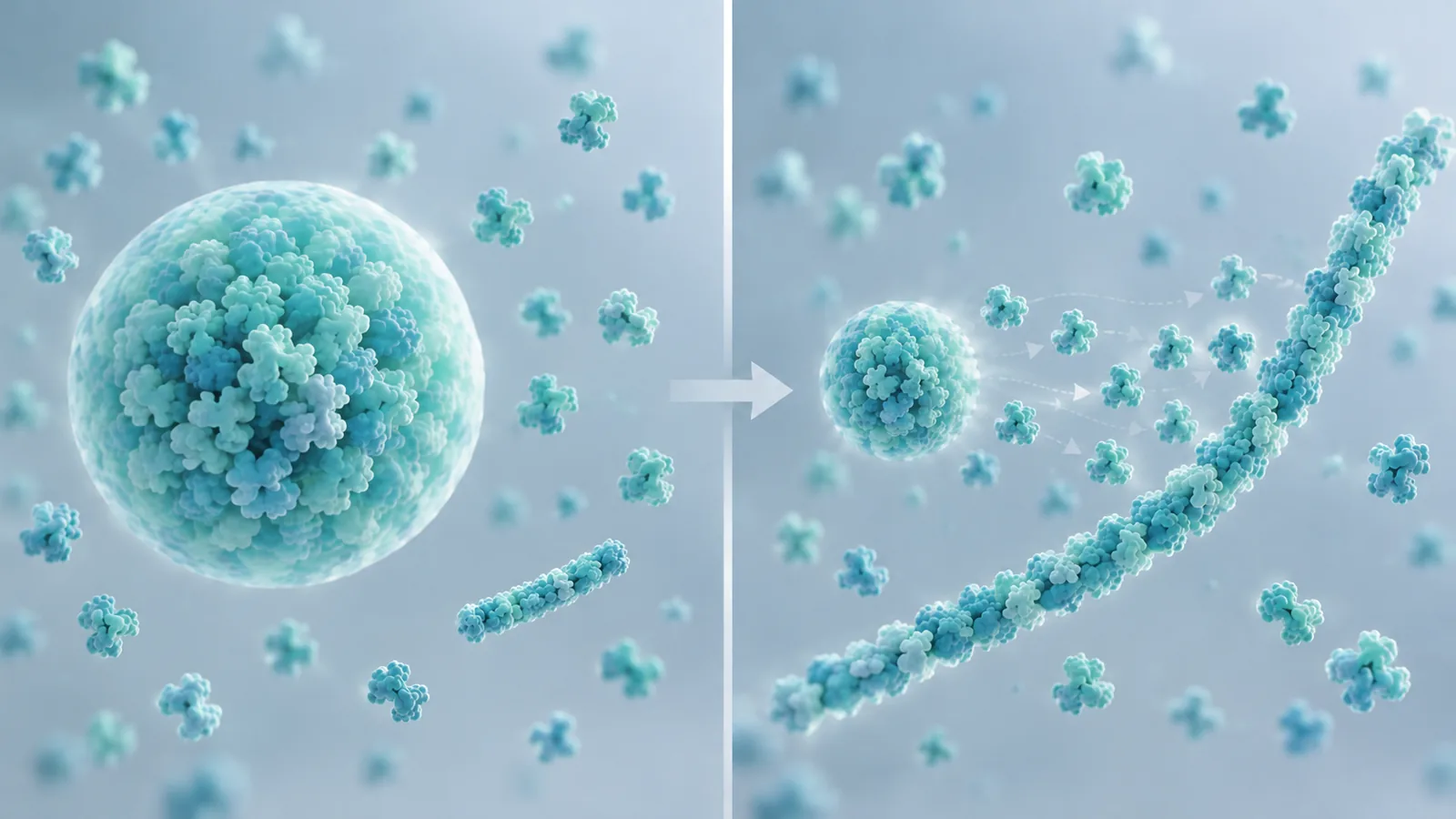
In the model, liquid droplets act as reservoirs of protein available to the growing fibres. The two structures draw on the same material and influence one another.
But what happens as the droplets age? Would older droplets support even more fibre growth?
As droplets age, fibre growth slows
The team varied how long droplets were allowed to age before adding fibre seeds. One group received seeds after 1 hour, while others received them after 24 or 48 hours.
The opposite happened: fibre growth was weaker in samples containing older droplets.
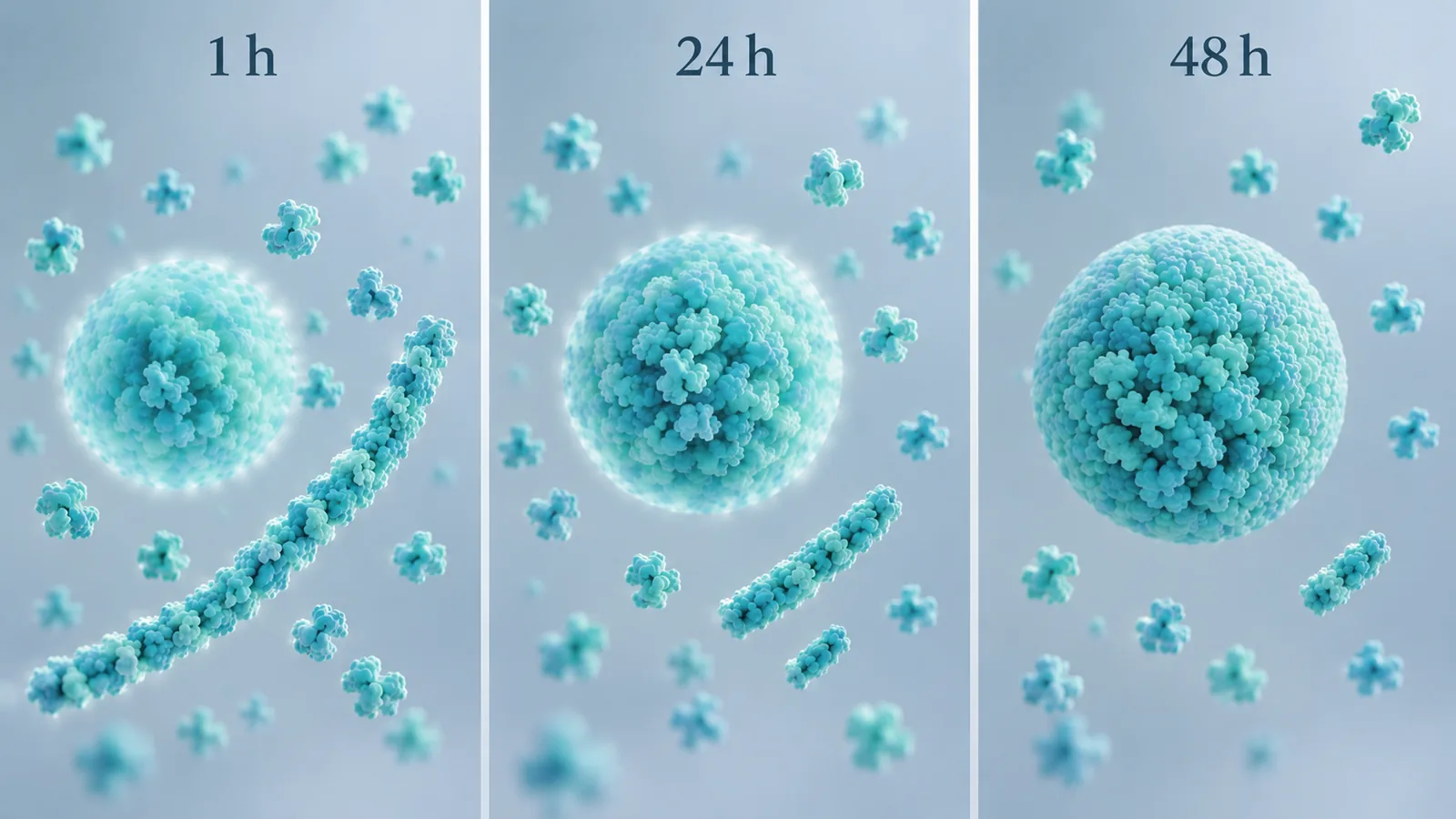
With relatively fresh droplets, fibres elongated prominently as droplets shrank. In samples containing older droplets, fibre growth was weaker and more droplets remained.
What had changed inside the droplets?
The researchers briefly photobleached the droplets and measured how quickly their fluorescence recovered. Recovery was slower in older droplets. Older droplets were also more resistant to dissolution in highly concentrated salt solutions.
Together, these results point to changes in the condensates that restrict molecular movement and exchange as they age. The researchers interpreted this behaviour as glass-like ageing. Earlier studies had also documented changes in the material properties of ageing protein condensates.5
Here, “glass-like” does not mean that the droplets become transparent. In materials science, a glass has a disordered arrangement in which molecules cannot easily rearrange their positions.
This is where the competition between the two routes comes into view.
For a fibre to elongate, protein molecules must move and join its growing end. As a droplet ages toward a glass-like state, molecular movement and exchange become more restricted. The researchers interpret this change as making further fibre growth less favourable.
Fibres grow by incorporating mobile protein molecules. Glass-like ageing of the droplets restricts the movement that can help supply them.
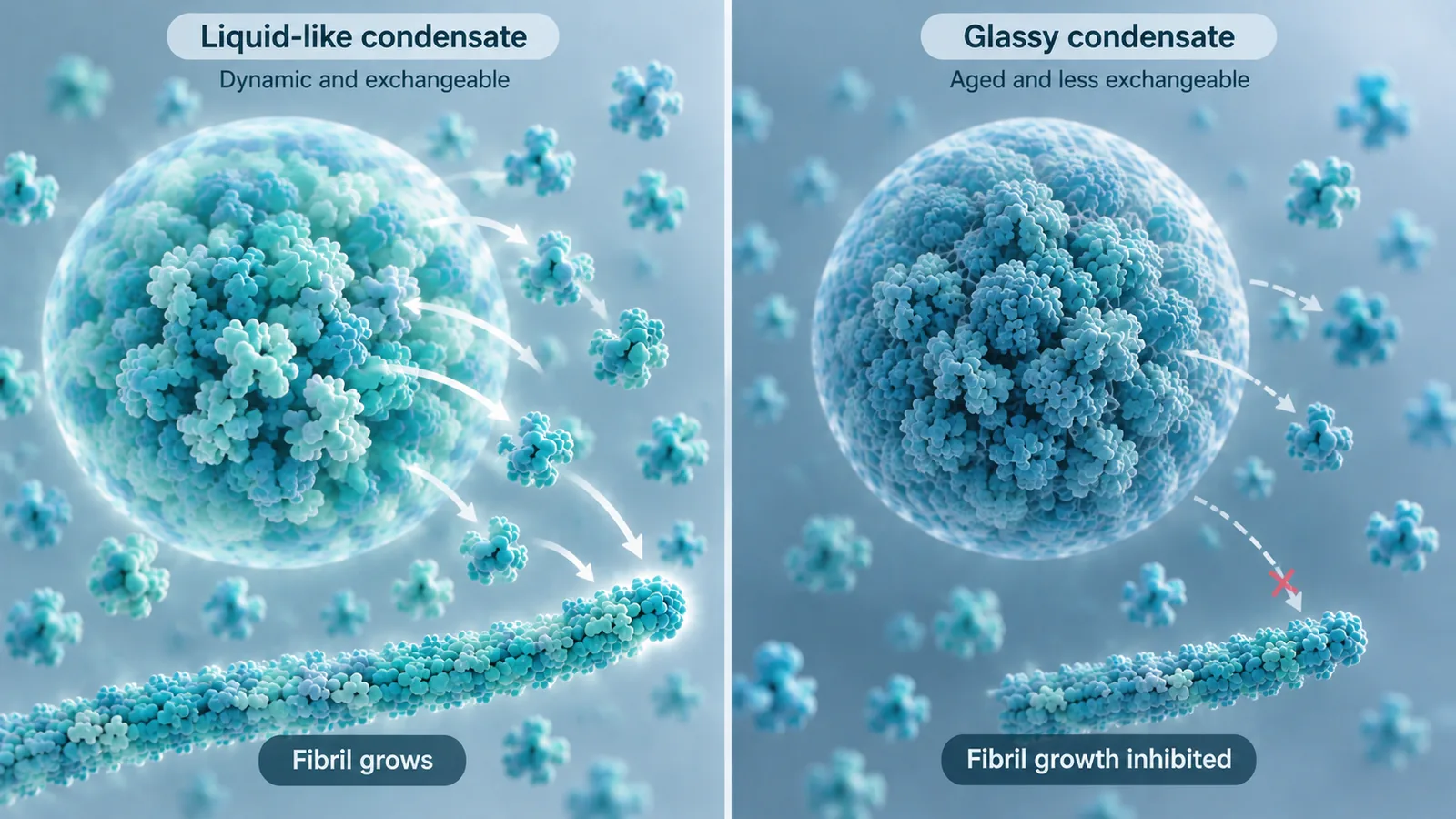
With fresh droplets, fibres grew more and the droplets shrank visibly. Older droplets tended to persist while fibres grew less. The authors see these outcomes as evidence of competition between two ways of becoming more solid-like.
Molecules of the same protein may join long, ordered fibres, or remain in a condensate whose dynamics slow dramatically. In these experiments, more extensively aged condensates were associated with less fibre growth.
The same material, different outcomes
The link between FUS condensates and fibre formation was not new.
In 2023, researchers showed that small FUS fibres can form even in solutions too dilute for liquid droplets to appear.6 Another study that year observed solidification beginning at a condensate surface and progressing inward.7
In 2024, researchers followed long-term ageing of droplets made from a segment of FUS. A rigid surface shell formed; fibres appeared in samples allowed to mature for much longer. Adding RNA inhibited aspects of this ageing process.8
Work first published online in 2025 also linked rearrangements of nanoscale domains inside FUS condensates to fibre formation at their surfaces.9
Taken together, these findings show that protein solidification does not follow a single route. A droplet's interior, its surface, and the dilute solution around it are different environments. The part or form of the protein under study, the molecules around it and the time elapsed can all influence the result.
The new study identifies conditions in which fibre growth competes with glass-like ageing of the condensate. The two material states can coexist, but the experiment did not show a mandatory direct conversion of one into the other.
Whether the same competition occurs inside living neurons remains unknown. Cells contain RNA, other proteins, and regulatory processes absent from simplified in-vitro experiments. Results from these laboratory samples do not establish what happens inside the neurons of people with ALS.
There is no single way for a protein to become solid. The same molecules can follow competing paths—into growing fibres or into glass-like condensates—and end up in very different material states.
Keep reading CAUSIFOLD
Follow new CAUSIFOLD articles and updates on Substack.
Subscribe on Substack ↗Notes
1. Sugar crystallization and glass formation. Water content, cooling conditions, and crystal nucleation affect the structure of sugar confectionery. A hard candy made without substantial crystallization may be glassy and lack long-range molecular order. This is an analogy between competing material states, not an assertion that sugar crystals and FUS fibres have the same structure or mechanism. Institute of Physics, “Sweet glasses”; J. Peter Clark, “Crystallization Is Key in Confectionery Processes”, Food Technology (2004).
2. Central study and author contributions. Liru Feng, Ryota Takaki, Iain Muntz, Lionel Ndamba, Martine Ruer-Gruß, Frank Jülicher and Louise Jawerth, “Fibres and glasses are competing material states in protein condensation,” Nature Physics, published online 20 October 2026. DOI: 10.1038/s41567-026-03415-z. The published contribution statement credits Feng and Jawerth with planning and supervising experiments and Feng with carrying them out; Ndamba and Ruer-Gruß assisted experimentally; Muntz, Feng, Takaki and Jawerth analyzed data; Takaki, Jawerth and Jülicher developed the theory. Jawerth is corresponding author. The sources reviewed did not establish a separate equal-first-author designation. Affiliations include Leiden University and Max Planck institutes in Germany.
3. FUS droplet ageing and ALS variants. Avinash Patel et al., “A Liquid-to-Solid Phase Transition of the ALS Protein FUS Accelerated by Disease Mutation,” Cell 162(5), 1066–1077 (2015). DOI: 10.1016/j.cell.2015.07.047. The study documents ageing-related aggregation of FUS droplets and acceleration by certain patient-derived mutations; it does not establish that every droplet directly becomes an amyloid fibre.
4. Fibre elongation, droplet shrinkage, and the model. Feng et al. (2026), Figs. 1–3 and Extended Data 1–2. Representative seeded-growth conditions were 4.5 μM FUS, 0.7 μM fibre seeds, and 100 mM KCl; glass-bead tests without droplets used 200 mM KCl and cannot be read as a controlled same-salt rate comparison. Even seed-free controls showed slight volume loss over 12 hours. The proposed role of interfacial exchange and conductivity is model-based: individual molecules were not tracked all the way from a droplet to a fibre. Original study.
5. Glass-like ageing and measurement limits. Louise Jawerth et al., “Protein condensates as aging Maxwell fluids,” Science 370(6522), 1317–1323 (2020). DOI: 10.1126/science.aaw4951. In Feng et al. (2026), Fig. 4 and Extended Data 3–4, fibre seeds (700 nM) were added after 1, 24, or 48 hours of ageing under 15 μM FUS and 100 mM KCl. Whole-droplet fluorescence recovery can reflect internal mobility as well as exchange with external solution. Resistance to dissolution in 1 M KCl is another sign of aging, not an independent measurement of an exact glass-transition point. Separate seed-free controls did not show clearly detectable fibres after 7 or 32 days, although a slight dye-signal increase occurred inside droplets by day 32. 2026 study.
6. Fibrillation below the droplet-formation threshold. Emilie Bertrand, Clément Demongin et al., “FUS fibrillation occurs through a nucleation-based process below the critical concentration required for liquid–liquid phase separation,” Scientific Reports 13, 7772 (2023). Bertrand and Demongin are co-first authors. Fibrillation in the dilute phase predates the 2026 report. DOI: 10.1038/s41598-023-34558-1.
7. Surface-promoted solidification. Yi Shen et al., “The liquid-to-solid transition of FUS is promoted by the condensate surface,” PNAS 120(33), e2301366120 (2023). The surface can promote an inward-progressing transition; this is not the same claim as predominant elongation in the surrounding dilute phase. DOI: 10.1073/pnas.2301366120.
8. Long-term ageing of a FUS fragment. Leonidas Emmanouilidis, Ettore Bartalucci et al., “A solid beta-sheet structure is formed at the surface of FUS droplets during aging,” Nature Chemical Biology 20, 1044–1052 (2024). Emmanouilidis and Bartalucci are co-first authors. The study used FUS residues 1–267 in agarose gel, found a rigid beta-sheet-rich surface shell and fibres in long-matured samples, and documented an RNA-related modulation of ageing. Differences from the 2026 experiment cannot be assigned to a single factor without matched conditions. DOI: 10.1038/s41589-024-01573-w.
9. Nanoscale domains and fibre formation. Guoming Gao, Emily R. Sumrall and Nils G. Walter, “Nanoscale domains govern local diffusion and ageing within fused-in-sarcoma condensates,” Nature Nanotechnology 21, 249–258 (2026 volume; first online 14 November 2025). Gao and Sumrall are co-first authors. The study links changes in nanoscale diffusion domains of protein and RNA to surface-associated FUS fibrillation; it is not a first observation in the Feng 2026 paper. DOI: 10.1038/s41565-025-02077-x.