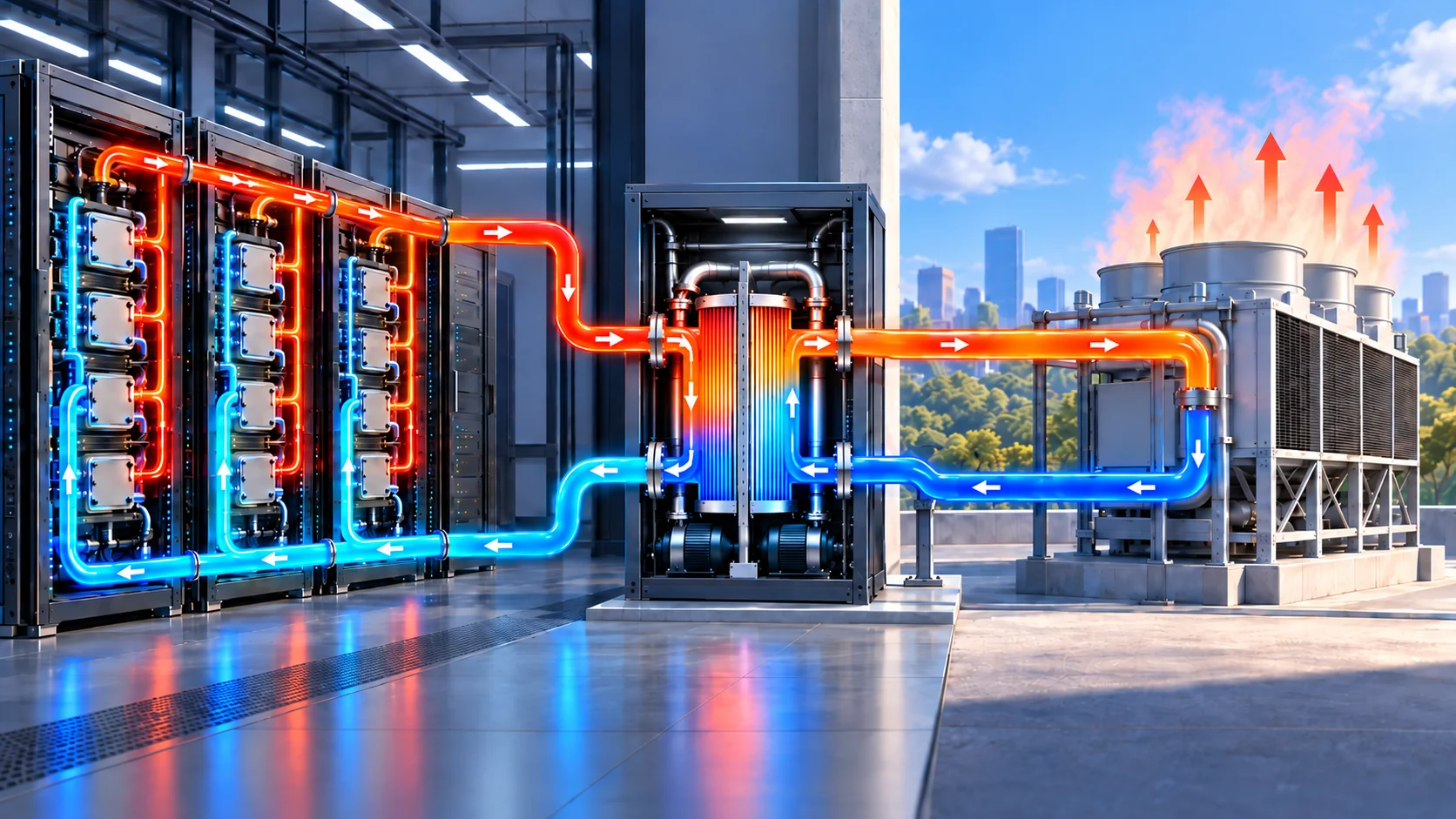
The HAWK supercomputer at the University of Stuttgart's High-Performance Computing Center uses liquid cooling.
Researchers analyzed 21 months of operating data and built a model that calculates the power consumed by servers and cooling equipment together.
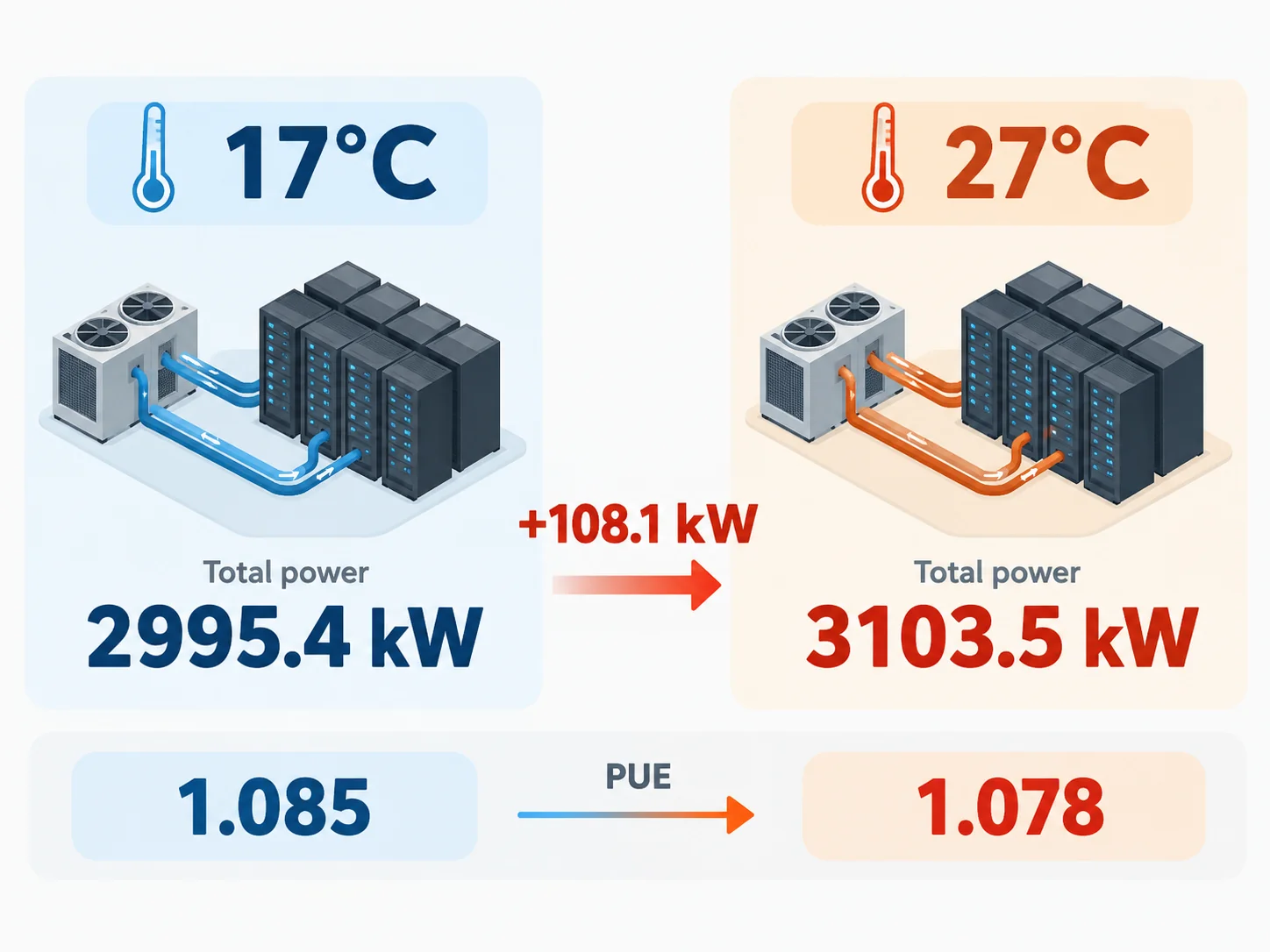
They compared two cases with the same outdoor conditions: a facility water supply temperature of 17°C and one of 27°C. The result was unexpected.
At 27°C, total power consumption was about 3.5% higher.
Yet power usage effectiveness (PUE), the metric widely used to judge data-center efficiency, was lower. 1
The efficiency number improved while the facility used more electricity.
How could that happen?
PUE Measures Something Different
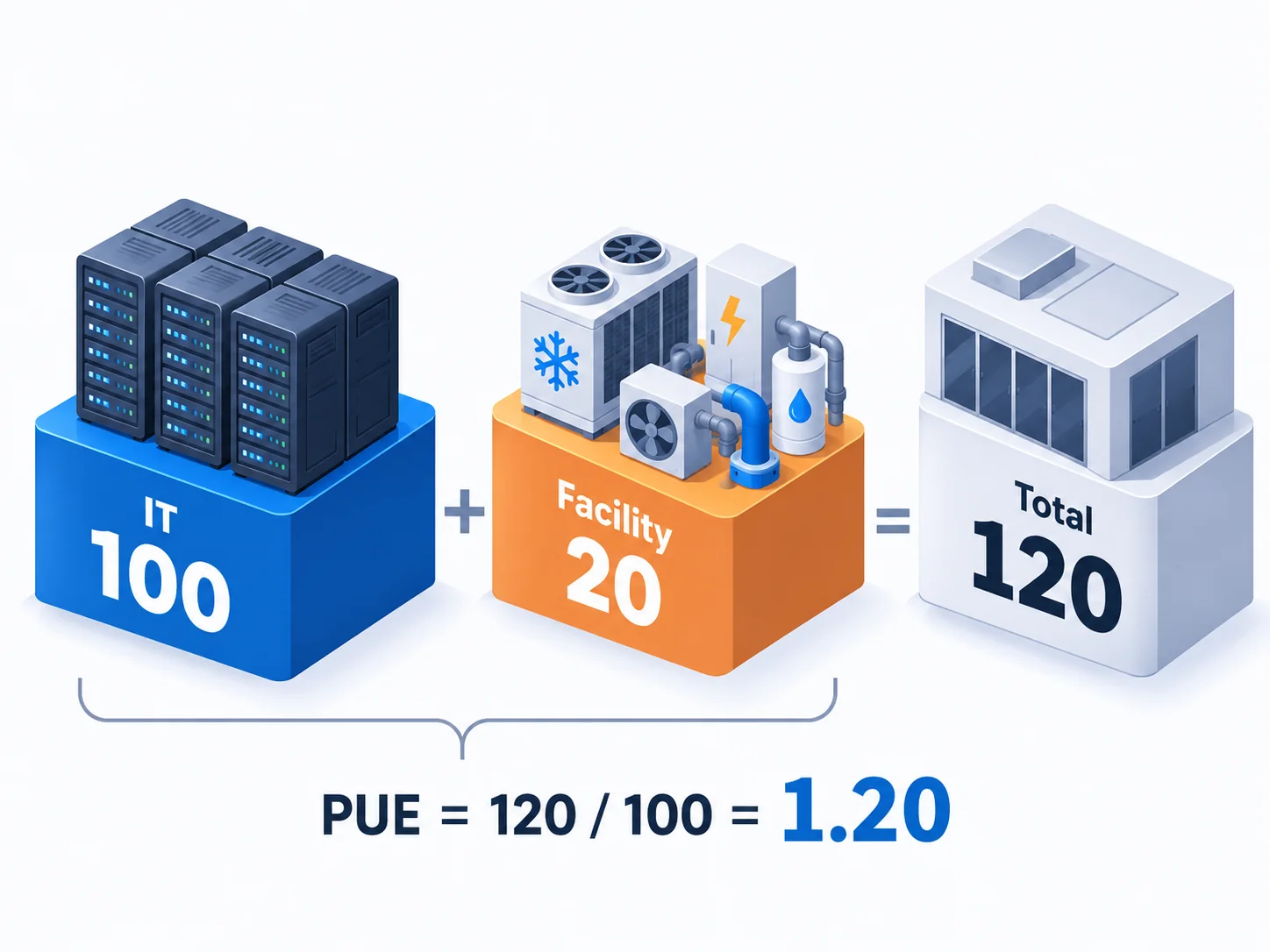
PUE is total data-center power consumption divided by the power consumed by IT equipment such as servers.
If IT equipment consumes 100 units and the total including cooling and electrical infrastructure is 120, PUE is 1.2. The closer it is to 1, the smaller the overhead outside the IT equipment.
In HAWK's measured operating data, raising the coolant temperature reduced liquid-cooling system power by more than 60% under one set of conditions. Meanwhile, IT equipment power rose by about 3%. 1
Warmer coolant can mean warmer chips, which can increase the power the servers consume.
So the cooling system can use less electricity while the servers use more.
PUE treats these two changes differently. Falling cooling power and rising IT power tend to reduce the ratio. But if the increase in server power outweighs the decrease in cooling power, total power consumption can rise.
That is what happened in one scenario simulated by the model validated against HAWK's operating data.
There Was No Single Best Water Temperature
That does not mean the coldest possible coolant is always the right choice.
In the HAWK model, colder water minimized total power when outdoor temperatures were low. At higher outdoor temperatures, warmer water performed better. 1
The optimal supply temperature changed with the outdoor environment and the servers' operating conditions.
This is why liquid cooling cannot easily be optimized as an isolated piece of equipment. Changing one water-temperature setting affects the power consumed by both the servers and the cooling infrastructure.
LG Is Connecting the Chip to the Chiller
LG Electronics' recent “Chip-to-Chiller” strategy illustrates the same shift in system boundaries.
It proposes managing cooling as a connected system, from the cold plate that removes heat from a chip, through the coolant distribution unit (CDU), to the large chillers serving the facility.
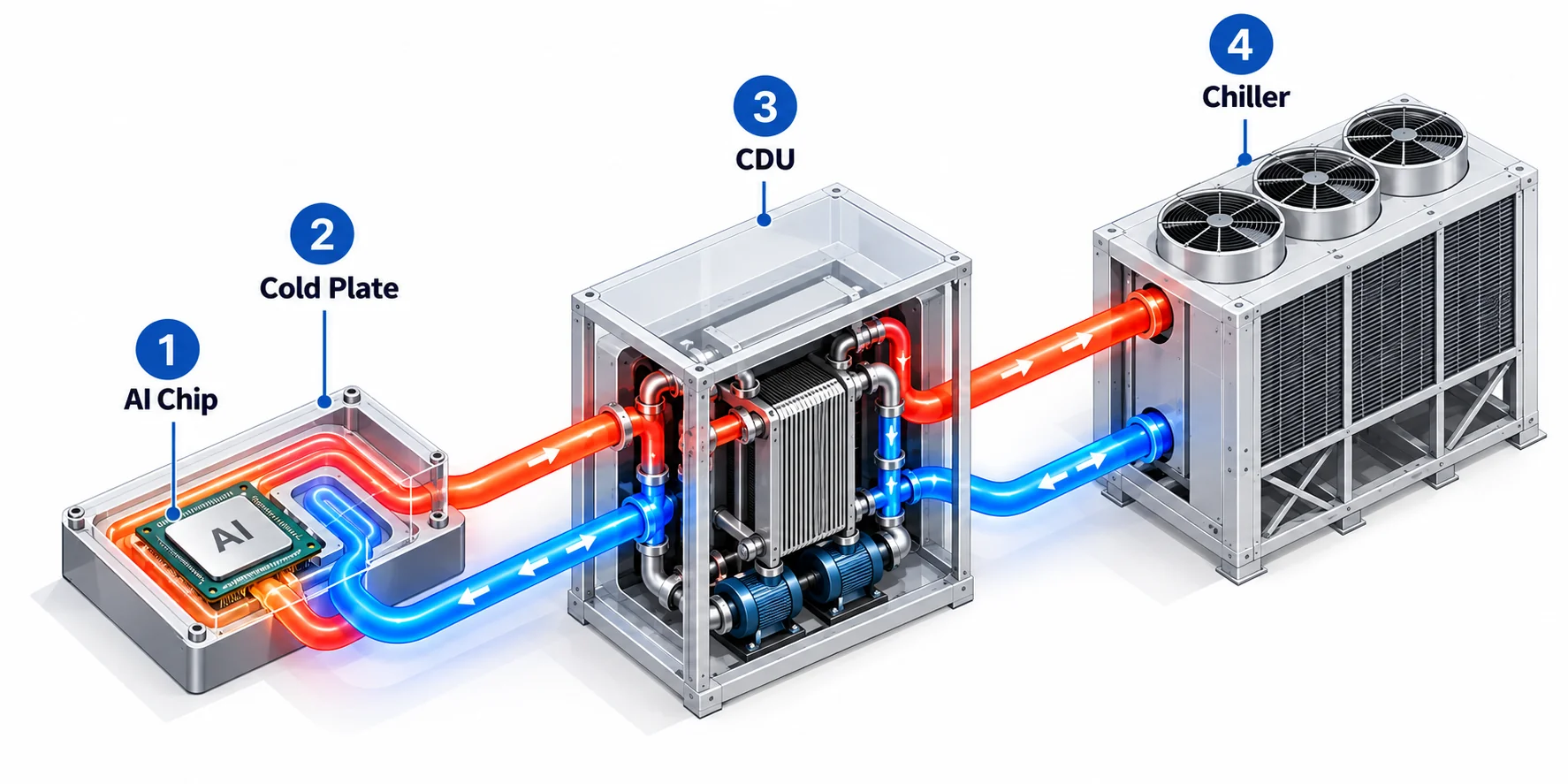
In September, LG also presented software intended to coordinate those components. According to the company, it predicts cooling loads and adjusts CDU and chiller operation together. 2
The manufacturing expansion is moving quickly, too. On October 1, LG announced plans for a new US production facility for AI data-center chillers, along with greater production capacity in Pyeongtaek and Changwon, South Korea. 2
A company known for producing chillers is now extending its involvement toward the cooling hardware closest to the chip.
That is how far the boundaries of data-center cooling have expanded.
Yet PUE Is Becoming More Important
Despite these changes, PUE remains a leading metric for assessing data centers.
In January, ISO and IEC published the second edition of the international PUE standard. 3
In September, the European Commission adopted a delegated regulation establishing a common rating scheme for data centers, with PUE among its principal indicators. As of October 12, the regulation remained under scrutiny by the European Parliament. 4
PUE has not become useless.
It still helps show how much additional electricity cooling and electrical infrastructure need to support IT equipment.
But it should not be read as a direct measure of the total energy efficiency of a data center.
The International Energy Agency's 4E energy-efficiency collaboration also noted this year that the actual energy savings from liquid cooling may not be fully reflected in PUE. 5
HAWK demonstrated the reverse mismatch as well: PUE improved even while total electricity consumption rose.
Efficiency of What?
There is more than one kind of data-center efficiency.
How little power cooling and electrical infrastructure use, how little power the entire facility uses, and how much computing work is done per unit of electricity are different questions.
As AI servers generate more heat and liquid cooling reaches closer to the chip, the differences matter more.
Before calling a number an efficiency measure, one question comes first:
Efficiency of what?
A lower PUE and lower electricity consumption are not the same thing.
Notes
1. Mashhur Gheni, Henner Kerskes, Konstantinos Stergiaropoulos, “Operational analysis of the cooling system in a direct liquid-cooled data center: a measurement and simulation study on the impact of supply water temperature,” Applied Energy 403 (2026), 127061. DOI: 10.1016/j.apenergy.2025.127061. In 21 months of operating data, the comparison of 17°C and approximately 25°C found a maximum 63.3% reduction in liquid-cooling power and an approximately 3.15% increase in IT power. The 17/22/27°C comparison and the divergence between PUE and total power are model-simulation results, not a direct three-condition field measurement. At an outdoor wet-bulb temperature of 5°C, modeled total power was 2,995.4 kW (17°C) and 3,103.5 kW (27°C). Original paper
2. LG Electronics, “LG Electronics Showcases ‘Chip-To-Chiller’ Cooling Solutions at Data Center World Asia 2026,” September 29, 2026; “LG Electronics Expands Chiller Production for AI Data Centers to Three Factories,” October 1, 2026. The cooling system and software claims are LG's product and business descriptions, not independently measured results from the HAWK study. Chip-to-Chiller · Production expansion
3. ISO/IEC 30134-2:2026, Information technology — Data centres key performance indicators — Part 2: Power usage effectiveness (PUE), Edition 2, January 2026. IEC standard
4. European Commission, Commission Delegated Regulation establishing a common Union rating scheme for data centres, C(2026)03472, September 21, 2026. European Parliament procedure 2026/2895(DEA) was awaiting a committee decision as of October 12, 2026; the scrutiny period was extended by two months on October 6. Official parliamentary procedure
5. IEA 4E EDNA, Liquid Cooling in Data Centres, June 22, 2026. It notes that PUE can understate the actual energy-efficiency benefits of liquid cooling. Official report