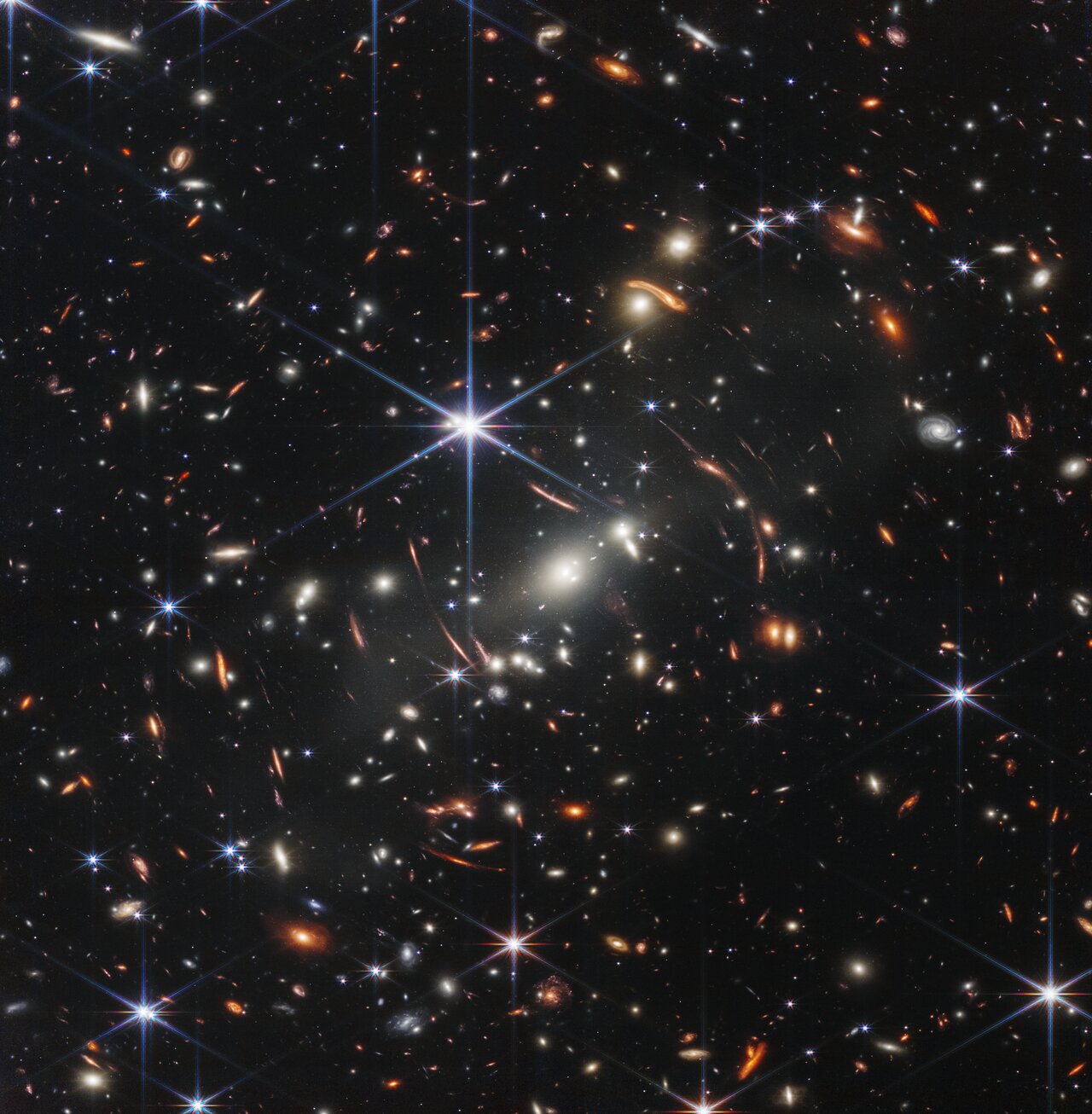
Dark matter emits no light, but gravity allows it to gather into structures. Astronomers call a gravitationally bound structure of dark matter a halo.1
A large dark-matter halo is thought to surround galaxies such as the Milky Way. Much smaller halos may exist around and within it. Some may be so small that they contain no stars and emit no light of their own.
This raises a question.
How small a clump can dark matter form?
Can halos continue forming down to extremely small masses? Or is there a mass scale below which dark matter can no longer readily gather?
The answer is connected to the properties of dark-matter particles.
If those particles moved quickly in the early universe, they would repeatedly escape regions where matter was beginning to accumulate. Small density differences could spread out before gravity had time to amplify them, preventing them from growing into halos.
Physicists call this dispersal of small-scale structure by particle motion free streaming.2
The stronger the free streaming, the harder it is for small halos to form. Conversely, if many halos survive down to very low masses, dark matter cannot have moved quickly enough to erase those structures.
The smallest halos therefore carry a record of how dark matter moved in the early universe.
To pursue this question, an international team led by principal investigator Anna M. Nierenberg of the University of California, Merced, observed quadruply imaged quasars with the James Webb Space Telescope (JWST) under observing program GO-2046.3
Two results from the same survey appeared in August 2026. A study led by Nierenberg, published on August 11, examined how far the halo mass distribution must extend toward low masses. One week later, on August 18, a study led by Daniel Gilman of the University of Chicago used the same sample of 28 gravitational lenses to tighten limits on dark-matter free streaming. These are different analyses of the same observing program, not independent confirmations using separate observations.3
How can an invisible halo be found?
The difficulty is that a small halo without stars cannot be observed directly through its own light.
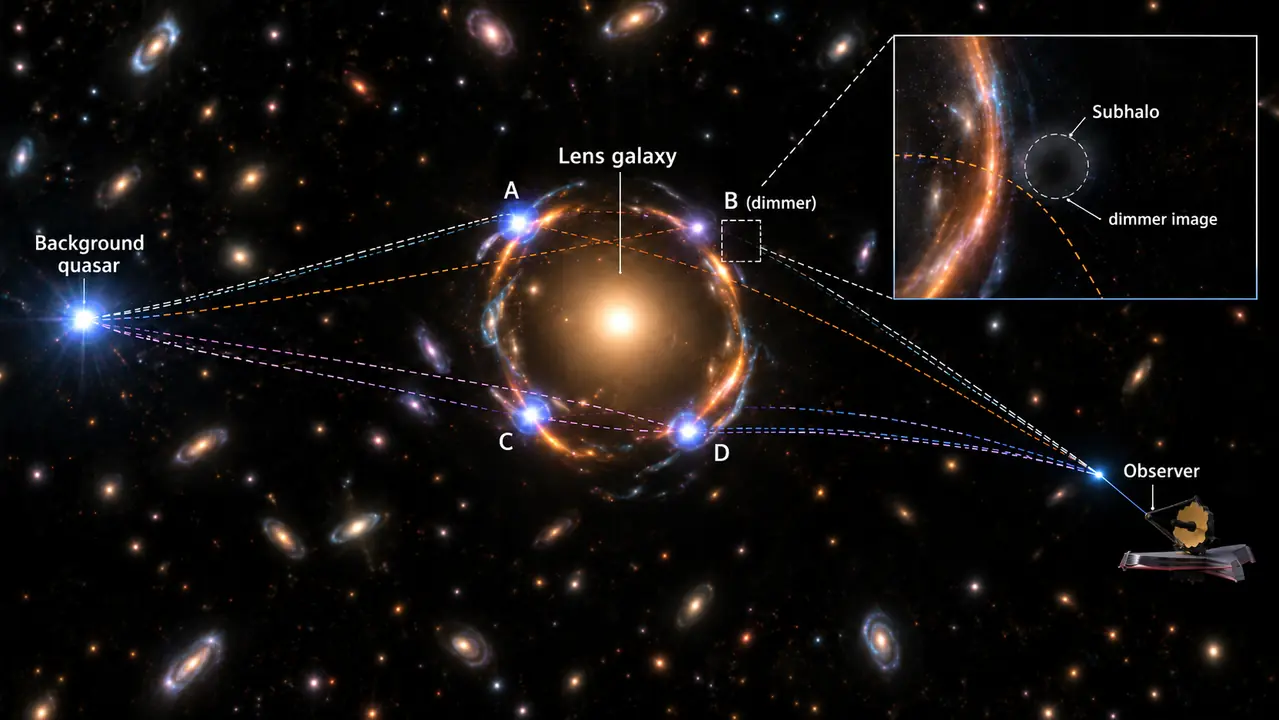
Instead of looking for the halo itself, the researchers studied how its gravity changes light from other objects.
Imagine a bright object far away and a massive galaxy between it and Earth. The foreground galaxy bends the background light, which can then reach Earth along different paths. A single object may appear as two or four distinct images.
This is strong gravitational lensing.4
In this study, the background objects were quasars: exceptionally bright sources powered by matter falling toward supermassive black holes at the centers of distant galaxies. Each of the final 28 systems was a quadruply imaged lens, in which one quasar appears in four images.
The brightnesses of the four images are not arbitrary. They depend on how mass is distributed within the foreground galaxy and therefore on how strongly each light path is bent.
If a small dark-matter halo lies near one of those light paths, however, its local gravitational field can change the result slightly. One or more images may then appear somewhat brighter or dimmer than expected.
An invisible halo can leave a trace in the light passing nearby.
Of course, an unexpected brightness ratio is not automatically evidence for dark matter. Stars in the foreground galaxy can also bend light, and an inaccurate model of that galaxy's overall mass distribution can produce a similar discrepancy.
The team worked to reduce these ambiguities. For most systems, it used mid-infrared flux ratios from warm dust around the quasars, which are less affected by individual foreground stars. For 24 of the 28 lenses, it also analyzed extended gravitationally lensed arcs from the quasars' host galaxies, helping constrain the foreground galaxies' large-scale mass distributions.5
The sample was also selected for suitability. JWST's Mid-Infrared Instrument (MIRI) survey initially observed 31 quadruply imaged quasars. After retaining 26 systems suitable for the dark-matter analysis, the researchers added two quadruply imaged lenses whose flux ratios had already been measured using observations from the W. M. Keck Observatory on Maunakea, Hawaii, and the Hubble Space Telescope, making a final sample of 28.6
The team then calculated a range of possible numbers of small halos at different masses and compared the resulting lens predictions with the 28 observed systems.
This was not a search that identified individual halos in photographs. It was a statistical comparison between universes with many small halos and universes with fewer of them.
How far down in mass must halos exist?
The first study, led by Nierenberg and published in Physical Review Letters on August 11, deliberately simplified the question.
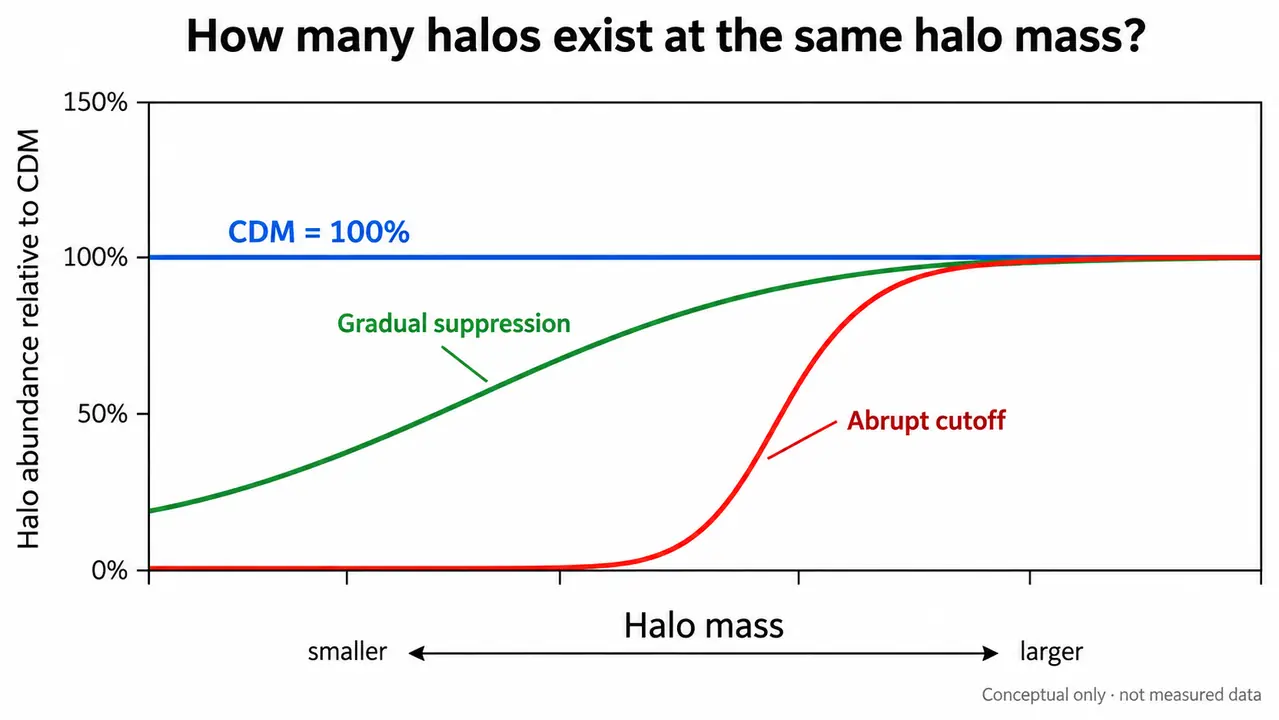
Suppose the distribution of newly formed halo masses is abruptly cut off below some mass.
How high could that cutoff be?
The analysis found that it would have to lie below roughly 160 million to 200 million solar masses. Depending on the model used for the expected number of small halos, the upper bound was either 10^8.2 or 10^8.3 solar masses.7
The meaning of those numbers matters.
The researchers did not discover a particular dark-matter halo weighing 160 million solar masses.
Instead, a model in which the halo distribution has already ended above that mass is difficult to reconcile with the 28 observed gravitational lenses.
What the team constrained, then, was not the mass of a single smallest halo, but how far the population of halos must continue toward lower masses.
The second study, led by Gilman and published on August 18, considered a more physically motivated case.
In reality, free streaming is expected to suppress progressively smaller halos rather than producing a sudden cutoff at a single mass.
How much suppression could the 28 lenses allow?
The analysis showed that models erasing too much small-scale structure are difficult to reconcile with the observations. The researchers also translated this finding into an upper bound on a length scale associated with the erasure of structures by dark-matter free streaming.8
The results were compatible with the prediction of cold dark matter (CDM), which preserves many small structures.
Here, cold does not mean a low everyday temperature. It means dark matter was moving slowly enough during structure formation for small density fluctuations to survive.
By contrast, warm dark matter (WDM) describes models in which greater particle motion in the early universe disperses more of those small fluctuations.
Now the question changes to the mass of a single particle
So far, 160 million to 200 million solar masses has described a possible boundary in the distribution of halo masses.
Now the object of the question changes.
How light could an individual particle making up a dark-matter halo be?
A halo's mass scale and the mass of one particle are entirely different quantities.
If we adopt a specific account of how dark matter was produced in the early universe, we can connect the extent of free streaming to a particle's mass.
In a particular class of WDM models, lighter particles keep moving faster for longer in the early universe. They erase more of the small density fluctuations, leaving fewer small halos.
Heavier particles have a weaker free-streaming effect, so more small structures can survive.
When the researchers applied the lensing constraints to a specific thermal dark-matter particle model, they obtained particle-mass lower bounds of 6.5 or 7.4 kiloelectronvolts (keV), depending on the modeling assumptions.9
These are not masses measured by directly detecting dark-matter particles.
JWST did not discover a 7 keV dark-matter particle.
There are several inferential steps between the observations and those numbers:
Gravitational-lens observations → population of small halos → free-streaming constraints → specified particle model → lower bound on particle mass.
What the telescope measured directly was information carried by light: image positions, relative brightnesses, and extended lensed arcs. Halo populations, free streaming, and particle mass were inferred through successive modeling steps.
If dark matter originated through a different process, the same lens observations could imply a different particle-mass constraint.
Does this mean cold dark matter is correct?
Not yet.
The results are compatible with the small-scale structures predicted by CDM, while narrowing the range of some WDM models that strongly suppress those structures.
But the two 2026 papers were not independent checks based on different observations.
Both relied on the same sample of 28 strong gravitational lenses.
One examined an extreme, abrupt low-mass cutoff in the halo distribution. The other examined the gradual suppression of small structures by free streaming.
The resulting limits also vary somewhat with the method used to calculate how many small halos should have formed in the first place.10
So these results do not settle what dark matter is.
Instead, they more tightly constrain how much of the universe's small-scale structure must have survived.
A larger sample will change the question
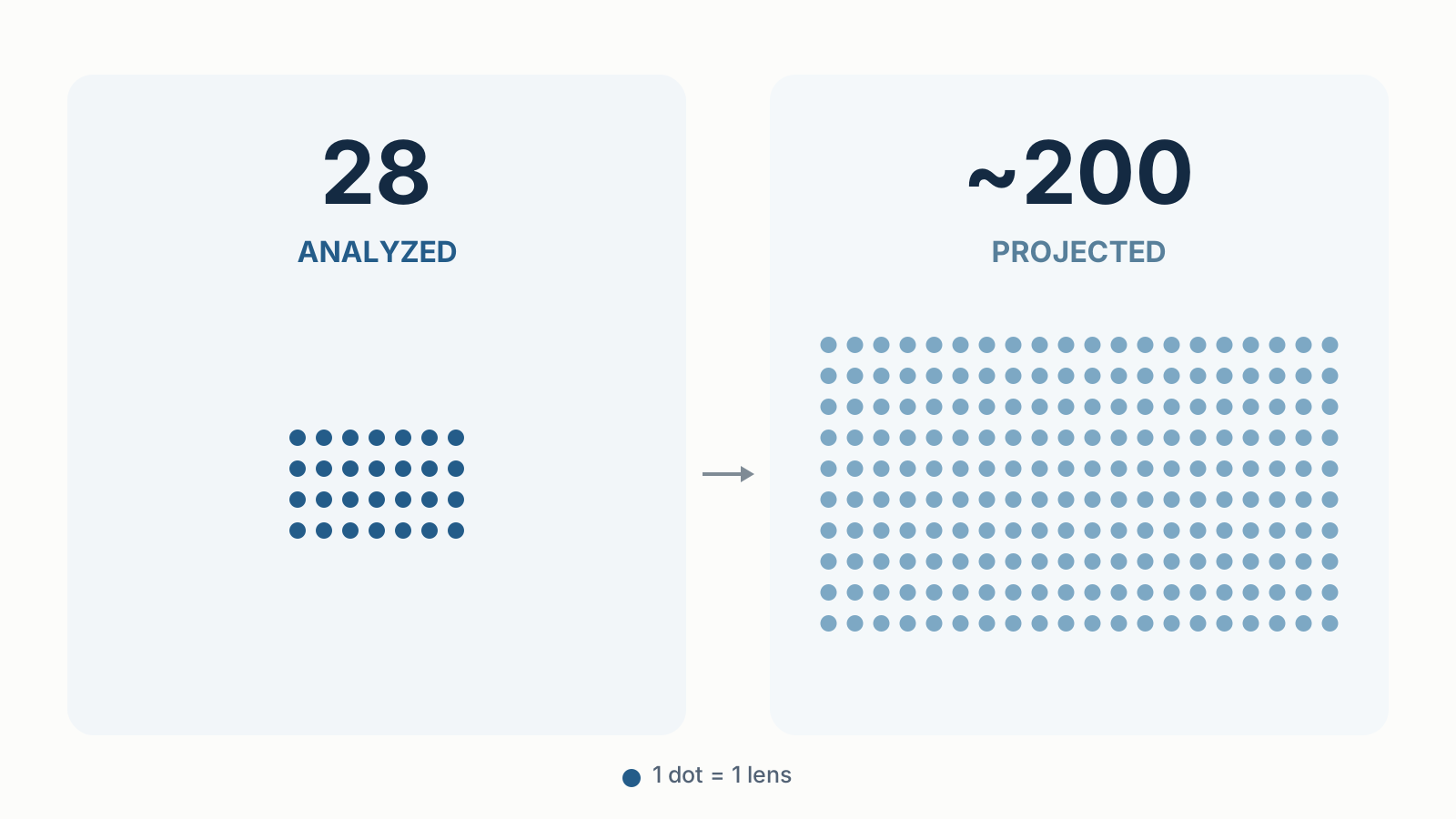
The current analysis contains 28 gravitational lenses.
The researchers project that increasing the sample to approximately 200 comparable quadruply imaged quasars could improve limits on the low-mass cutoff of the halo distribution by more than a factor of ten.11
For now, the work rules out dark-matter models that disperse too much small-scale structure.
With a large enough sample, the question could change.
At what scale, if any, does the actual universe begin to produce fewer small halos than CDM predicts?
That difference has not been clearly detected with the present 28 lenses.
If a boundary is established in the future, the smallest halos could help distinguish how dark-matter particles moved in the early universe.
This study did not discover that boundary. It narrowed where the boundary could still be.
Notes
1. A halo is not a solid "ball of dark matter." The word clump is useful, but halos have no surface like rocks or planets. They are extended distributions of gravitationally bound dark-matter particles. A large galactic halo may contain smaller halos, called subhalos. Even a small halo without stars or gas has gravity and can therefore be investigated through gravitational lensing. Source: Nierenberg, A. M. et al. “Measurement of the Minimum Cold Dark Matter Halo Mass with Strong Gravitational Lensing.” Physical Review Letters 137, 071001 (2026). DOI: 10.1103/jnjt-1ghp..
2. Why does free streaming erase small structures first? Rapidly moving particles in the early universe could escape regions where dark matter was beginning to accumulate. Larger density fluctuations could continue growing under gravity, while smaller ones were disrupted before they grew. Stronger free streaming therefore means fewer low-mass halos. Its scale depends not only on particle mass but also on how dark matter originated in the early universe. Source: Gilman, D. et al. “Free-Streaming Length of Dark Matter from JWST Observations of 28 Strong Gravitational Lenses.” Physical Review Letters 137, 081004 (2026). DOI: 10.1103/qckh-cqrd..
3. Who initiated the observations, and how are the two 2026 studies related? The work uses JWST Cycle 1 General Observer program GO-2046, "A definitive test of the dark matter paradigm on small scales," led by principal investigator Anna M. Nierenberg at UC Merced. Survey I (2024) described observing 31 quadruply imaged quasars with MIRI; Survey II (2024) constrained free streaming using an initial nine systems. Nierenberg was first author of the August 11, 2026 PRL paper; Daniel Gilman of the University of Chicago led the August 18 PRL paper. The author lists overlap substantially, and both use the same final set of 28 systems. They are different physical analyses of the same survey, not independent observational replications. The final flux-ratio measurements appear in Survey III, led by R. E. Keeley; the extended-arc analysis appears in Survey IV, led by Gilman. Sources: Nierenberg, A. M. et al. “JWST lensed quasar dark matter survey – I. Description and first results.” Monthly Notices of the Royal Astronomical Society 530, 2960–2971 (2024). DOI: 10.1093/mnras/stae499.; Nierenberg et al., PRL 137, 071001 (2026); Gilman et al., PRL 137, 081004 (2026); Keeley, R. E. et al. “JWST lensed quasar dark matter survey. III. Dark matter sensitive flux ratios and warm dark matter constraint from the full sample.” Physical Review D 114, 043043 (2026). DOI: 10.1103/53tj-sjlg.; Gilman, D. et al. “JWST lensed quasar dark matter survey. IV. Stringent warm dark matter constraints from the joint reconstruction of extended lensed arcs and quasar flux ratios.” Physical Review D 114, 043044 (2026). DOI: 10.1103/k2m5-kf6p..
Keeley, R. E. et al. “JWST lensed quasar dark matter survey – II. Strongest gravitational lensing limit on the dark matter free streaming length to date.” Monthly Notices of the Royal Astronomical Society 535, 1652–1671 (2024). DOI: 10.1093/mnras/stae2458.
4. Why does one quasar appear four times? There are not four separate quasars. Gravity from the foreground galaxy bends light from one source along multiple paths so that images of that single quasar appear in four positions. This is a quadruply imaged lens. The light paths travel through different gravitational fields, making them sensitive to local changes caused by small halos. Source: Gilman et al., PRL 137, 081004 (2026).
5. Why combine mid-infrared measurements with lensed arcs? Optical light from very near the quasar center comes from a compact region and can be easily affected by microlensing from individual foreground stars. Mid-infrared emission from warm dust around the quasar comes from a more extended region, roughly 1–10 parsecs across, reducing the influence of individual stars while remaining sensitive to small dark-matter halos. Extended arcs also help constrain the foreground galaxy's large-scale mass distribution and separate errors in that model from the effects of small halos. Arc information was modeled for 24 of the final 28 systems. Sources: Nierenberg et al., MNRAS 530 (2024); Gilman et al., PRD 114, 043044 (2026).
6. Why observe 31 objects but analyze 28? The JWST program originally observed 31 quadruply imaged quasars using MIRI. Five were excluded because of factors such as unsuitable foreground-galaxy structure, an unexpected number of images, or images overlapping too much for separate brightness measurements. This left 26 JWST systems. Two additional quadruply imaged systems with previously measured narrow-line emission flux ratios from Keck and Hubble observations brought the final sample to 28. Sources: Keeley et al., PRD 114, 043043 (2026); Gilman et al., PRD 114, 043044 (2026).
7. What does 160 million–200 million solar masses mean? The first paper tested a simplified model in which the CDM-predicted halo mass function and mass–concentration relation remain valid until an abrupt cutoff below a mass m_low. At 10-to-1 odds, the upper limit on m_low is 10^8.2 or 10^8.3 solar masses, depending on the adopted small-halo abundance model. This is not the absolute minimum mass of an individual halo. Subhalos in larger halos can lose mass through tidal interactions and end up below that current mass. Source: Nierenberg et al., PRL 137, 071001 (2026).
8. What is the 6–7 kiloparsec scale? The second paper used lensing data and structure-formation models to constrain how strongly small-scale structure could be suppressed, then expressed that bound as a free-streaming length. The upper bound was approximately 6.0 or 7.0 kiloparsecs, depending on the adopted small-halo abundance model. One kiloparsec is about 3,260 light-years, giving a numerical conversion of about 20,000–23,000 light-years. This does not mean one dark-matter particle traveled that distance in a straight line. It is a characteristic scale for the disruption of early-universe density fluctuations by particle motion. Source: Gilman et al., PRL 137, 081004 (2026).
9. The 6.5–7.4 keV bound concerns the mass of a particle. The 160 million–200 million solar-mass range refers to the distribution of halo masses. By contrast, 6.5 and 7.4 keV are lower limits on the mass of a hypothetical individual dark-matter particle. They follow from applying the free-streaming constraint to a particular spin-1/2 thermal-relic model, in which the particles are assumed to have been produced thermally in the early universe. Although keV is a unit of energy, particle physics often expresses mass in energy units. The final published limits were 6.5 and 7.4 keV. They are not direct measurements of dark matter generally. Sources: Gilman et al., PRL 137, 081004 (2026); Gilman et al., PRD 114, 043044 (2026).
10. Why do the values differ between analyses using the same data? There is more than one way to estimate the original abundance of small halos. The researchers used priors from the semianalytical galacticus approach and from N-body simulations. As a result, the first paper gives cutoff upper limits of 10^8.3 and 10^8.2 solar masses, while the second gives thermal-relic particle-mass lower limits of 6.5 and 7.4 keV. The differences demonstrate remaining model dependence, not errors in measuring the same quantity. Sources: Nierenberg et al., PRL 137, 071001 (2026); Gilman et al., PRL 137, 081004 (2026).
11. Why would 200 systems matter? With only 28 lenses, it is difficult to separate the total abundance of small halos from the extent of low-mass suppression. The first paper projected that a sample of about 200 comparable quadruply imaged lenses could improve the cutoff constraint by more than an order of magnitude—a factor exceeding ten—and constrain the overall halo abundance more directly from the data. This is a projection, not an achieved measurement. Source: Nierenberg et al., PRL 137, 071001 (2026).