PTA.
Not Paul Thomas Anderson.
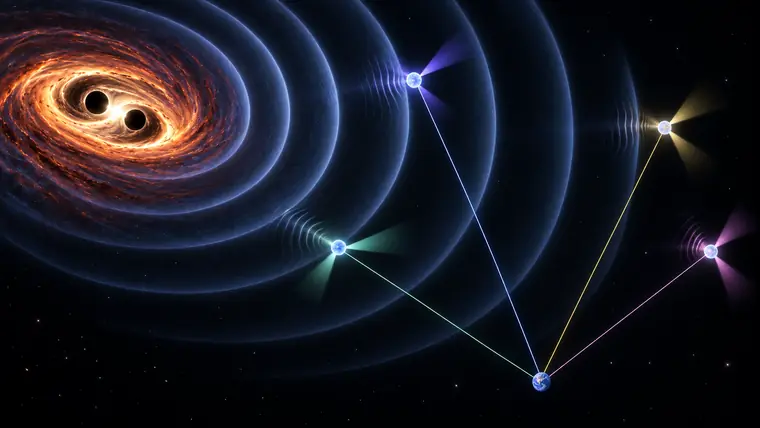
In astronomy, PTA stands for Pulsar Timing Array. It is an observing method that uses multiple pulsars as precision cosmic clocks to search for extremely slow gravitational waves.
A 2026 study proposed using this method to search for an unusual class of objects.
Pairs of supermassive black holes that have already merged and disappeared as binaries.
The paper called them “zombie binaries.”1
The name does not mean that two black holes come back to life. The two black holes have already merged into one. If we observe that direction now, we do not see the two black holes orbiting each other as they once did.
What remains is a trace of the pre-merger state imprinted in signals associated with the pulsars.
The key point is that this past trace can still be read from Earth today.
Using pulsars as cosmic clocks
A pulsar is an ultradense object left behind after a massive star dies.
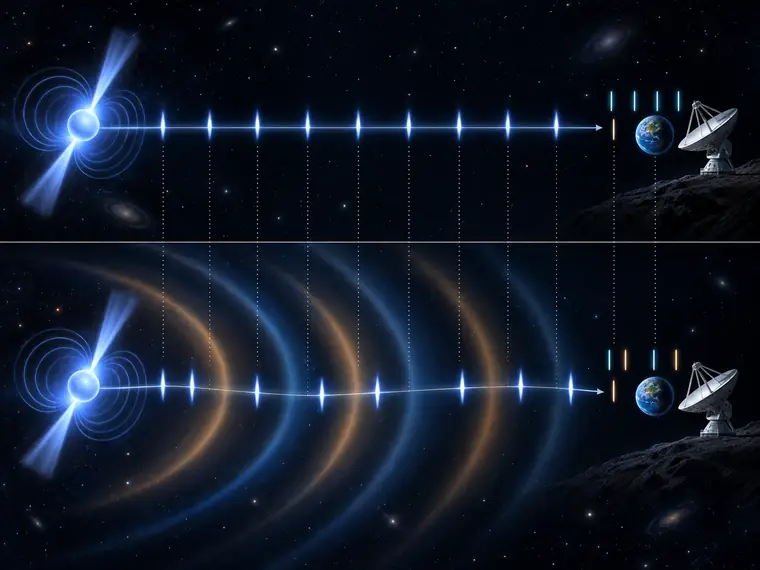
Some pulsars rotate very rapidly and emit radio signals at highly regular intervals. Millisecond pulsars with particularly stable rotation are useful as cosmic clocks because the expected arrival times of their pulses can be predicted with extraordinary precision.
Astronomers monitor such pulsars for years or decades.
Tiny differences arise between the predicted and measured pulse arrival times. After accounting for effects such as changes in the pulsar’s rotation, material along the radio-wave path, and observational errors, researchers can search for minute timing shifts produced when gravitational waves perturb spacetime.
A PTA searches for gravitational waves by comparing the signals from many pulsars together. A real PTA is not a single instrument but an observing network that combines long-term timing data from many millisecond pulsars.2
Ground-based gravitational-wave detectors measure changes in space inside human-built instruments. PTAs instead use the paths between Earth and pulsars already distributed across the Milky Way.
For that reason, a PTA is often described as a galaxy-sized gravitational-wave detector.
But PTAs have another property that is just as important as their spatial scale.
A single network can contain information about different epochs of the same gravitational-wave source.
Different eras of the same black hole binary
Suppose a pair of supermassive black holes is emitting gravitational waves.
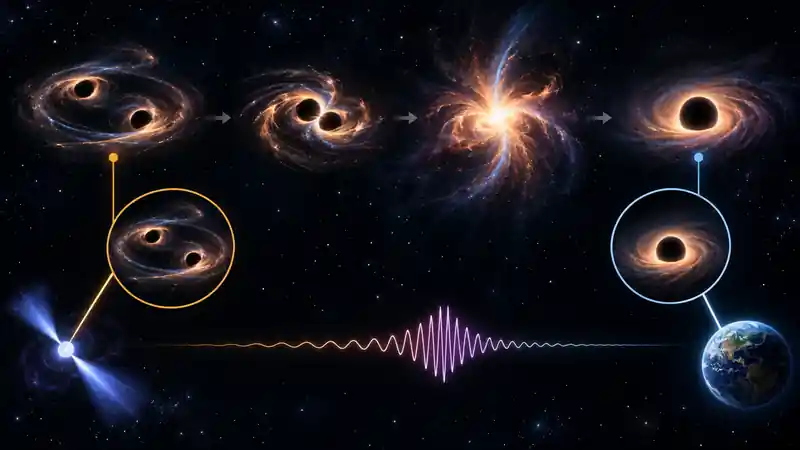
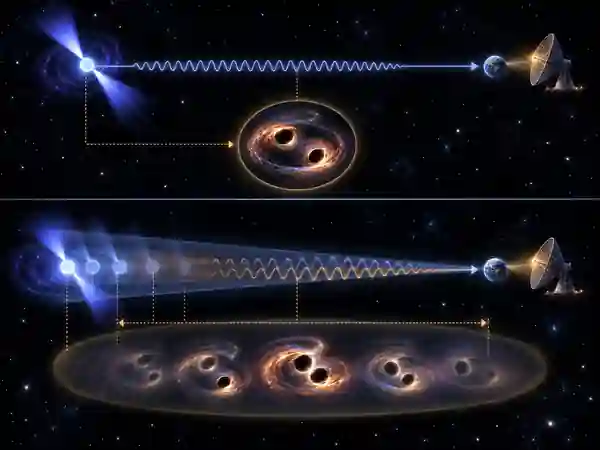
When those waves pass near Earth, they leave a signature in the pulse arrival times. Researchers call this the Earth term.
But the pulses we receive now did not just leave the pulsar.
If a pulsar is thousands of light-years away, its radio waves have also spent thousands of years traveling through space.
The state of spacetime at the pulsar’s location when that radio pulse was emitted also leaves a signature in the measured arrival time. This is the pulsar term.
The Earth term and the pulsar term can therefore contain gravitational-wave information from the same black hole binary while corresponding to different stages in its history.
The exact time separation depends not only on the pulsar’s distance but also on the relative directions of the pulsar and the gravitational-wave source on the sky. For Galactic pulsars used in PTAs, this separation can reach thousands of years.3
The Earth term contains the comparatively recent state of the binary, while a pulsar term can contain a state from thousands of years earlier, when the same two black holes were farther apart and orbiting more slowly.
Using multiple pulsars can let researchers compare different epochs of the same binary sampled at different locations.
In astronomy, distance is always connected to time. Light and gravitational waves do not travel infinitely fast, so looking farther away also means seeing farther into the past. We see the Sun as it was about eight minutes ago, and a galaxy millions of light-years away as it was millions of years ago.
In a PTA, that relationship becomes more than a limitation of observation. Pulsars at different distances and directions can record different epochs of the same gravitational-wave source. Pulsar distance and sky geometry therefore become part of an observational timeline extending across hundreds or thousands of years.
Looking into the past because an object is far away is ordinary in astronomy. The unusual feature of a PTA is that multiple pulsars can let us compare different epochs of the same source within one observing network.
This property itself is not a new discovery.
In 2012, Chiara Mingarelli and colleagues showed that detecting both the Earth term and pulsar term could allow different evolutionary stages of a supermassive black hole binary to be compared. Their work showed that the two terms together could provide additional information about the binary’s physical properties and evolution.4
The problem is that pulsar terms are difficult to analyze.
The distance to each pulsar must be known accurately enough, and each pulsar samples a different epoch. Those differences are useful information, but they also make signal reconstruction and computation harder.
The 2026 study used this long-known property in a different way.
It proposed looking for cases in which the old orbital signal is gone from the Earth term, while a pre-merger signal remains in the pulsar term.
Already merged here, still a binary in the past
When two supermassive black holes orbit each other, they lose energy through gravitational-wave emission.
Their separation shrinks and their orbital motion speeds up. Eventually the two black holes merge into one.
If that merger was already over before PTA observations began, the old, slowly orbiting binary signal is no longer available in the Earth term in the same way.
The two black holes have already become one.
But a distant pulsar term points to an earlier epoch.
At the time represented by that signal, the two black holes may not yet have merged.
In the Earth-side record the system is already one black hole, while in the pulsar-side record it can still be a binary.
That is what the paper calls a “zombie binary.”
The novelty of the 2026 study is not the general fact that PTAs can probe the past.
It is the proposal that black hole binaries which have already merged can themselves become a distinct search target using only their surviving past signatures in pulsar terms.1
That expands the range of sources a PTA might search for.
The target population could include not only black hole binaries that are still orbiting today, but also binaries that merged before the observing campaign began.
Ninety percent is not a discovery probability
The paper did not actually discover a zombie binary.
The author used three models for how frequently supermassive black holes merge, together with simplified observing configurations representing existing and future PTAs, to calculate how often zombie-binary signals would enter a detectable-strength regime.
For a configuration modeled after the existing European PTA, the probability that at least one zombie binary would have a signal-to-noise ratio (SNR) above 3 was no more than 3%.
For an IPTA-like future configuration, the result depended strongly on the assumed black hole population model. In the two models that allow relatively more massive binaries, the probabilities were 23% and 22%.
The largest change appeared in a simulated configuration at the level of the next-generation Square Kilometre Array (SKA).
For all three black hole population models, the probability of having at least one zombie binary with SNR above 3 exceeded 90%. The mean number was calculated to be about 2.3, 6.1, and 5.7 depending on the population model.5
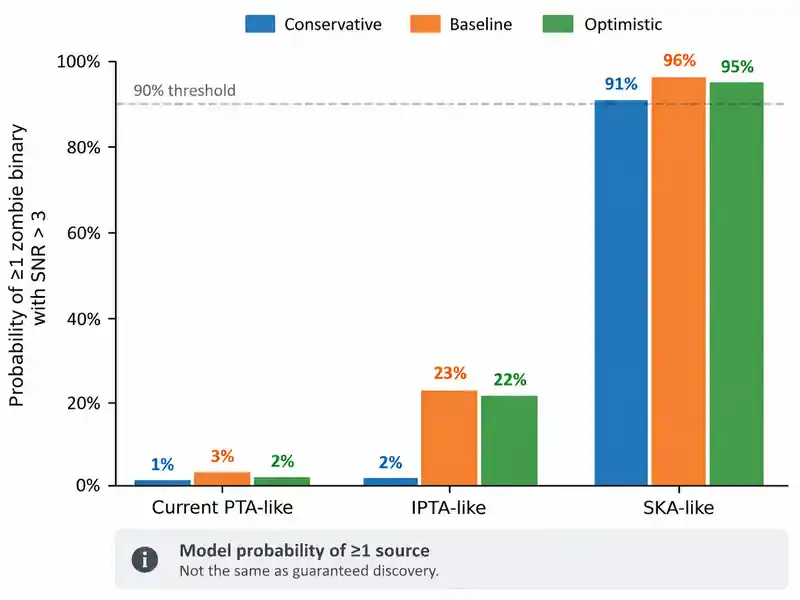
But these numbers should not be read as “the SKA has more than a 90% chance of discovering a zombie black hole.”
The threshold used in the paper is not a formal discovery criterion. It is an SNR measure of how strong the modeled signal is relative to noise. A source exceeding a threshold in a model and confidently identifying that source in real data are different problems.1
Real data contain pulsar-specific noise, other gravitational-wave signals, distance errors, and other complications.
The calculation also makes assumptions about black hole orbits.
The study focused on binaries on nearly circular orbits whose evolution is driven mainly by gravitational-wave emission.
Real supermassive black hole binaries can be more complicated. Strong eccentricity would change both their evolutionary rate and the frequency seen in the pulsar term. Stars and gas around the binary can also affect orbital evolution. The paper leaves these effects for future work.6
Current pulsar-distance uncertainties were also not fully incorporated.
The present result is therefore not a prediction that a specific number of zombie binaries will actually be discovered by future observatories.
Rather, it is a calculation showing that if the very-low-frequency gravitational-wave signal now seen by PTAs is primarily produced by a population of supermassive black hole binaries, then past signals from mergers that have already ended could enter the detectable-SNR regime in more precise future PTAs.
Pulsar distance becomes part of detector performance
For this proposal to become a practical search, another problem matters greatly.
The distances to the pulsars must be known accurately.
A pulsar’s distance is not merely a coordinate telling us where the object is.
It is one of the quantities that helps determine which epoch of the black hole binary is encoded in the pulsar-term signal.
If the distance is uncertain, then the expected epoch and frequency of the past signal are uncertain as well.
The study notes that its SNR calculation does not fully include current pulsar-distance errors, so the result could be somewhat optimistic. The author explains that more accurate pulsar distances would help reconstruct signals scattered across multiple pulsars as coming from a single source.6
For next-generation PTAs, performance therefore depends not only on how precisely pulse arrival times can be measured, but also on how accurately the distance to each pulsar is known. Precision pulsar distances are also treated as important information for gravitational-wave source studies with SKA-based PTAs.7
Even a non-detection would leave information
There is another consequence.
The 2026 study uses a relatively simple model for black hole orbits.
If a zombie binary were actually detected, the pulsar-term signals would contain information about how the two black holes moved during the thousands of years before merger. Interpreting those signals would require accounting for eccentric orbits and the influence of the surrounding environment on orbital evolution.
The 2026 paper argues that an actual zombie-binary detection could provide a new way to study the environment and dynamics of supermassive black hole binaries over the thousands of years before merger. At the same time, it notes that the expected signal in each pulsar changes depending on the orbital-evolution model used.6
A non-detection could also be informative.
How often the most massive supermassive black holes actually merge remains uncertain.
The paper proposes that zombie-binary searches could place new constraints on the high-mass end of black hole merger-rate models, although how strong those constraints would be remains a question for future work.6
In short, a PTA is somewhat like collecting photographs of the same black hole binary taken at different dates.
The Earth term is the most recent photograph, while the pulsar terms are like photographs taken hundreds or thousands of years earlier. Even if the two black holes have already merged in the newest picture, they can still appear as two separate orbiting objects in the older ones.
Searching for zombie binaries means finding those older records and fitting them back together as traces of the same black hole system.
In that way, the observational reach of a PTA can extend from black hole binaries that exist now to the past of mergers that have already ended.
Notes
1. Hippolyte Quelquejay Leclere, “Probing past mergers of supermassive black holes with pulsar timing arrays: The role of pulsar terms,” Physical Review D 114, 043063 (2026), published 24 August 2026. DOI: 10.1103/9wq2-gqkh. The paper defines supermassive black hole binaries that merged before PTA observations began as “zombie binaries” and calculates their modeled detectability under simplified current and future PTA configurations. It does not report an actual zombie-binary detection. Physical Review D · arXiv
2. International Pulsar Timing Array, “A Global, Galactic-Scale Gravitational Wave Detector.” The IPTA combines observations and data from regional PTA collaborations. Ryan M. Shannon et al., “The SKAO Pulsar Timing Array,” The Open Journal of Astrophysics 8 Supplement 1 (2025), DOI: 10.33232/001c.154243, also describes a PTA as an ensemble of millisecond pulsars monitored over long periods. IPTA · The Open Journal of Astrophysics
3. Leclere 2026, Sec. II. The geometrical delay between the Earth term and pulsar term depends on both pulsar distance and the relative directions of the pulsar and gravitational-wave source, and can reach thousands of years for Galactic PTA pulsars. It is therefore not described simply as “looking back by the pulsar’s distance.” arXiv full text
4. Chiara M. F. Mingarelli et al., “Observing the Dynamics of Supermassive Black Hole Binaries with Pulsar Timing Arrays,” Physical Review Letters 109, 081104 (2012). DOI: 10.1103/PhysRevLett.109.081104. This work showed that Earth and pulsar terms can be used together to observe different evolutionary stages of a single supermassive black hole binary. The use of a thousands-of-years time separation is therefore not a discovery unique to the 2026 study. PubMed · arXiv
5. Leclere 2026, Sec. VI, Fig. 4. In an EPTA-like modeled configuration, the probability of at least one zombie binary with SNR>3 was at most 3%. In an IPTA-like configuration, two population models gave 23% and 22%. In an SKA-like configuration all three models exceeded 90%, with mean numbers of about 2.3, 6.1, and 5.7. These are model outputs, not confirmed-discovery probabilities in real observations. arXiv full text
6. Leclere 2026, Sec. VII. The study assumes nearly circular binaries whose evolution is driven primarily by gravitational-wave emission. Large eccentricities and other orbital-evolution processes could change the expected signals. Current pulsar-distance uncertainties are not fully included in the SNR calculation, which may make the estimates optimistic, and realistic identification in PTA data is left for future work. The paper also proposes that zombie-binary searches could probe pre-merger dynamics and constrain merger-rate models at the high-mass end. arXiv full text
7. Ryan M. Shannon et al., “The SKAO Pulsar Timing Array,” The Open Journal of Astrophysics 8 Supplement 1 (2025), DOI: 10.33232/001c.154243. The paper describes how the SKA can observe many millisecond pulsars with high timing precision and explains that precision distance measurements provide important information for PTA gravitational-wave source studies. The Open Journal of Astrophysics