Life cannot begin without ingredients: organic molecules such as sugars, amino acids and nucleobases that living organisms use today. But where did those molecules first come from?
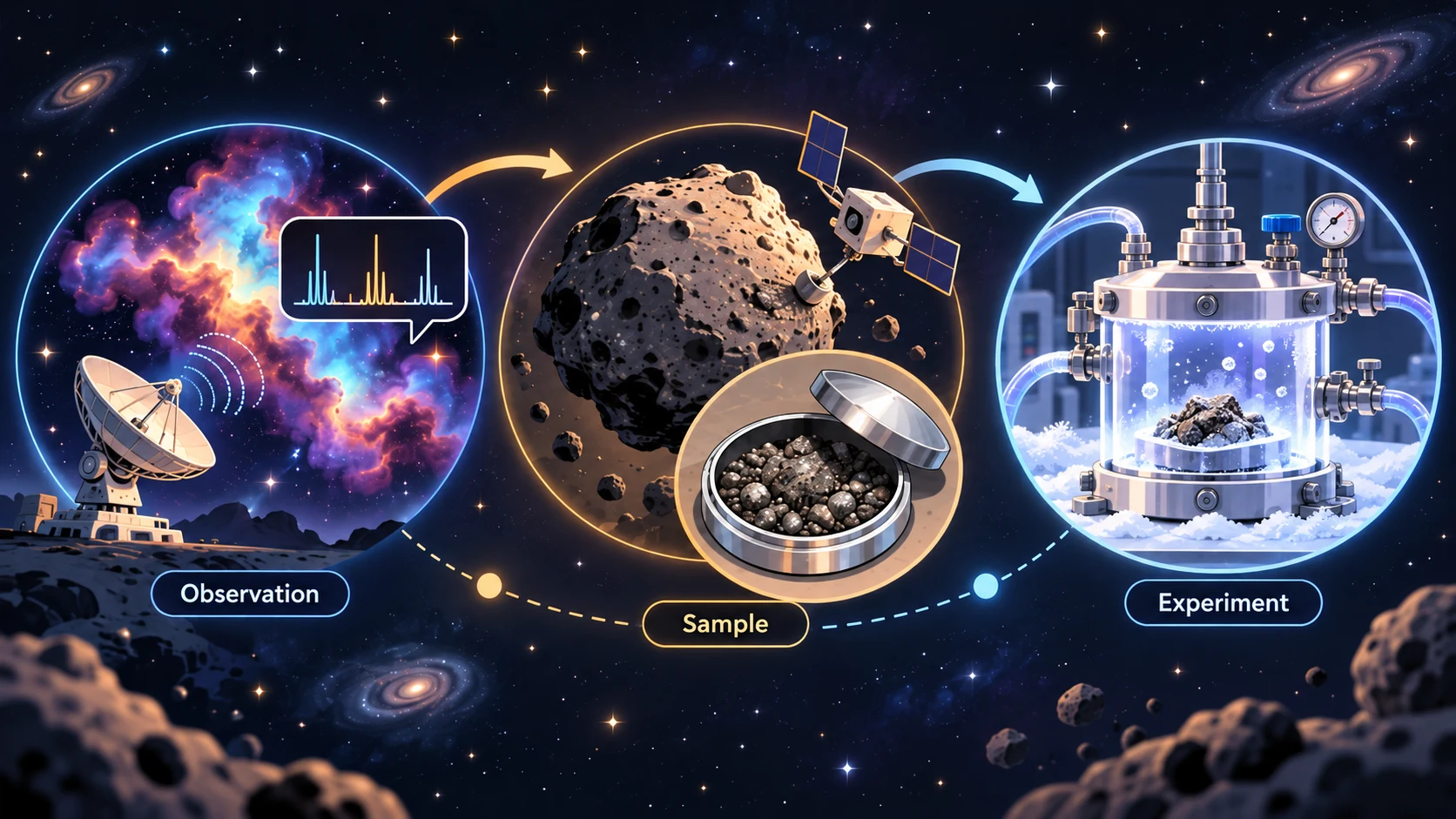
The answer may not lie solely on the young Earth. Meteorites and asteroid samples have long yielded organic molecules associated with life, while laboratory experiments have shown that irradiating extremely cold ices can produce more complex compounds. In 2026, that evidence extended to the gas and dust between stars—the interstellar medium.
A team led by Izaskun Jiménez-Serra of Spain's Center for Astrobiology identified erythrulose, a four-carbon sugar, in the molecular cloud G+0.693−0.027 near the center of the Milky Way. According to the paper, this was the first detection of a sugar in the interstellar medium.1
These are not three confirmations of the same result. The locations, molecules and methods differ. What is expanding is the evidence that chemical processes capable of producing sugars and other complex organic compounds without life are not confined to a single kind of space environment.
So is making the ingredients really the only difficult part of life's origin?
The first sugar identified between the stars
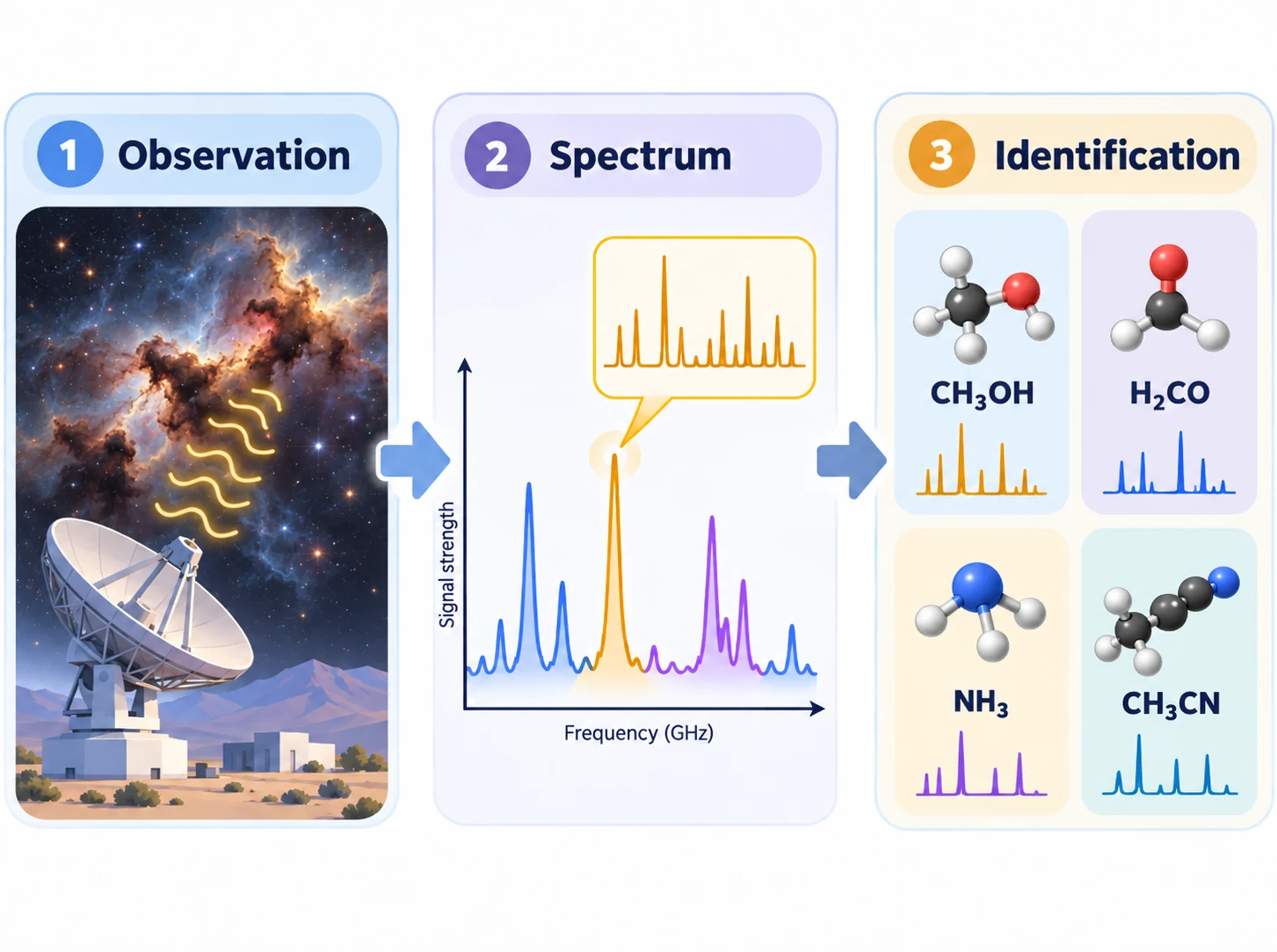
G+0.693−0.027 is a molecular cloud in the central region of our galaxy. The researchers did not collect material from it. They observed radio signals associated with molecules there using the Yebes 40-meter radio telescope in Spain and the IRAM 30-meter telescope.
Different molecules emit or absorb radio waves at characteristic frequencies. The pattern of signals across multiple frequencies acts rather like a molecular fingerprint. The researchers looked for a set of signals expected from erythrulose and checked whether they appeared together in the observations.
They identified 17 rotational transitions attributable to erythrulose. The lines that overlapped less with signals from other molecules were strong enough that they were difficult to dismiss as random noise.1
Erythrulose is not ribose, the sugar in RNA's backbone. The significance is different: sugar chemistry can leave products in interstellar environments, not only on asteroids or planets.
The observation does not establish precisely where or how erythrulose formed. The team's calculations suggested a possible route involving simpler two-carbon organic molecules reacting on the surfaces of interstellar dust grains. The telescopes supplied evidence of the molecule's presence; its proposed formation pathway came from modeling.2
Bennu: a sample brought back to Earth
The erythrulose result was obtained by reading radio signals from far away. The evidence from Bennu is much more direct. NASA's OSIRIS-REx spacecraft collected surface material from the asteroid and returned it to Earth in 2023. Unlike an ordinary meteorite that has fallen to the ground, the sample's collection and recovery allowed contamination to be tracked and controlled.
When Yoshihiro Furukawa of Tohoku University and colleagues analyzed the material, they identified four five-carbon sugars and two six-carbon sugars. The group included ribose, a component of RNA, and glucose, widely used by organisms as an energy source. Glucose was the most abundant sugar reported.3
That is not evidence that RNA was found on Bennu, much less that Bennu harbored life. Ribose is one ingredient of RNA; glucose alone cannot establish metabolism. The measurement establishes sugars in the returned material, not a functioning biological process.
How those sugars formed is another question. Their distribution resembled the mixture that can emerge when formaldehyde reacts repeatedly in water in laboratory experiments. Bennu's parent body also bears signs of prolonged interaction with water. Combining those clues, the researchers proposed that related aqueous reactions in the parent body might have produced the sugars.3
Sugars are not the only biologically relevant organics reported from Bennu. Other analyses identified numerous amino acids and all five standard nucleobases used in DNA and RNA. Another study described complex, nitrogen- and oxygen-rich polymeric organic matter.4
An important boundary remains. Such polymers contain linked organic structures, but that does not mean researchers discovered information-bearing biopolymers such as RNA or proteins.
Bennu contains several kinds of material used by life. The existence of those ingredients, however, is quite different from the existence of a living system assembled from them.
Testing Arrokoth-like conditions in the laboratory
The third line of evidence differs again. In 2019, NASA's New Horizons spacecraft flew past Arrokoth, a very cold, reddish Kuiper Belt object. Spectral observations also indicated ice rich in methanol.
No one has returned surface material from Arrokoth to Earth. The experiment therefore did not analyze sugars sampled directly from that world.
Instead, researchers at the University of Hawai‘i reproduced selected Arrokoth-like conditions in a laboratory. They chilled methanol ice to 40 K—roughly −233 °C—and exposed it to a 5 keV electron beam, mimicking some of the energy deposited in outer Solar System ices by energetic particles. After warming the irradiated ice to room temperature and examining the residue, they identified sugars and sugar derivatives including ribose and glucose.5
The processed ice also developed light-reflecting properties similar to Arrokoth's very red surface. But this is not evidence that those same sugars actually exist on Arrokoth. It shows that irradiating very cold, methanol-rich ice can enable chemistry leading to sugars under the tested conditions.5
The three studies did not observe the same thing
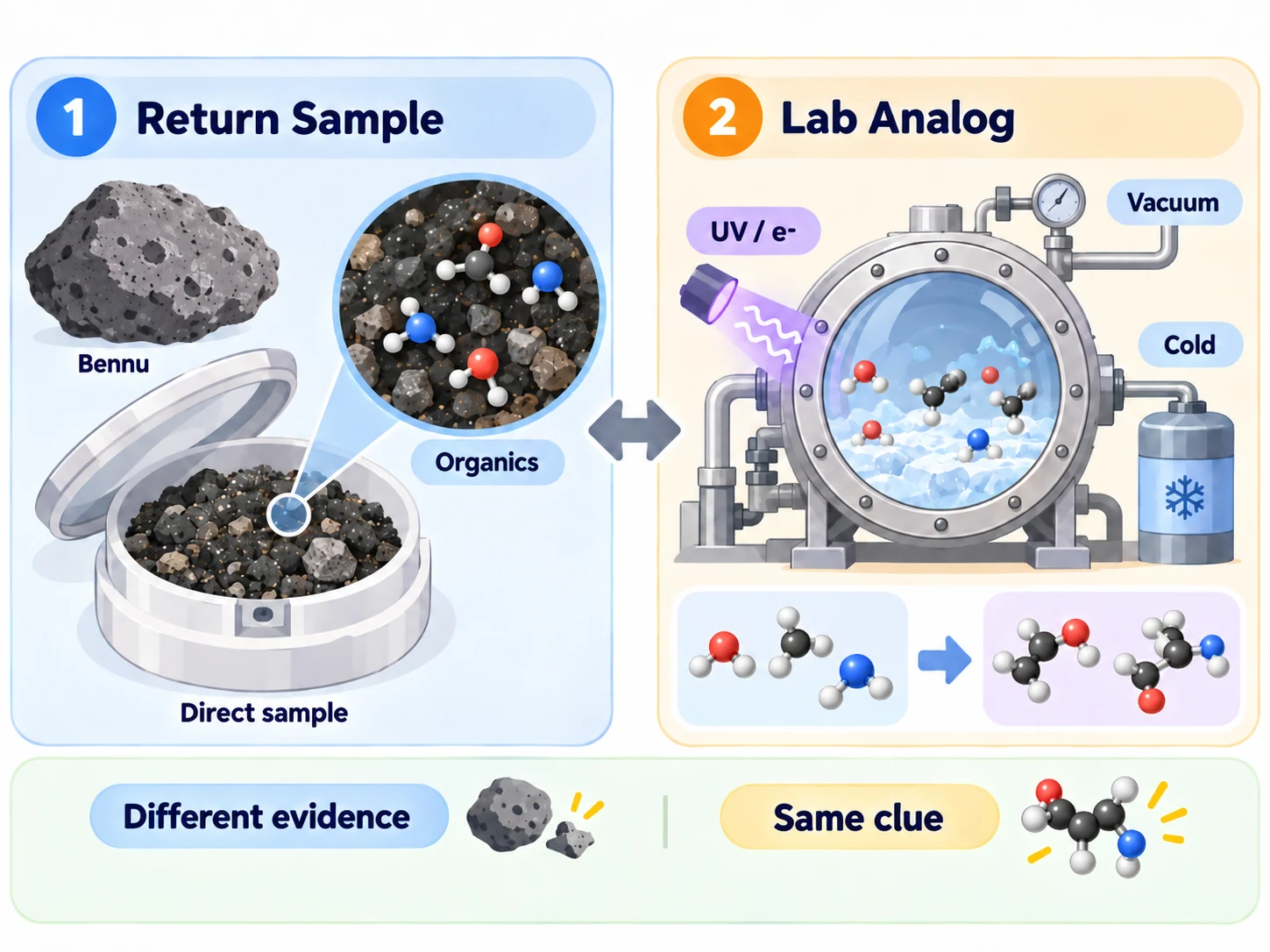
Compressing all three findings into one neat sequence would be misleading. Astronomers read distant signals from an interstellar cloud; researchers measured returned Bennu material directly; and a third group simulated some relevant conditions in a laboratory. Neither the detected molecular sets nor the proposed formation routes were identical.
Nor was 2026 the first year that sugars were reported in extraterrestrial material. Ribose and other sugars had already been reported in primitive meteorites in 2019, and scientists have investigated abiotic organic chemistry in space for decades.6
The novelty of the 2026 erythrulose study is therefore not the first demonstration that space can contain organic matter. It is the detection of a sugar in the interstellar medium, expanding the range of environments where sugar-related chemistry is supported by observations.
The common conclusion is narrower than a story of one universal recipe: processes associated with sugars and complex organic matter need not be restricted to any single space environment, even without biology. That does not mean all three environments produced the same molecules by the same reactions.
Ingredients alone do not become life
This brings the harder question into focus. Sugars, amino acids, nucleobases and complex polymeric organics have each been identified in Bennu samples. The inventory of potentially useful ingredients has grown, but an inventory cannot explain how life began.
None of these studies directly answers how life emerged. Put together, they underline the explanatory gap between having molecules and forming a chemical system that maintains and reproduces itself.8
There are several hurdles. Molecules must become concentrated enough to react, and conditions must allow some of the many possible reactions to recur. Many molecules can take two non-superimposable mirror-image forms, like left and right hands. Life on Earth overwhelmingly uses particular forms, but the reason for that selection is unresolved. In the Bennu sugar study, the quantity of material was too small to establish which mirror-image form predominated.7
The 2026 Nobel Prize in Chemistry went to Henri B. Kagan, for work on nonlinear effects in asymmetric organic synthesis, and Kensō Soai, for discovering an autocatalytic reaction in which a product amplifies its own asymmetry.9 Their discoveries showed how a small initial excess of one molecular mirror-image can grow through chemical reactions. They did not show that such a process actually determined life's molecular handedness on early Earth, or that Bennu's sugars had a measured excess of either form.
Beyond selecting molecular forms, researchers still need to explain how small molecules became linked into structures that facilitate further reactions. When did information storage and replication emerge? What part, if any, did RNA play? These remain open questions.
It would therefore be premature to declare that the central bottleneck in life's origin has completely shifted away from the production of ingredients. These studies cannot determine whether concentration, molecular selection, polymer formation, self-maintenance or replication was the most difficult step.
Finding ingredients is only the beginning
Across these independent studies, one conclusion becomes clearer: asking whether the ingredients are present is not the end of the origin-of-life problem.
Ribose had already been found in meteorites. More carefully controlled Bennu samples yielded ribose, glucose and other sugars. Irradiation of exceptionally cold methanol ice produced various sugars in the laboratory. And in 2026, a sugar was detected in the interstellar medium for the first time.
These discoveries do not explain life's origin. They show that, in the environments and experimental conditions investigated so far, there is more than one way and place for organic molecules relevant to life to occur without life itself.
The more difficult question remains: how did some of those ingredients accumulate, favor particular reactions, link together and eventually form a chemical system capable of maintaining and reproducing itself?
The studies do not answer that question. They make the distance between the existence of life's ingredients and the beginning of life more apparent.
Notes
1. Evidence for interstellar erythrulose. The team reported 12 groups of spectral features comprising 17 rotational transitions in broad-frequency observations of G+0.693−0.027. Selected comparatively unblended lines yielded an integrated significance greater than 9σ. The paper described this as the first sugar identified in the interstellar medium. Erythrulose is a chiral four-carbon ketose, not ribose. An August 2026 author correction changed the vertical-axis unit in Figure 1 from K to mK without changing the study's conclusion. Sources: Jiménez-Serra et al., Nature Astronomy 10, 1353–1363 (2026); Author Correction (2026).
2. Detection and formation are different evidence. The telescopes detected signals consistent with the presence of erythrulose. The route involving simpler two-carbon aldehydes and alcohols reacting on interstellar grains comes from quantum-chemical calculations and astrochemical models, not observation of the formation event. Source: Jiménez-Serra et al., Nature Astronomy (2026).
3. Sugars in Bennu and a possible formation route. Four five-carbon sugars—ribose, lyxose, xylose and arabinose—and two six-carbon sugars—glucose and galactose—were identified. Their distribution resembled products of reactions involving aqueous formaldehyde. Combining this with evidence of prolonged aqueous alteration of Bennu's parent body, the authors proposed a possible formation mechanism; they did not observe the mechanism directly. Sample concentrations did not permit stable-isotope or enantiomeric-ratio measurements of the sugars. Source: Furukawa et al., Nature Geoscience 19, 19–24 (2026).
4. Other organics in Bennu. A 2025 study reported 33 amino acids, including 14 used to make terrestrial proteins, along with the five canonical nucleobases adenine, guanine, cytosine, thymine and uracil. A separate study reported nitrogen- and oxygen-rich polymeric organic material. These findings must not be equated with the detection of RNA or proteins. Sources: Glavin et al., Nature Astronomy 9, 199–210 (2025); Sandford et al., Nature Astronomy 9, 1803–1811 (2025).
5. Arrokoth was simulated, not sampled. Researchers irradiated methanol ice at 40 K with 5 keV electrons to model an aspect of cosmic-ray energy deposition in the outer Solar System. Analysis after warming revealed sugars and derivatives, including glucose and ribose; the irradiated ice also became optically redder. Neither finding demonstrates that those compounds have been measured on Arrokoth. Source: Zhang et al., PNAS 121, e2320215121 (2024).
6. Not the first extraterrestrial sugar. Ribose and other extraterrestrial sugars were reported in two primitive meteorites in 2019. The specific first claimed in the 2026 study is a sugar detected in the interstellar medium. Source: Furukawa et al., PNAS 116, 24440–24445 (2019).
7. Molecular handedness remains unresolved. Enantiomers are mirror-image molecular forms that cannot be superimposed. Terrestrial life strongly favors specific forms of amino acids and sugars. Bennu's sugar concentrations were insufficient for an enantiomeric-ratio measurement; in a separate study, analyzable non-protein chiral amino acids were present in nearly equal proportions. Sources: Furukawa et al., Nature Geoscience (2026); Glavin et al., Nature Astronomy (2025).
8. The shifting focus of the question is an editorial synthesis, not a direct conclusion of any single paper. Remote observation, returned samples and laboratory analogues establish distinct facts. They do not determine whether concentration, selection, polymerization, self-maintenance or replication is the decisive bottleneck. Sources: interstellar observations, Bennu samples, Arrokoth analogue.
9. Scope of the 2026 Nobel Prize in Chemistry. Henri B. Kagan's nonlinear effect and Kensō Soai's asymmetric autocatalysis were separate achievements recognized for illustrating amplification of molecular asymmetry. The prize does not establish a specific prebiotic pathway on early Earth. Sources: Nobel Prize in Chemistry 2026, official announcement; American Chemical Society statement, 7 October 2026.