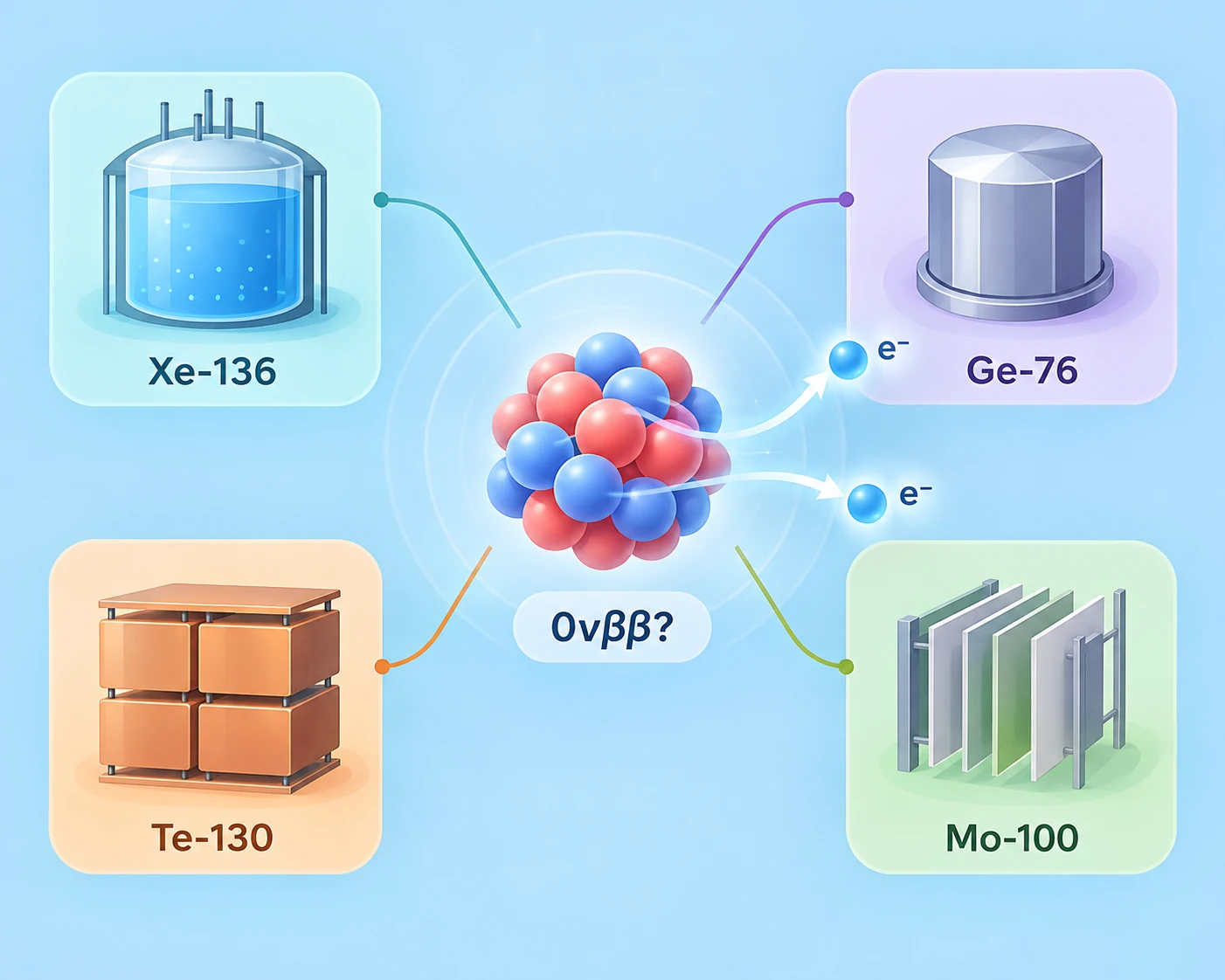
Could a neutrino be its own antiparticle?
Matter has antimatter counterparts. The electron's antiparticle is the positron: same mass, opposite electric charge. Protons have antiprotons. But opposite charge is not always what distinguishes particles from antiparticles. A neutron is electrically neutral, yet the antineutron is a different particle.
What, then, about the electrically neutral neutrino? There are two possibilities. Neutrinos and antineutrinos could be distinct particles, like neutrons and antineutrons; in that case they are Dirac neutrinos. Or a neutrino might be its own antiparticle, making it a Majorana neutrino. No experiment has yet established which possibility nature realizes.
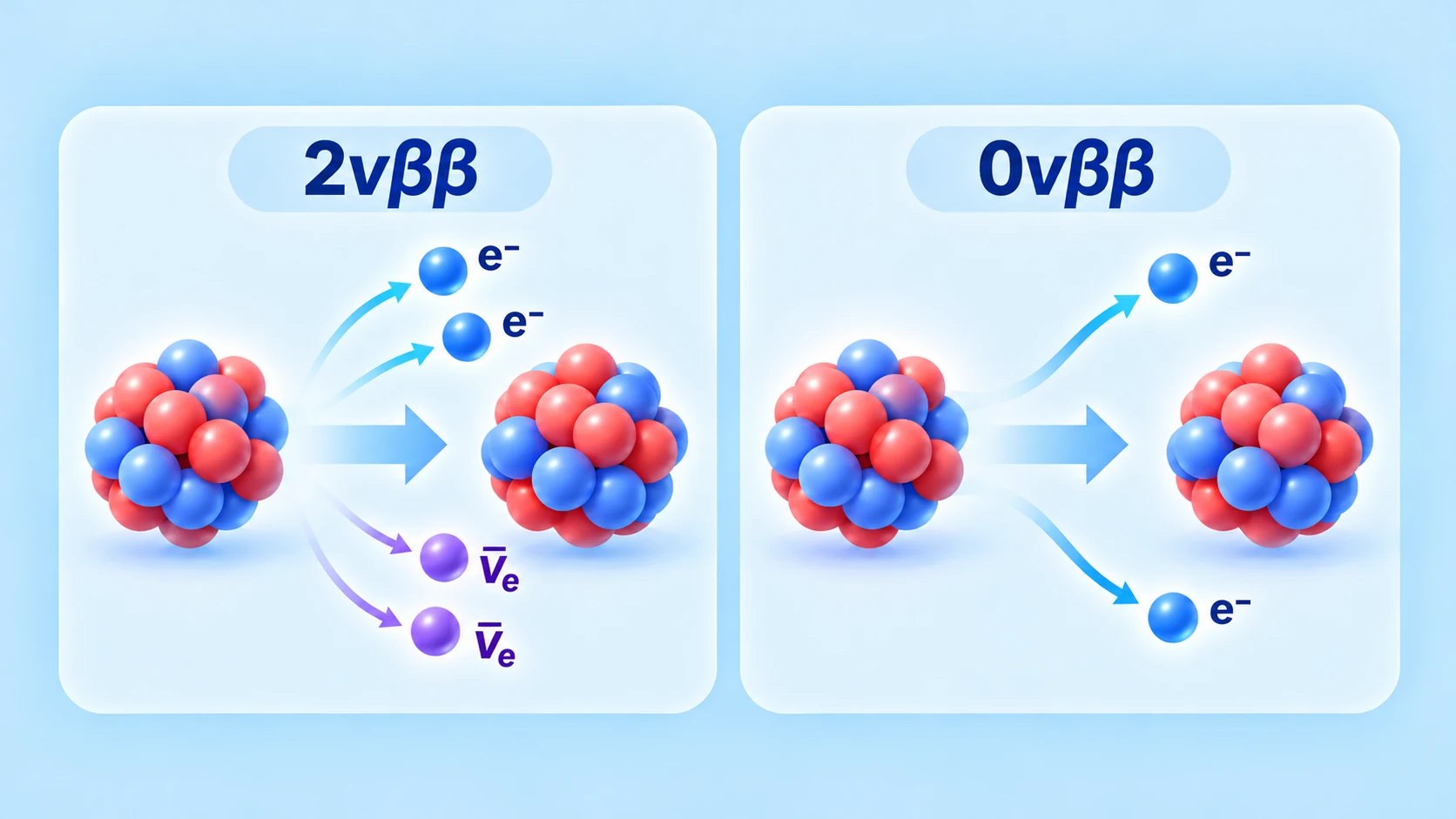
One potential test involves double-beta decay. In certain nuclei, two neutrons turn into two protons, releasing two electrons and two electron antineutrinos. If researchers instead observed the two electrons with no emitted neutrinos, they would have found neutrinoless double-beta decay (0νββ).
This would not mean two emitted antineutrinos met and annihilated outside the nucleus. In the most studied mechanism, two weak interactions inside the nucleus are connected by the exchange of a virtual Majorana neutrino. With a Majorana mass component, the two electrons could emerge without neutrinos in the final state.1
Discovery of this process would establish that neutrinos have a Majorana mass component. But no neutrinoless double-beta decay has been detected. If it occurs, it is extraordinarily rare.
Searching for a decay with a 10²⁶-year half-life
One candidate isotope is xenon-136 (¹³⁶Xe). Experiments searching for its neutrinoless double-beta decay have found no signal. Current limits indicate that the half-life, if the process exists, must be considerably longer than 10²⁶ years.2
That is vastly longer than the age of the universe. Scientists are not proposing to watch a single nucleus for that long. Hundreds of kilograms of xenon-136 contain roughly 10²⁷ nuclei. Almost none will decay in a few years, but by observing so many nuclei simultaneously, a detector may catch an exceedingly rare event.
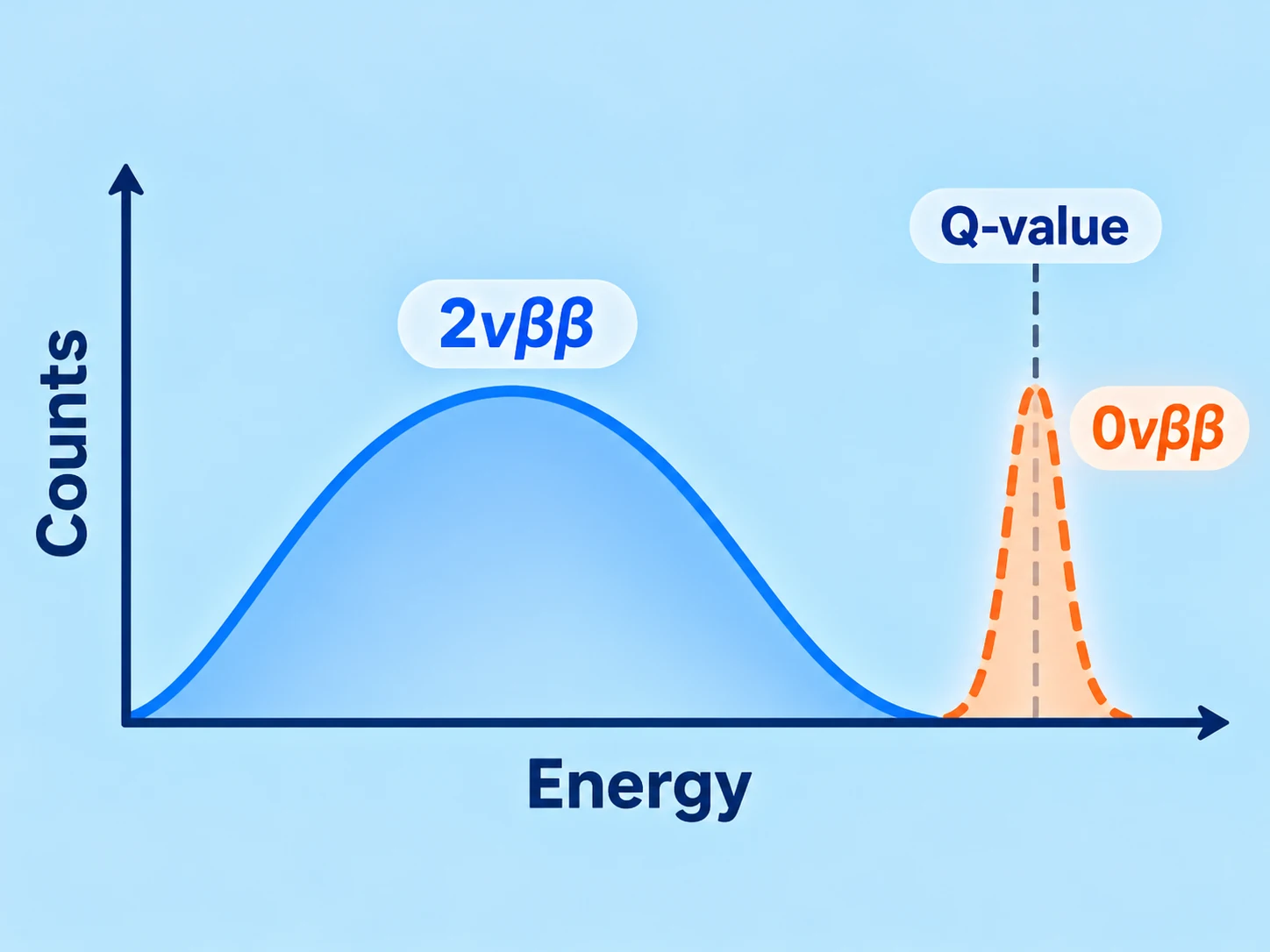
Mass alone is not enough. In 0νββ, no neutrino escapes with energy, so the total energy of the two electrons clusters around a definite value. The detector looks for events inside this narrow energy window. Unfortunately, natural radioactivity and cosmic rays can imitate the signal. Experiments therefore seek deep underground locations, materials with exceptionally low radioactive contamination, precise energy measurement and powerful background rejection.
Collect enough material, measure accurately, and suppress false signals.
It is difficult to optimize all three at once. A technology that houses a great mass of isotope may not offer the sharpest energy resolution; an instrument that tracks individual particles in detail may be difficult to scale up. That is why teams searching for the same decay build different machines.
Three detectors using the same xenon isotope
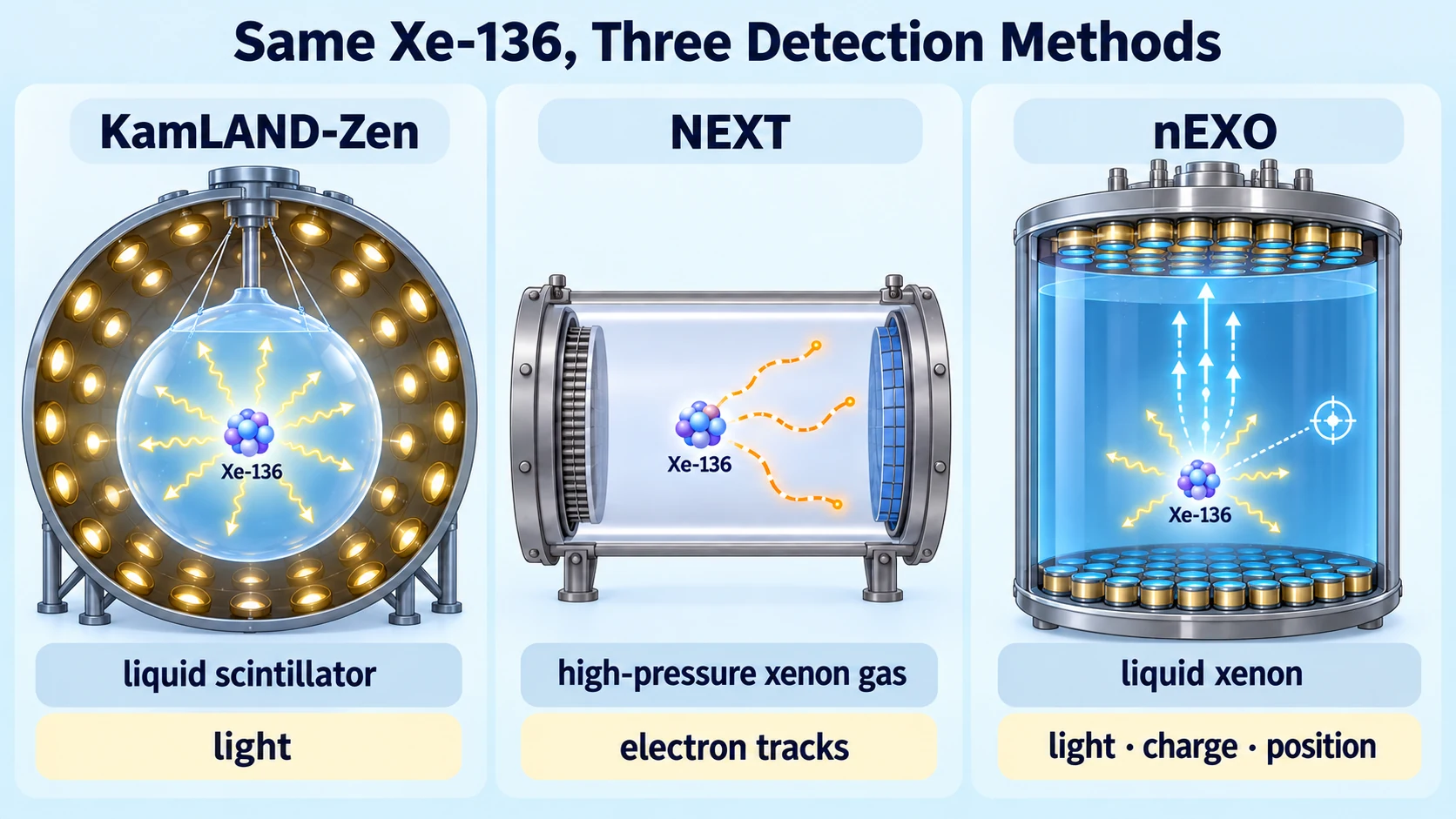
The contrast is already evident for xenon-136. The KamLAND-Zen collaboration dissolves enriched xenon in liquid scintillator, a liquid that emits light when particles deposit energy. Large quantities can be housed in a vessel, making it possible to expose a substantial mass of xenon. Its recent analysis used 745 kg of enriched xenon and still found no desired decay.2
The NEXT collaboration uses xenon as a high-pressure gas. Gas requires more volume to hold the same mass, but it allows the detector to reconstruct tracks left by electrons. Because the candidate decay would release two electrons from the same point, track topology can help distinguish a real event from background. NEXT therefore measures not only energy but also event geometry. Calibration results from the actual NEXT-100 detector, reported in 2026, project better than 1% energy resolution when extrapolated to the decay's energy—not a directly observed 0νββ signal.3
The nEXO collaboration pursues another approach: tonnes of liquid xenon enriched in xenon-136, with information about where each event occurred inside the detector. KamLAND-Zen emphasizes a large isotope mass dissolved in scintillator; NEXT reconstructs electron tracks in gas; nEXO aims to scale liquid xenon itself to the multi-tonne range.3
Even for one isotope, detector design depends on the compromises among target mass, energy resolution and information about the event. But the choice does not stop at xenon.
Different nuclei, different engineering problems
The LEGEND collaboration uses germanium-76 (⁷⁶Ge). Its high-purity germanium crystal serves both as the material that might decay and as the semiconductor detector that measures the event. This arrangement permits extremely precise energy measurement. LEGEND-200 is already collecting data. Its first result, published in 2026, found no signal.4
The CUORE collaboration cools tellurium-130-bearing crystals to very low temperatures and measures the minute heat released by events. CUPID and AMoRE are preparing detectors built around molybdenum-100-containing crystals, measuring both heat and light. AMoRE-II is being prepared at the Yemilab underground laboratory in South Korea.5
No isotope or technology wins on every criterion. The nuclei differ in availability, usable materials, detector compatibility and energy. Some approaches offer particularly precise energies; others provide more information for identifying false signals. Changing isotope changes the engineering problem.
Yet detector construction is only the first reason to diversify nuclei.
The longest half-life limit is not necessarily the best result
KamLAND-Zen obtained a xenon-136 half-life lower limit of 3.8×10²⁶ years. A combined germanium-76 analysis incorporating LEGEND-200 and two earlier experiments reached 1.9×10²⁶ years.24 The former number is twice the latter, but that does not mean xenon is twice as successful.
Different nuclei have different decay energies and different arrangements of protons and neutrons. Even if the underlying neutrino physics is the same, the probability of decay can differ between nuclei. Researchers calculate the effect of nuclear structure through the nuclear matrix element.6
This is not a quantity measured directly by the experiment. Nuclear theories produce values that vary with the calculation. Under a light-Majorana-neutrino-exchange assumption, translating the same half-life limit into a limit on an effective neutrino mass gives a range, not one universally fixed number. KamLAND-Zen's mass constraint depends on which matrix-element calculation is used.2
Experiments on different isotopes therefore cannot be ranked simply by lining up half-life limits. Their differences are a reason to combine them carefully.
Before any discovery, different nuclei and technologies compensate for different weaknesses. A xenon experiment that maximizes target mass and a germanium experiment that measures energy exceptionally well face different backgrounds and different nuclear-theory uncertainties. Taken together, nonobservations constrain the same physics without trusting only one instrument or one isotope.6
After a possible discovery, this diversity becomes even more valuable. Suppose xenon-136 produces a signal consistent with 0νββ. Researchers would ask whether germanium-76 or tellurium-130 also shows a decay in the range predicted by the same physics. Confirmation with a different detector and nucleus would reduce the chance that the first signal came from an unrecognized background or a peculiar instrumental effect. A failure to see a signal elsewhere would not automatically disprove the first result: the second experiment must have sufficient sensitivity and exposure.
There is a further possibility. Physicists have proposed more than one mechanism capable of producing 0νββ. Different mechanisms can imply different relationships among decay rates in xenon, germanium and tellurium. If half-lives can eventually be measured in multiple nuclei, those relationships might help determine what causes the decay, not merely whether it exists. But that discrimination depends on nuclear matrix elements, their correlated uncertainties and the mechanism assumed in the model. Multiple detections would not automatically identify the mechanism.6
The experiments are not redundant. Before discovery, they surround the problem using different strengths; after discovery, they can test whether the signal is genuine and what it means.
JUNO could eventually join the search
JUNO is not currently searching for neutrinoless double-beta decay. Its present instrument precisely measures oscillations in reactor electron antineutrinos, including the pattern relevant to the neutrino mass ordering.
Researchers have nevertheless studied potential future uses of its large detector. One proposal would place a separate vessel containing xenon-136-enriched liquid scintillator at its center. The target would then be rare decays in the nuclei inside that vessel, rather than antineutrinos arriving from reactors.7
The approximately 20,000 tonnes of liquid scintillator now in JUNO would not automatically become a 20,000-tonne 0νββ target. The isotope inventory, detector modifications and schedule have not been finalized. Nor would JUNO be first to raise the question: KamLAND-Zen and LEGEND already have search data, NEXT is exploring a different xenon technology, and new-generation detectors such as nEXO are being developed.
If JUNO eventually joins them, an instrument built to read the ordering of three neutrino mass states would turn toward another, older mystery.
Are neutrinos and antineutrinos truly different particles?
Notes
1. What happens to the neutrino in 0νββ? This is not annihilation of two antineutrinos after they leave the nucleus. In the representative light-Majorana exchange mechanism, a virtual neutrino connects two weak interactions within the nucleus. Other mechanisms are possible. The Schechter–Valle black-box theorem implies that observing 0νββ entails a Majorana mass component, but would not establish that light-neutrino exchange dominates. J. Schechter and J. W. F. Valle, Physical Review D 25, 2951 (1982), original paper; M. Agostini et al., Reviews of Modern Physics 95, 025002 (2023), review.
2. KamLAND-Zen. The full KamLAND-Zen 800 analysis used 745 kg enriched xenon and a ¹³⁶Xe exposure of 2.1 tonne-years. Its combined no-signal result set a 90% confidence lower bound on the half-life of 3.8×10²⁶ years. Assuming light-Majorana exchange and gA≈1.27, different nuclear-matrix-element calculations imply an effective Majorana-mass upper bound ranging from 28 to 122 meV; it does not directly measure the mass of one mass eigenstate. S. Abe et al., Physical Review Letters 135, 262501 (2025), published paper · preprint.
3. NEXT and nEXO. In an actual NEXT-100 calibration with a single-cluster selection, the energy resolution at the ²⁰⁸Tl 2615 keV photopeak was (0.90±0.02)% FWHM. Extrapolation as 1/√E to the ¹³⁶Xe Qββ energy of 2458 keV gives (0.93±0.02)% FWHM. That is not a direct resolution measured with 0νββ decay events. FWHM is the full width at half maximum of a peak. nEXO's proposed approximately 5,000 kg is total liquid xenon, enriched to approximately 90% ¹³⁶Xe, not five tonnes of pure isotope. NEXT Collaboration, European Physical Journal C 86, 1057 (2026), paper; nEXO Collaboration, pre-conceptual design · project.
4. LEGEND-200. The experiment operates enriched ⁷⁶Ge semiconductor detectors in low-background liquid argon. The initial LEGEND-200 exposure was 61.0 kg-years. Combining its result with GERDA and the MAJORANA DEMONSTRATOR, researchers found no signal and obtained the 90% confidence half-life lower bound 1.9×10²⁶ years. That bound must not be described as LEGEND-200 alone. H. Acharya et al. (LEGEND Collaboration), Physical Review Letters 136, 022701 (2026), open paper.
5. Tellurium and molybdenum. CUORE uses TeO₂ crystals containing ¹³⁰Te as cryogenic bolometers. CUPID's 2025 baseline design describes 1,596 ¹⁰⁰Mo-enriched Li₂MoO₄ scintillating crystals capable of measuring light and heat, using CUORE's cryogenic infrastructure. AMoRE-II is another molybdate-based cryogenic development at Yemilab. These design and construction stages must not be mistaken for completed searches. CUORE Collaboration, Science 390, 1029–1032 (2025), paper; CUPID Collaboration, European Physical Journal C 85, 737 (2025), design study; AMoRE Collaboration, sensitivity study · strategy submission.
6. Multiple isotopes: complementarity, confirmation and mechanism. Under dominant light-Majorana exchange, the inverse half-life depends on an isotope-specific phase-space factor, the squared nuclear matrix element and the squared effective Majorana mass. Nuclear-matrix-element estimates and the axial coupling carry theoretical uncertainties and correlations. Thus, limits across isotopes cannot be directly ranked, and combining experiments does not eliminate nuclear-model uncertainty. For constraints before discovery, see T. Shickele et al., Physical Review D 114, 013007 (2026), paper. After a prospective discovery, independent signals in other isotopes could corroborate the observation if the experiments have enough sensitivity; rates could also constrain candidate operators only within model and nuclear calculations. M. Agostini, F. F. Deppisch and G. Van Goffrier, JHEP 02, 172 (2023), paper; K. Ishidoshiro, Physical Review D 114, 035047 (2026), operator study. The latter compares theoretical scenarios, not observed signals.
7. Possible future JUNO upgrade. J. Zhao, L.-J. Wen, Y.-F. Wang and J. Cao modeled a separate inner vessel containing ¹³⁶Xe-enriched scintillator. Their illustrative 5-tonne and 50-tonne cases refer to the isotope mass in a fiducial volume, not current installed xenon. JUNO began taking data in its 20-kiloton scintillator detector on 26 August 2025; a future double-beta-decay upgrade remains a proposal. J. Zhao et al., Chinese Physics C 41, 053001 (2017), paper · preprint · JUNO operation announcement.