
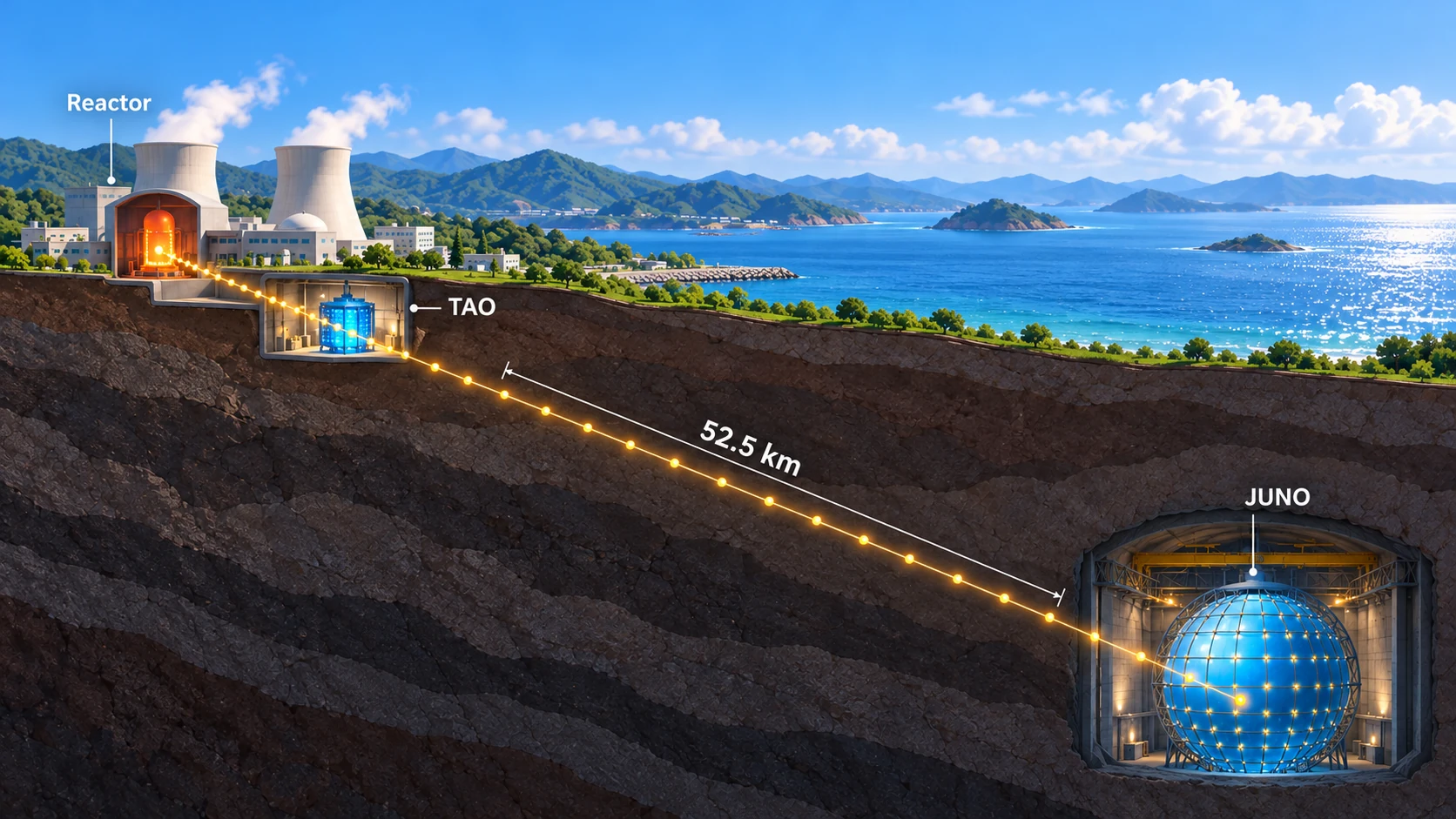
A reactor releases electron antineutrinos
Neutrinos are extremely light fundamental particles with no electric charge. They seldom interact with matter. They emerge from nuclear reactions in the Sun, stellar explosions, and power reactors on Earth. Countless neutrinos pass through our bodies and the planet, leaving almost no trace.
There are three neutrino flavors—electron, muon and tau—and experiments distinguish the corresponding three antineutrino flavors.
One profound question remains unsettled: are neutrinos fundamentally distinct from antineutrinos, or could a neutrino be its own antiparticle?1
The particles emitted during beta decay of reactor fission products are electron antineutrinos. Fission of uranium or plutonium produces unstable nuclei. When a neutron in one of those nuclei changes into a proton, an electron and an electron antineutrino are emitted. This is beta decay.
Because so many fission products undergo successive decays, a reactor provides an enormous, continuous supply of electron antineutrinos. JUNO uses antineutrinos not because mass ordering can only be studied with antiparticles, but because reactors are intense, stable sources.
An international collaboration led by the Institute of High Energy Physics (IHEP) of the Chinese Academy of Sciences built the Jiangmen Underground Neutrino Observatory (JUNO) beneath Jiangmen in Guangdong Province, China. It lies an average of approximately 52.5 km from the reactors at the Yangjiang and Taishan nuclear power plants and was designed to measure the subtle changes in their electron antineutrinos. Determining the neutrino mass ordering is one of its central goals.2
The 2026 Nobel Prize in Physics went to Francis Halzen for decisive contributions to the IceCube Neutrino Observatory, which uses Antarctic ice as a detecting medium, and to the discovery of high-energy neutrinos of astrophysical origin.3 IceCube observes very energetic neutrinos arriving from the distant universe. JUNO examines the oscillation patterns left by much lower-energy electron antineutrinos from reactors. Both study neutrinos, but their sources, energy ranges and scientific questions differ.
A neutrino can arrive as a different flavor
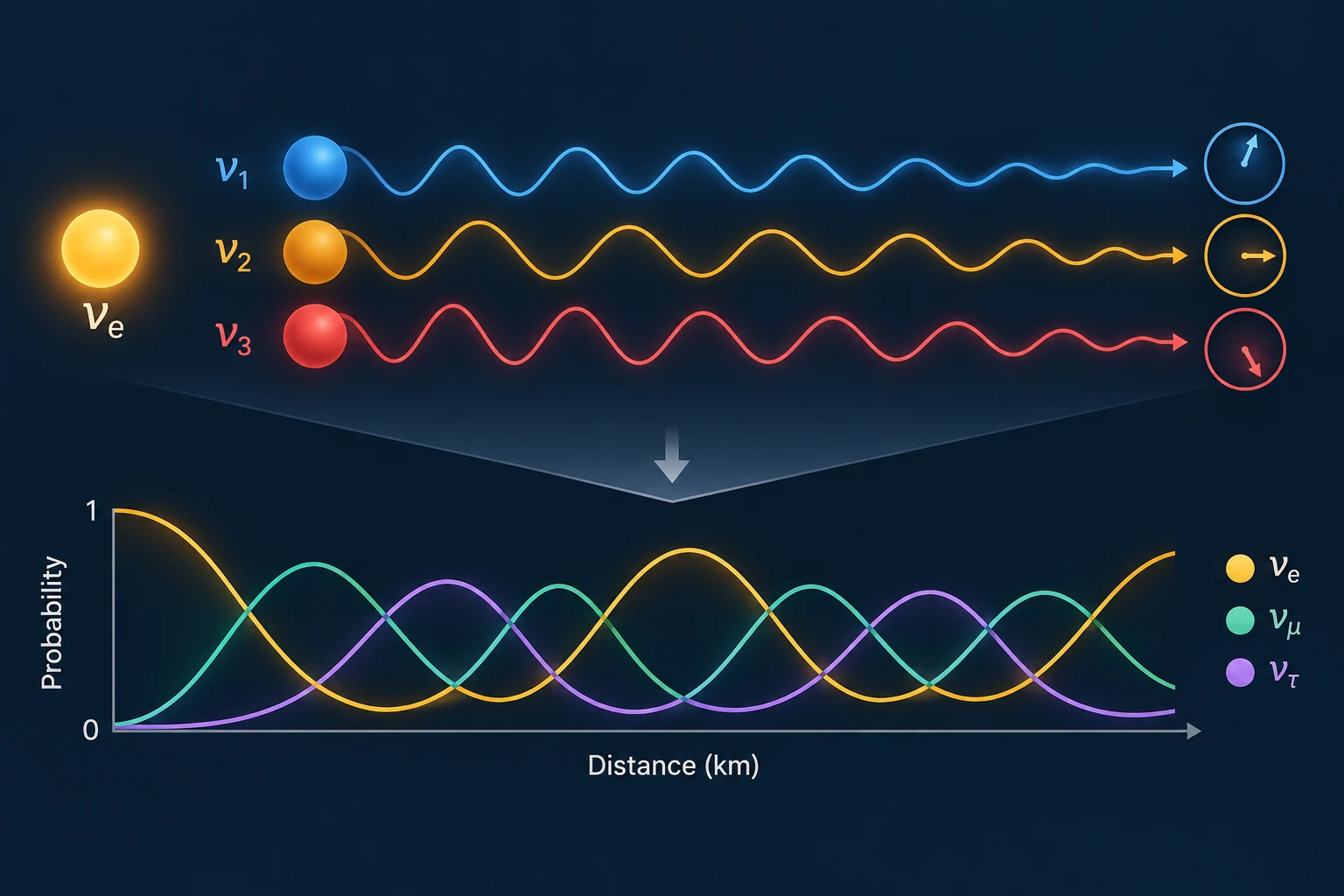
Here lies one of the particle's stranger properties. The electron, muon and tau flavors are not each associated with a single fixed mass. There are also three distinct neutrino mass states.
This is quantum mechanics rather than an everyday change of identity. Imagine a clock with three hands turning at slightly different speeds. The hands begin in one arrangement, then gradually shift relative to each other.
Likewise, the relative quantum phases of the three neutrino mass states evolve during propagation. A neutrino produced in the electron flavor may therefore be detected in another flavor. This is neutrino oscillation.4
Antineutrinos oscillate too. Even if all the particles start out as electron antineutrinos in a reactor, not all will still appear as electron antineutrinos after traveling 52.5 km. JUNO measures that change.
Counting the electron antineutrinos that remain
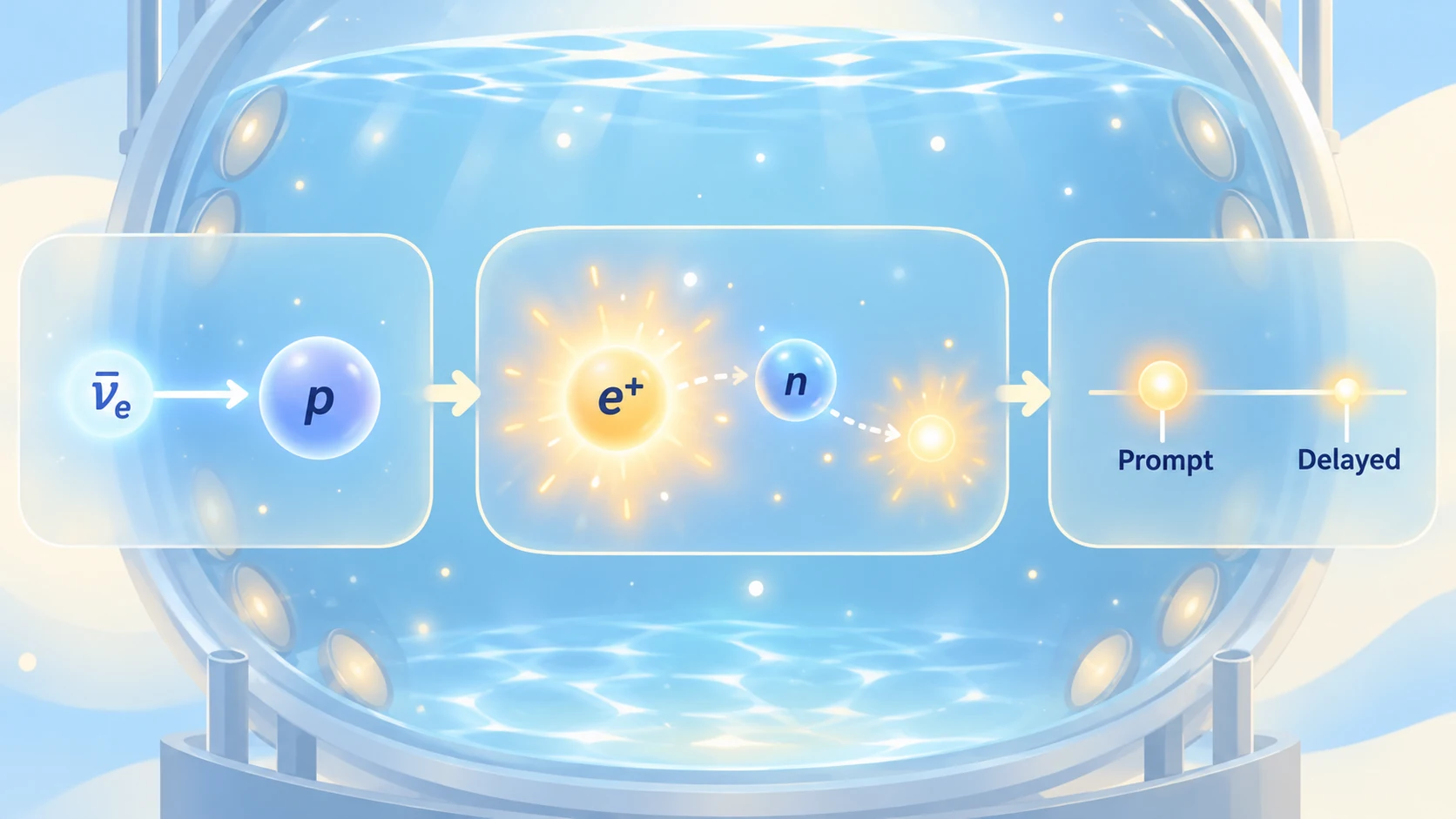
An electron antineutrino can produce a particularly recognizable reaction inside JUNO. It interacts with a proton to produce a positron—the electron's antiparticle—and a neutron. The positron deposits energy and produces a light signal; shortly afterward, neutron capture produces a second signal.
Because these flashes occur in a characteristic sequence, they can be distinguished from many accidental backgrounds. This is inverse beta decay, a standard technique for detecting reactor antineutrinos.
Muon and tau antineutrinos at reactor energies cannot be identified through the corresponding charged-current reaction: the particles required to tag their flavors are far too massive to produce at these energies.5 Rather than count the muon and tau antineutrinos that appeared, JUNO measures how many electron antineutrinos survived.
The survival fraction changes with energy. At some energies more electron antineutrinos remain; at others more have disappeared. Plot the event count against energy and a pattern of peaks and troughs emerges: an energy spectrum. JUNO reads its fine structure.
Reading a beat pattern after 52.5 km
The three mass states are conventionally labeled ν₁, ν₂ and ν₃. We know ν₂ is heavier than ν₁. The unresolved issue is whether ν₃ lies above or below the other two. If ν₃ is heaviest, the arrangement is normal ordering; if it is lightest, inverted ordering.
No one is weighing individual neutrinos directly. Instead, the ordering affects the oscillation pattern. Different mass-squared differences produce a broad, slow variation in the electron-antineutrino spectrum and a much faster series of ripples. Their overlap produces something resembling beats between waves of different frequencies.6
A baseline of approximately 52.5 km is well suited to seeing the slow variation and repeated fast ripples together. That is why JUNO was neither placed next to a reactor nor much farther away.
The normal and inverted orderings shift the positions of the small peaks and dips relative to one another. The entire spectrum does not become unrecognizably different. The ordering is encoded in tiny changes to the beat pattern.
Why the detector holds 20,000 tonnes
The difference is extraordinarily small. Of all the electron antineutrinos traveling 52.5 km from the reactors, very few interact inside JUNO. To resolve the mass ordering, the detector must gather many rare events without blurring the fine oscillation ripples.
It must catch enough particles and measure their energy precisely.
JUNO therefore has a vast central spherical acrylic vessel, 35.4 m in diameter, containing roughly 20,000 tonnes of liquid scintillator—a liquid that produces light when particles deposit energy. Tens of thousands of light sensors surrounding the vessel measure the flashes, allowing scientists to reconstruct deposited energy.2
A large target increases the number of rare interactions. But if energy resolution is insufficient, adjacent ripples merge; if the energy scale is distorted, peaks appear at the wrong positions. Neither size nor precision alone is sufficient.
Measuring the spectrum at the starting line
Another challenge remains even with an extremely precise detector. Some fine features in the spectrum could have existed when the reactor produced the antineutrinos; not every bump observed by JUNO is necessarily caused by oscillation.
Scientists must distinguish the reactor's starting spectrum from the changes accumulated during propagation. That is the role of the Taishan Antineutrino Observatory (TAO), a smaller near-reactor experiment built to measure the source spectrum before substantial oscillations occur.7
TAO measures the pattern near the start; JUNO measures what is left after 52.5 km. Comparing the two helps separate reactor-spectrum structure from neutrino oscillations. TAO began taking actual data in 2026. In its June report on the 207-day analysis, the JUNO collaboration stated that TAO's precise reactor-antineutrino spectrum had contributed to the updated result.8
The first indication of normal ordering
JUNO began physics data collection on 26 August 2025. Its first result, based on 59.1 live days, appeared in Nature in June 2026. It measured key parameters of the slower oscillation about 1.6 times more precisely than earlier combined measurements, but it did not establish the mass ordering.9
At the Neutrino 2026 conference in June, the collaboration presented a preliminary analysis of roughly 207 days. With constraints from long-baseline accelerator neutrino experiments added to JUNO data, normal ordering was preferred at approximately 2.3σ.8
On 29 September 2026, the collaboration released a detailed preprint. It analyzed 207.2 live days and 8,294 inverse-beta-decay candidates. JUNO measured an atmospheric mass-squared splitting to approximately 1% precision. That is a major gain in measuring the oscillation pattern, not a discovery of either ordering.8
How results from different experiments are combined matters. The analysis used a Daya Bay reactor-experiment constraint to select the physically appropriate minimum under each mass-ordering hypothesis. Adding mass-squared-splitting constraints from long-baseline accelerator experiments then favored normal ordering with a one-sided significance of at least 2.1σ across all possible values of the CP-violating phase.8
The conference figure of 2.3σ and the preprint's minimum of 2.1σ are not two directly interchangeable estimates. In particular, 2.1σ is not a JUNO-only detection significance. A separate Bayesian model comparison yielded a Bayes factor of 10.18 in favor of normal ordering; this cannot simply be translated into a 91% probability that the ordering is correct.8 10
More data and continued checks of energy calibration, systematic uncertainties and the source spectrum are essential. As of October 2026, the analysis released on 29 September remains a preprint, not a peer-reviewed journal publication.
Still, the advance from 59.1 to 207.2 days is real. The first data demonstrated precision oscillation measurement. The larger dataset, considered together with external long-baseline constraints, began to distinguish between the two possible mass orderings.
Will the preference for normal ordering survive more data and grow into evidence strong enough to count as a discovery?
Notes
1. Dirac or Majorana? Neutrinos and antineutrinos would be distinct in the Dirac case. In the Majorana case a neutrino is its own antiparticle. Existing oscillation experiments do not distinguish these possibilities. Scholarly review.
2. JUNO and its central detector. JUNO Collaboration, “Initial performance results of the JUNO detector,” Chinese Physics C 50, 043001 (2026), DOI 10.1088/1674-1137/ae3dc1. The 35.4 m acrylic vessel contains about 20 kilotonnes of liquid scintillator. The IHEP-led international collaboration also studies solar, supernova, atmospheric and geoneutrinos. Detector paper.
3. Scope of the 2026 Nobel Prize in Physics. Francis Halzen was recognized for decisive contributions to IceCube and discovery of high-energy neutrinos of astrophysical origin, not for reactor oscillations or mass ordering at JUNO. Official Nobel announcement · IceCube announcement.
4. Flavors and mass states. The three flavors are electron, muon and tau. Each is a quantum superposition of mass eigenstates ν₁, ν₂ and ν₃, with relative phases that evolve during propagation. Their mixing is described by the PMNS matrix. Particle Data Group.
5. Why the other flavors are not tagged by the same reaction. Reactor antineutrino energies are a few MeV, insufficient to produce the much heavier charged leptons required for corresponding muon- or tau-flavor reactions. JUNO measures electron-antineutrino disappearance rather than direct appearance of the other flavors. JUNO analysis.
6. Beats and mass-squared splittings. The oscillation wavelengths depend on differences of squared masses (Δm²), not simply the masses. The electron-antineutrino survival probability includes a slow variation driven by Δm²₂₁ and rapid variations driven by larger splittings. JUNO ordering-sensitivity paper.
7. TAO. The near-detector measures the unoscillated reactor-antineutrino spectrum and constrains fine source structure. It began actual data taking in 2026 and was cited as contributing to the June analysis. It does not independently determine mass ordering. TAO design study · JUNO preprint documenting the measured TAO reactor spectrum.
8. The 207-day analysis. The June conference announcement reported 2.3σ with external long-baseline constraints. IHEP official announcement. The collaboration's September 29 preprint analyzed 207.2 live days and 8,294 inverse-beta-decay candidates. Daya Bay constraints resolved the appropriate minimum for each ordering; with long-baseline accelerator constraints, normal ordering was preferred at a one-sided significance ≥2.1σ over possible CP phases. A Bayes factor of 10.18 is not a direct discovery probability or posterior probability independent of modeling assumptions. JUNO Collaboration, arXiv:2609.37895. The preprint is distinct from the peer-reviewed first-data result.
9. First 59.1 live days. The JUNO Collaboration, “Measurement of reactor neutrino oscillation with the first JUNO data,” Nature 654, 343–348 (2026), DOI 10.1038/s41586-026-10538-z. The result improved the precision of measurements of sin²θ₁₂ and Δm²₂₁ by approximately a factor of 1.6 compared with earlier combined results; it was not an ordering determination. Nature paper.
10. Meaning of statistical evidence. Sigma values depend on the test, hypotheses and constraints. A 2.3σ one-sided normal-tail equivalent is around 1%, not a “99% probability that normal ordering is true.” The ≥2.1σ result combines experiments and covers CP phases. A Bayes factor of 10.18 is not automatically a 91% probability. JUNO preprint · Particle Data Group.