
How Far Has a New Form of Magnetism with Almost No Net Magnetization Come?
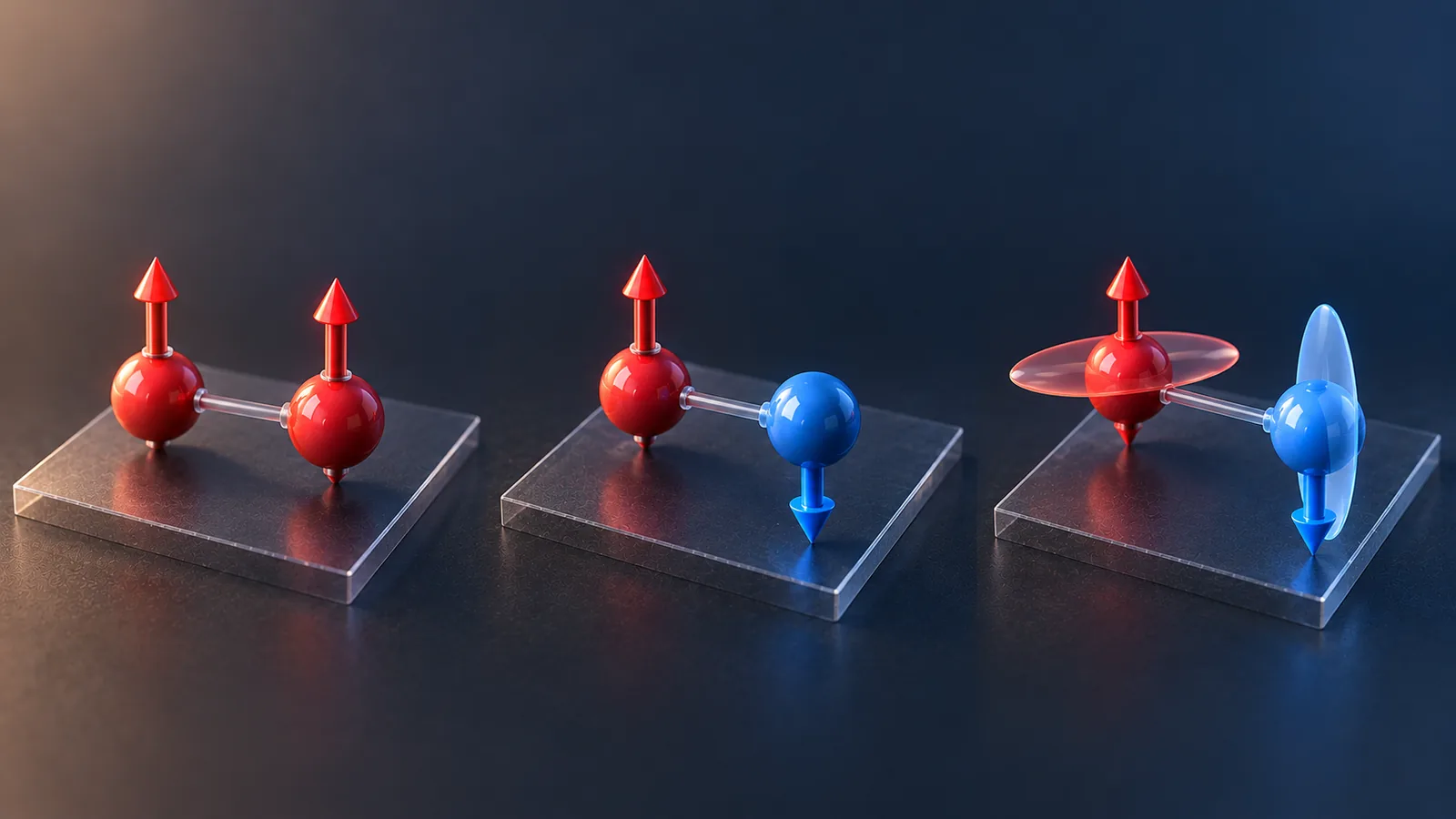
Atoms that have magnetic properties can be arranged regularly inside a material without making the entire material act like a strong magnet. When the magnetic directions of the atoms oppose one another, their effects can cancel, even though the underlying order remains.
Altermagnetism is a form of magnetic order attracting particular attention. Its net magnetization can be nearly zero, yet the energies of electronic states can follow a pronounced pattern that changes with crystal direction.
Altermagnets are also candidates for future information storage. If two magnetic states can represent 0 and 1 and can be changed and distinguished electrically, they could store information. Their small net magnetization might also reduce magnetic interference with nearby devices. Such advantages have not yet been demonstrated in practical memory products.1
When altermagnetism was systematically described in theory in 2022, ruthenium dioxide (RuO₂) emerged as a prominent candidate. Later precision experiments on some samples, however, did not detect the anticipated spin splitting or magnetic order. Evidence accumulated in other materials, and October 2026 brought new methods of distinguishing spin-sensitive electronic signals at atomic scales. What any given experiment establishes depends on the specific material, sample, and quantity measured.12
Magnetic order survives even when magnetization is small
In an ordinary bar magnet, the magnetic properties of many atoms point approximately in the same direction. The direction and size of an atom's or electron's magnetic property are described by its magnetic moment. Magnetization describes the net magnetic alignment of a material.
Neighboring moments can instead form a regular pattern pointing in opposite directions. This is a characteristic arrangement in antiferromagnetism. The moments compensate, yielding nearly zero net magnetization, but ordered magnetism persists inside the crystal.
What then distinguishes an altermagnet from a conventional antiferromagnet?
The distinction appears in electronic energy states. An electron has a quantum property called spin, associated with magnetism. Two opposite spin states can be distinguished, although this does not mean the electron is literally spinning like a tiny ball. Electronic states of opposite spin may have equal or unequal energies.
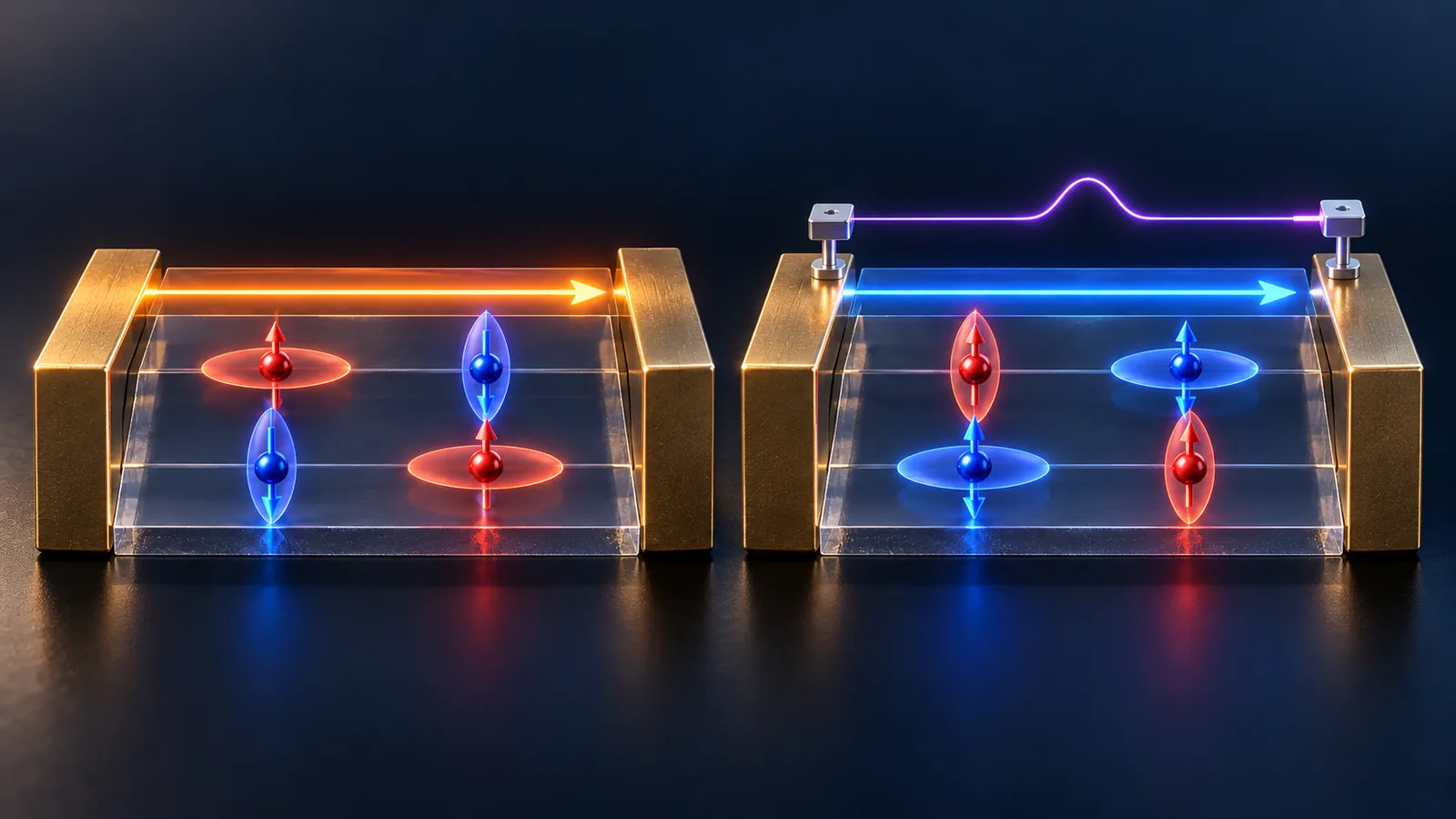
The materials discussed here are crystals, whose constituent atoms repeat in an ordered arrangement. In a crystal, electronic energy can depend on the electron's direction of motion. Altermagnetic order can allow an energy difference between opposite-spin states in one direction to reverse its sign in another direction.1
This difference at the same electronic momentum is called spin splitting. It does not mean that one electron breaks into two. Crystal symmetry refers to a rule under which an atomic arrangement remains equivalent after a certain rotation or translation. In an altermagnet, the pattern of magnetic moments and the direction-dependent spin splitting are connected through such symmetry.
Establishing altermagnetism thus requires complementary tests of internal magnetic order, directional electronic energies, and spin—not merely a picture of alternating arrows.
Conflicting results for RuO₂
In 2022, researchers found a transverse voltage when driving current through a RuO₂ thin film. They interpreted the result as an anomalous Hall effect related to altermagnetism: certain kinds of magnetic order can produce such an electrical response.2
But observing a transverse voltage is not the same as directly establishing how the magnetic moments are arranged. Other features of the electronic structure or measurement conditions can affect the signal. Subsequent teams therefore examined electronic energy, spin, and internal order separately.
In 2024, Jiayu Liu and colleagues used light to release electrons from samples, measuring their energies and directions of motion through photoemission spectroscopy. Even when the measurements distinguished spin, they did not find the predicted splitting in the thin films and single crystals they examined. The observed bands were better described by calculations without magnetic order.3
That year, Philipp Keßler and colleagues investigated the internal magnetic arrangement. They used a sensitive local magnetic-field probe for thin films and neutron diffraction for single crystals. Neither type of measurement revealed the expected long-range order within the investigated sample and sensitivity ranges. They also reinterpreted a previously reported neutron signal as arising from multiple scattering. The sample types and methods were not interchangeable.4
In 2026, Tiema Qian and colleagues measured magnetization and magnetic torque in RuO₂ single crystals under strong magnetic fields. Again, they did not detect long-range order—an orderly pattern of moments that persists over much more than just neighboring atoms.5
These negative results do not overturn altermagnetism as a whole. Failure to detect a signal applies to the examined specimens and the sensitivity of each method.
Growing a thin RuO₂ film on another crystal can strain its lattice because the atomic spacings do not match perfectly. Changing the separations between atoms can change electronic energies. A 2026 calculation by Seungjun Lee and colleagues found that certain strain conditions could support altermagnetic-like spin splitting; it was not an experimental observation of order in a real film.6
For RuO₂, the unresolved question is which kinds of magnetic order, if any, appear under particular sample and strain conditions.
Converging evidence in MnTe and CrSb
While questions about RuO₂ grew, experiments in other compounds produced complementary evidence for altermagnetism. Different techniques addressed limitations left by earlier measurements.
In 2024, J. Krempaský and colleagues observed split electronic energies in MnTe by photoemission and compared them with theory.7
That year, O. J. Amin, A. Dal Din, and colleagues imaged regions of MnTe having different directions of magnetic order. Such regions are called magnetic domains. In 2026, Zheyuan Liu and colleagues used polarized-neutron diffraction to examine order within bulk MnTe. They also observed changes in magnetic-order direction depending on the small magnetic field applied during cooling.8
The three studies measured electronic energies, domains, and magnetic order in the bulk, respectively. They are not repeated measurements of one observable, but their results jointly support the MnTe interpretation.
Evidence also accumulated for CrSb. Sonka Reimers and colleagues observed direction-dependent electronic-energy splitting in 2024, without directly resolving the spin of those states.9 In 2025, Guowei Yang and colleagues addressed that distinction using spin-resolved photoemission.10
The range of methods widened further in 2026. One team contacted CrSb with the superconductor Nb and inferred direction-dependent spin polarization from the voltage-current response at the interface—an estimate derived from a model, not a direct spin-resolved image. Another team analyzed quantum oscillations, small periodic changes in signals under a varying strong magnetic field, to probe electronic states in the crystal's bulk.11
These independent physical observables can support the same interpretation without being treated as identical forms of evidence.
A new probe distinguishes spin-sensitive signals at the surface
Connecting measurements of electron energy and spin to the positions of individual atoms at a crystal surface has remained difficult.
A study published in Nature on 13 October 2026 by Zhuying Wang and colleagues approached that problem by changing the microscope probe.14
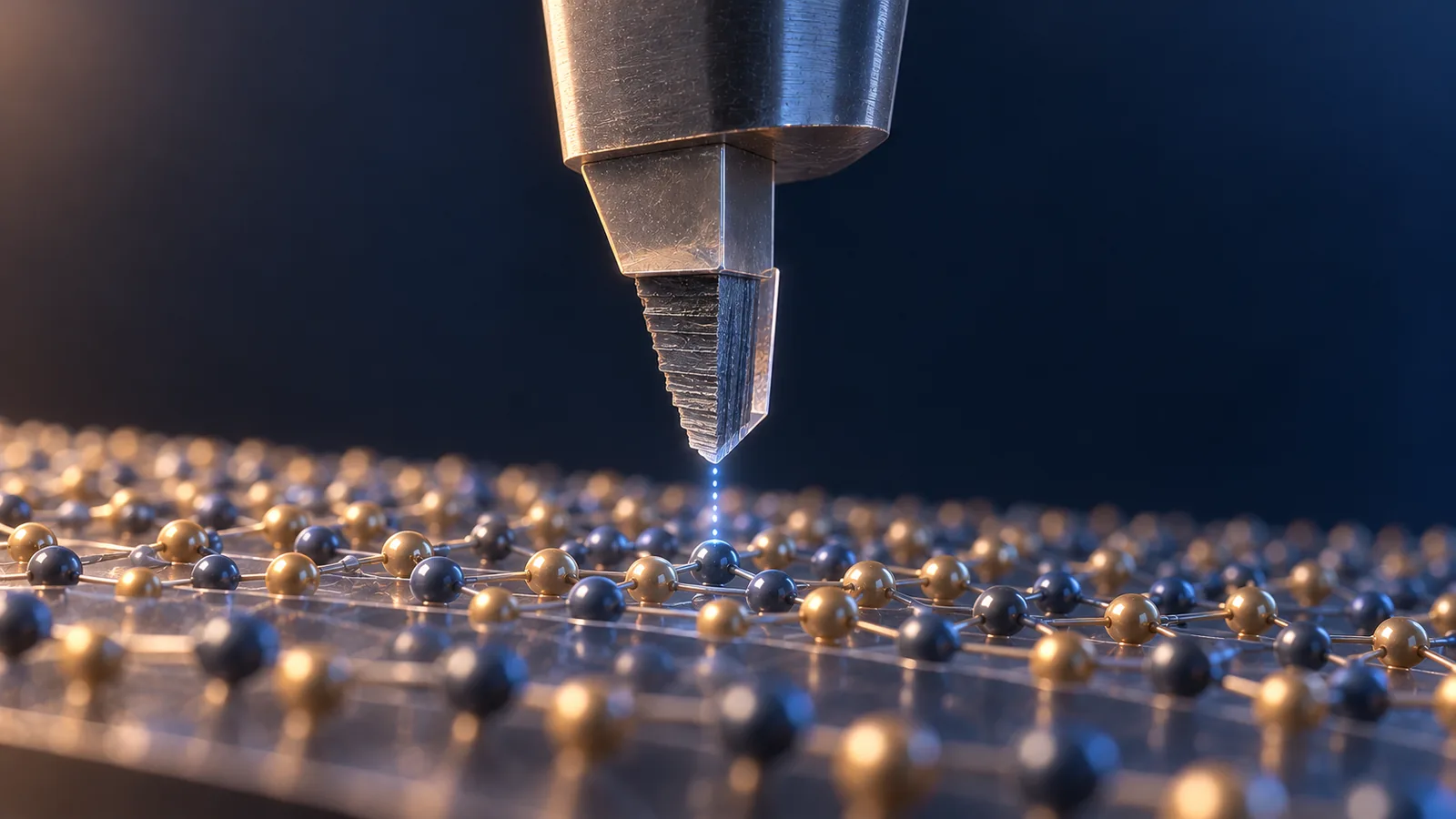
A scanning tunnelling microscope (STM) brings an extremely sharp probe close to a sample and measures the minute current that tunnels across the gap. By scanning the probe and recording current, researchers can examine surface electronic states at atomic length scales. A conventional probe, however, can mix signals associated with opposite spins.
The researchers made a probe from a particular crystal whose edge electronic states link spin with the direction of motion. This property makes the tunnelling process spin selective. Its composition, preparation, and calibration are detailed in the footnote.14
They first tested the probe against a material whose magnetic arrangement was known, comparing it with an ordinary metallic probe. They then studied the surface of the layered metal KV₂Se₂O. Evidence of room-temperature altermagnetism in this compound had already been reported in 2025; the new contribution was to relate atomic positions to spin-sensitive surface signals.14
The researchers distinguished vanadium sites and fine changes in the surface structure, then studied the electronic interference patterns around defects. An electron also behaves as a quantum wave; waves scattered from a defect can overlap and produce interference. The orientation of these patterns carries information about the contributing electronic states.
Changing magnetic-field direction shifted the characteristic excitation energies in opposite ways along two perpendicular crystal directions. Reversing the sign of the probe bias rotated the prominent spin-sensitive interference anisotropy by 90 degrees. Controls with conventional probes helped test the interpretation.14
Together, these observations support direction-dependent spin-related states in the surface layer of KV₂Se₂O. The findings connect atomic positions with electronic responses; they are not direct photographs of each atomic spin.
The arrangement of moments between deeper layers still needs to be established independently. STM measurements were conducted mainly around 4.8 K (approximately −268°C), so this experiment did not demonstrate a room-temperature memory device.14
X-rays distinguish two kinds of iron site
On 14 October, Nature Communications published a study by Ganesha Channagowdra and colleagues of insulating Fe₂Mo₃O₈, a magnetic compound containing two distinct iron environments.15
One kind of iron atom is surrounded by four oxygen atoms; the other by six. Even when both atoms are iron, these different local geometries influence electron energies and how X-rays interact with them.
The team illuminated a crystal with X-rays and measured the energy of scattered X-rays. The difference between incoming and outgoing photon energies carries information about electronic excitations within the sample. By comparing these energy losses with calculations, the team associated different features with the two iron sites. The technique is called resonant inelastic X-ray scattering (RIXS).15
They also alternated the X-rays' circular polarization. In circular polarization, the electric-field direction rotates as the wave travels. A different response to right- and left-handed polarization is called circular dichroism; it can provide information about symmetry.15
The two iron environments both showed differences between opposite polarizations. Circular dichroism alone, however, does not prove that magnetic order produced the signal: it can have other causes.
The researchers compared different temperatures and scattering directions. Above the magnetic ordering transition, the dichroism disappeared within measurement uncertainty. It also disappeared in an experimental geometry that preserves the relevant mirror symmetry, even when magnetic order was present. These controls were central to relating the dichroism to magnetic order.15
They compared the observations with a theoretical state called bi-altermagnetism. A sublattice is a repeating group of equivalent positions within a crystal. In this model, the two different sets of iron environments each host altermagnetic-like order. The prefix “bi” does not merely mean that there are two iron-site types; it refers to the interpretation involving two altermagnetic sublattices.15
The X-ray measurements and calculations support that interpretation. They do not directly measure the spin direction of each iron atom, resolve the RuO₂ controversy, or demonstrate a functioning memory device.
Reading and changing the magnetic order electrically
The studies above variously support or challenge claims of altermagnetism in specific compounds. To use a confirmed altermagnet in memory, researchers must both change its state and read it reliably.
Storing information requires at least two distinguishable stable states and ways to write and read them electrically. Because an altermagnet's net magnetization nearly compensates, simply measuring it like an ordinary magnet may not reveal which state is present.
In 2025, Zhiyuan Zhou and colleagues reported current-driven changes in CrSb order coupled to metallic layers. A device using platinum (Pt) required an assisting magnetic field, while a separate device using tungsten (W) switched without an applied assisting field during the tested measurements. These were different structures and conditions; the result does not establish that every CrSb device operates without a field.12
In August 2026, Zhaohui Li and colleagues reported a heterostructure with thin CrSb and PtTe₂ layers. They inferred the magnetic state from electrical signals at the interface, then investigated current-driven switching of the order. They were reading an indirect electrical response, not directly watching the atomic moments switch.13
A representative writing experiment was performed at 170 K (approximately −103°C) with an external assisting magnetic field of ±30 mT. The result cannot be presented as a demonstration of a practical room-temperature memory. The precise pulse and readout conditions are in the footnote.13
What is still required for practical memory
Switching magnetic order with current is not equivalent to having a usable memory product. Researchers must establish how long a state survives without power, how quickly and efficiently switching occurs, and how performance varies from device to device.
A repeated pulse test by itself does not demonstrate product lifetime or long-term data retention. Reliable writing and reading at room temperature, without an external assist field, remain separate engineering tests.13
The practical question is whether a magnetic order established in experiments can also be recorded and distinguished reliably under real operating conditions.
Notes
1. Theory, not independent experimental confirmation. Libor Šmejkal, Jairo Sinova and Tomáš Jungwirth classified altermagnetic order through crystal symmetries that distinguish it from ferromagnetism and conventional antiferromagnetism. Rotation-related, opposite-spin sublattices can support momentum-dependent spin energies. Their papers develop theory and perspectives, not two independent experimental detections. Šmejkal, Sinova & Jungwirth, Physical Review X 12, 031042 (2022), “Beyond Conventional Ferromagnetism and Antiferromagnetism: A Phase with Nonrelativistic Spin and Crystal Rotation Symmetry”; and Physical Review X 12, 040501 (2022), “Emerging Research Landscape of Altermagnetism”.
2. Why RuO₂ became a candidate. Feng, Zhou and Šmejkal were co-first authors of the original anomalous-Hall study; Feng and Zhou worked on film growth and transport/magnetic measurements, while Šmejkal and others contributed theory. Zhiqi Liu conceived and supervised the work. An anomalous-Hall interpretation must be considered alongside later studies not finding the expected order. Fedchenko's group separately interpreted photoemission as evidence of broken time-reversal symmetry. The Feng article received a publisher correction in November 2022 concerning symbols and equation notation in a figure. Feng et al., Nature Electronics 5, 735–743 (2022), “An anomalous Hall effect in altermagnetic ruthenium dioxide”; Fedchenko et al., Science Advances 10, eadj4883 (2024), “Observation of time-reversal symmetry breaking in the band structure of altermagnetic RuO2”.
3. RuO₂ spin spectroscopy. Jiayu Liu, Jie Zhan, Tongrui Li and Jishan Liu were co-first authors. ARPES and spin-resolved ARPES of investigated films and crystals did not show the expected altermagnetic spin splitting; the bands better matched a nonmagnetic calculation. This does not rule out unexamined samples and strain conditions. Liu et al., Physical Review Letters 133, 176401 (2024), “Absence of Altermagnetic Spin Splitting Character in Rutile Oxide RuO2”.
4. Tests of magnetic order in RuO₂. Philipp Keßler and Laura Garcia-Gassull were co-first authors. Keßler and Simon Moser worked on films; μSR involved Keßler, Moser, Zaher Salman and colleagues; Dmitry Khalyavin, Pascal Manuel and Fabio Orlandi performed neutron diffraction on single crystals; Garcia-Gassull and Igor Mazin contributed calculations. Reported μSR upper bounds were 1.14 × 10⁻⁴ μB/Ru for bulk material and 7.5 × 10⁻⁴ μB/Ru for an 11 nm film on TiO₂(110). A previously reported (100) neutron signal was reassigned to multiple scattering in single crystals. Neutron diffraction was not also performed on the films. Non-detection is bounded by sample type and sensitivity. Keßler et al., npj Spintronics 2, 50 (2024), “Absence of magnetic order in RuO2: insights from μSR spectroscopy and neutron diffraction”.
5. High-field RuO₂ measurement. Tiema Qian and colleagues measured magnetization and torque in single crystals at fields up to 31 T, finding no detectable long-range order and interpreting the samples as paramagnetic metal. This does not settle differently strained films. Qian et al., Physical Review Research 8, L012072 (2026), “Determining the nature of magnetism in altermagnetic candidate RuO2”.
6. Strain-dependent RuO₂ calculations. Seungjun Lee of Kyung Hee University is first author and, with Tony Low, a corresponding author of the final paper. The study by Lee, Seung Gyo Jeong, Jian-Ping Wang, Bharat Jalan and Tony Low analyzed orientation, strain and Hubbard U with first-principles methods. It predicted nonmagnetic (001)/(101) orientations on TiO₂ without additional effects, but calculated altermagnetic-like spin splitting and transport responses in certain strained (100)/(110) films. The final detailed CRediT assignment to individual computational tasks was not available for verification. This is theoretical, not an experimental confirmation in a strained sample. Lee et al., Nano Letters 26, 8110–8116 (2026), “Strain-Driven Altermagnetic Spin-Splitting Effect in RuO2”.
7. MnTe electronic spectroscopy. J. Krempaský, Libor Šmejkal and S. W. D’Souza were co-first authors; photoemission experiments and analysis were complemented by theoretical calculations and spectral simulations, with further contributors to synthesis and temperature-resolved experiments. The observed electronic structure supported an altermagnetic spin-splitting interpretation. Krempaský et al., Nature 626, 517–522 (2024), “Altermagnetic lifting of Kramers spin degeneracy”.
8. MnTe magnetic domains and internal order. O. J. Amin and A. Dal Din were co-first authors in the X-ray photoemission electron microscopy (XPEEM) work, with P. Wadley and others. This imaged/controlled domains under particular shape and cooling conditions. Separately, Zheyuan Liu, Shinichiro Asai and Takatsugu Masuda used polarized-neutron diffraction in bulk MnTe, observing altermagnetic order and a weak ferromagnetic component; opposite millitesla-scale fields applied during cooling changed the ordering direction. Neither was electrical memory writing. Amin et al., Nature 636, 348–353 (2024), “Nanoscale imaging and control of altermagnetism in MnTe”; Liu et al., Physical Review Letters 136, 256704 (2026), “Observation of Altermagnetic Order Switching in Bulk MnTe by Polarized Neutron Diffraction”.
9. Early CrSb bands. Sonka Reimers, Lukas Odenbreit and Martin Jourdan prepared CrSb(100) epitaxial films and performed spin-unresolved soft-X-ray ARPES at 12 K, observing band splitting of about 0.6 eV and comparing it with altermagnetic calculations. This should not be presented as a spin-resolved measurement. Reimers et al., Nature Communications 15, 2116 (2024), “Direct observation of altermagnetic band splitting in CrSb thin films”.
10. CrSb spin measurement. Guowei Yang and Zhanghuan Li were co-first authors; Yang handled ARPES, Li modeling and first-principles work, and Yang Liu planned the study. Spin-resolved measurements distinguished states associated with opposite spins and regions where splitting vanished, compared with calculations of g-wave symmetry. Yang et al., Nature Communications 16, 1442 (2025), “Three-dimensional mapping of the altermagnetic spin splitting in CrSb”.
11. Complementary CrSb methods. Yan Zhang and colleagues used Andreev reflection with a superconducting Nb contact on three CrSb crystal faces. The approximately 73.4%, 67.9% and 61.9% directional polarization values are model-inferred from interface response, not direct spin images. Independently, Mengmeng Long, Theodore I. Weinberger and Zheyu Wu were co-first authors of a low-temperature, high-field quantum-oscillation study, with Long contributing growth/characterization and oscillations, Weinberger and Wu oscillations, and Weinberger also DFT; Alexander G. Eaton conceived the work and, with F. Malte Grosche, led it. The latter supported a bulk g-wave interpretation with calculations. Their observables are different and do not constitute identical replicate experiments. Zhang et al., Physical Review Letters 137, 016701 (2026), “Andreev Reflection to Probe Momentum-Dependent Spin Polarization in Altermagnet CrSb”; Long et al., Nature 656, 854–860 (2026), “3D bulk-resolved g-wave altermagnetic order parameter in CrSb”.
12. Electrical control of CrSb. In the final Nature paper, Zhiyuan Zhou worked on design, growth, transport, analysis and simulation; Xingkai Cheng and Mengli Hu on symmetry and first-principles calculations; Ruiyue Chu on device fabrication; and Feng Pan and Cheng Song conceived/supervised the work. The published Figure 4 distinguishes assisting-field switching in CrSb(1-100)/Pt from switching without an applied assisting field during measurement in W/CrSb(11-20). The paper's room-temperature anomalous-Hall measurements must not be conflated with switching tests; switching temperatures of both structures were not independently resolved for this article. The earlier arXiv:2403.07396 manuscript had different author information, so its parameters are not treated as final publication values. Zhou et al., Nature 638, 645–650 (2025), “Manipulation of the altermagnetic order in CrSb via crystal symmetry”.
13. Electrical reading and writing in PtTe₂/CrSb. The final Nature Materials article of 24 August 2026 lists Zhaohui Li, Wenqing He, Hua Bai and Yang Wang as co-first authors, and Lei Shen and Hyunsoo Yang as corresponding authors. Li performed growth/transport and switching tests; He model simulations and analysis; Bai analysis; Yang Wang and Xiwen Zhang first-principles calculations. Yongxi Wang handled magnetometry; Grutter, Kinane and Caruana polarized-neutron reflectometry; Shen supervised calculation and Hyunsoo Yang led the project. A proximity-induced anomalous Hall response in PtTe₂ indirectly reads order; current-driven changes are interpreted in conjunction with other evidence and modeling. The full journal publication's abstract and Figures 1–4 support that general result. The specific protocol comes from the public author preprint, not an exhaustive check against the publisher's official supplementary information: PtTe₂(5 nm)/CrSb(8 nm), 170 K, in-plane assisting field ±30 mT, 10 ms write pulses, a 500 ms wait after switching, and Hall resistance readout at 100 μA. Figure 4h records 6,000 pulses in these test conditions. This is not a product lifetime/retention demonstration. A separate 300 K / 5 T spin-Hall magnetoresistance measurement is not the 170 K writing experiment. Li et al., Nature Materials, online 24 August 2026, “Electrical manipulation and detection of perpendicular altermagnetic order via a proximitized Dirac semimetal”.
14. KV₂Se₂O antecedent and helical STM. Bei Jiang and colleagues published room-temperature metallic d-wave altermagnetism evidence in 2025; the October 2026 work was not the first discovery of the compound. Jiang et al., Nature Physics 21, 754–759 (2025), “A metallic room-temperature d-wave altermagnet”. In the 2026 Nature paper, Zhuying Wang, Shuikang Yu, Xingkai Cheng and Xiaoyu Xiao are co-first authors. A shaped probe exploiting helical edge states of the higher-order topological insulator α-Bi₄Br₄ was calibrated on Au(111); comparison of antiferromagnetic stripes in Fe₁.₀₂Te with a conventional PtIr tip helped validate spin sensitivity. On the KV₂Se₂O surface, the team registered lattice defects and modulation against atomic positions and combined field-dependent changes along perpendicular directions with a 90° bias-reversing, spin-sensitive interference anisotropy to infer 2D d-wave altermagnetism. The public author manuscript, Figures 2–5 and Methods, describes more than 20 probes fabricated, limited successful spin-resolved measurements on this surface, and primarily 4.8 K operation. Layer-to-layer magnetic arrangement was not established. The 13 October Nature publication was an accepted early article; the publisher's complete SI was not exhaustively checked. Wang et al., Nature (13 October 2026), “Atomic-scale spin sensing of a 2D d-wave altermagnet via helical tunneling”.
15. Fe₂Mo₃O₈ sublattice-specific RIXS circular dichroism. Ganesha Channagowdra and colleagues illuminated single crystals near the Fe L₃ absorption edge. Features around 0.5 eV and 1 eV were assigned, through theory comparisons, to tetrahedral and quasi-octahedral iron environments, respectively; lower-energy spin-orbit excitations were also associated with quasi-octahedral sites. Circular dichroism appeared in a magnetic state at roughly 32 K but disappeared within uncertainty above an ordering transition near 60 K. A mirror-symmetry-preserving scattering geometry removed the difference even when order persisted. Comparisons with atomic models incorporating Weiss fields support a bi-altermagnetic interpretation, not real-space images of individual spins. Dichroism has other possible causes, and the model neglected direct hopping between iron sites; controls matter. Figures 1–3 and Methods were checked against the public author manuscript, not every publisher SI file or review document. Channagowdra et al., Nature Communications (14 October 2026), “Signatures of bi-altermagnetism revealed by sublattice-specific circular dichroism in resonant inelastic X-ray scattering”.